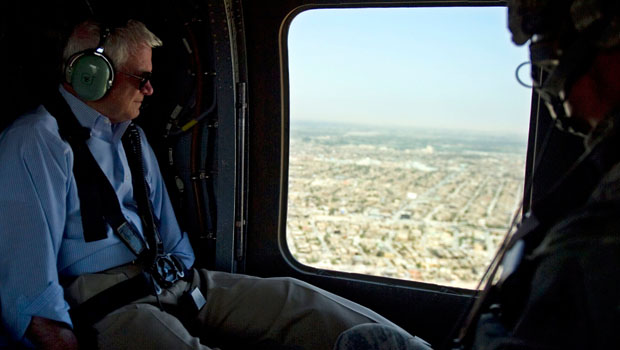
Addressing soldiers at Camp Victory outside Baghdad a day after the US combat role in Iraq officially ended, Biden expressed confidence that the worst days of the conflict were over.
Calling for unity around the new mission, he also acknowledged that the 2003 invasion had split US public opinion.
"It is no secret that this war has divided Americans but they have never shrunk from the united support of the United States military," Biden said.
"Now is the time to put these differences behind us," he added.
"Operation Iraqi Freedom is over but American engagement with Iraq will continue with the mission that began today, Operation New Dawn."
The US vice president acknowledged the heavy toll paid by Iraqis during the conflict but expressed confidence that the worst was over.
"Today is also an important acknowledgement of the Iraqi losses in this conflict," Biden said.
"Tens of thousands of security forces and innocent civilians have been killed. Many times that number have been wounded and displaced.
"The Iraqi people have rejected their ugly face of violence... I truly believe that the darkest days are now behind us.
Biden, who has held repeated meetings with Iraqi political leaders since an inconclusive March general election in a bid to speed up protracted coalition talks, called on them to have to make the necessary compromises to form a new government.
"I strongly urge them to match the courage their citizens have shown by bringing this process to a close and forming a government," Biden said.
Meanwhile, Defense Secretary Robert Gates said Wednesday that while the war in Iraq is over, history will judge whether the fight was worth it for the United States.
The Pentagon chief met with troops at Camp Ramadi just a few hours after President Barack Obama declared an official end to the US combat role in Iraq and told Americans it was time to "turn the page."
Asked whether he believes combat is over, Gates answered succinctly, "I believe it is." He was less direct when asked whether the war was worth it, saying that will depend in part on whether Iraq emerges as a democratic anchor in the Middle East.
That judgment "really requires a historian's perspective," Gates said.
"I believe our men and women in uniform believe we have accomplished something that makes the sacrifice, the bloodshed, not to have been in vain," he said. "How it all weighs in the balance remains to be seen. The problem with this war, I think, for many Americans, is that the premise on which we justified going to war turned out not to be valid," Gates added. "Even if the outcome is a good one from the standpoint of the United States, it'll always be clouded by how it began."
Ramadi, home of one of the US military's new advisory brigades, is in the heart of Anbar province, the cradle of the Sunni insurgency against the initial US occupation.
Gates said Anbar holds "a special and haunting significance" for the US military. Several members of his staff were wounded or saw their comrades killed in the province during the worst years of the fighting.
The difference between that time and now was illustrated by the questions soldiers asked the secretary. Some of their top concerns included health care, retirement and the state of combat pay now that the combat mission is officially over.
One soldier asked whether the US might maintain a military presence in Iraq after 2012, when all US forces are due to leave by agreement with the Iraqi leadership.
"Any such proposal would have to be at the initiative of the new Iraqi government," Gates replied. "We would obviously be willing to look at that." He emphasized that the US is still waiting for the formation of that new government before that idea can even be broached.
Fewer than 50,000 US troops remain in Iraq, down from more than 165,000 at the height of the fighting. The remaining forces' primary role is to help train and equip Iraqi forces over the next year.
Lt. Col. Buddy Houston, deputy brigadier commander of the 4/3 Advise and Assist Brigade, said there have been no incidents in the last 14 months where Iraqis asked for direct combat help.
"I can't imagine a violent situation where we would have to go back in and re-engage," Houston said. He added that he didn't anticipate, "even under the worst-case scenario," that a civil war could break out in Iraq as US troops leave.