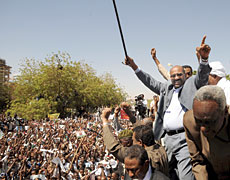
KHARTOUM: Sudan’s president told thousands of cheering supporters yesterday that an international call for his arrest on war crimes charges was a ploy by Western nations set on grabbing the country’s oil.
Omar Bashir, the first sitting president to be charged by the International Criminal Court, responded to his indictment over the conflict in the western Darfur region by ordering 10 foreign aid agencies to leave Sudan.
Authorities accused the aid groups of passing information to the ICC on alleged atrocities in Darfur, center of the world’s largest humanitarian operation, and one aid official said at least three more agencies may be sent home.
The agencies expressed outrage, denying any links with the ICC and saying their expulsion put thousands of lives at risk. UN Secretary-General Ban Ki-moon said UN aid operations in Darfur would be severely damaged if the Sudanese government followed through on its decision to expel aid organizations. His spokeswoman Michele Montas read out a statement at the United Nations in which the secretary-general appealed to the government of Sudan to urgently reconsider its decision.
The US State Department’s acting deputy spokesman Gordon Duguid told reporters in Washington that the United States and other countries were urging Sudan to reconsider its decision.
At the Khartoum rally, Bashir said The Hague-based ICC was a tool of imperialists targeting Sudan for its oil, natural gas and other resources. “We have refused to kneel to colonialism, that is why Sudan has been targeted ... because we only kneel to God,” he told the crowd outside the Republican Palace.
Cheers of “We are ready to protect religion!” and “Down, down USA!” from the protesters interrupted his speech. Washington has welcomed the ICC warrant.
Some in the crowd carried banners branding the court’s prosecutor a criminal, and after his speech Bashir, 65, danced along to nationalist songs, waving his cane in the air.
The ICC has no powers of arrest and relies on national police forces to hand suspects over.
UN General Assembly President Miguel d’Escoto Brockmann said he regretted that a warrant had been issued to arrest Bashir, saying the move was absurd and politically motivated.
“I am sorry about this decision of the ICC and I think it’s more a decision motivated by political considerations than really for the sake of advancing the cause of justice in the world,” said the Nicaraguan diplomat, a former foreign minister.
Brockmann said the prosecution against Bashir should have been delayed, as called for by the African Union and the Arab League, in order to allow peace talks to make progress.
“A few people with a very dubious past and with very little credibility pretend to know better than the whole African Union. This is absurd and really not an adequate way to deal with this issue,” he said.
China, which has sent peacekeepers to Darfur, urged the UN Security Council to heed calls from African and Arab countries and suspend the case against Bashir.
The African Union (AU) said it would send a high-level delegation to press the Security Council to delay the indictment for a year to give the peace process in Darfur a chance. It also appealed to Sudan to maintain peace and protect both its citizens and the organizations helping them.
Turkey was worried about the impact that an arrest warrant for Bashir could have on efforts to stabilize the conflict-torn country.
Anatolia news agency quoted Foreign Minister Ali Babacan as saying at a NATO meeting in Brussels: “We will see what consequences the warrant will have, but, to be honest, we have concerns.
“We believe the problems (in Sudan) cannot be resolved by excluding the Sudanese administration. On the contrary, the problems will grow.”
Turkey holds a non-permanent seat at the UN Security Council, which, under the ICC statute, can ask the court to suspend the investigation or prosecution for 12 months. Western powers with permanent Security Council seats have made clear they will veto any postponement for now.
Sudan expert Alex de Waal said the indictment could wreck delicately balanced peace efforts between north and south Sudan and in Darfur in his blog (http://www.ssrc.org/blogs/darfur/).
People are misguided if they think the court would encourage Sudanese politicians to replace Bashir in a coup, or bring about a quick resolution to the Darfur conflict, he wrote.