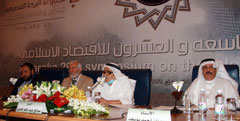
JEDDAH: Scholars and experts have called for a sustained in-depth study and research into Islamic economy to make it more acceptable and viable.
The last 15 years have witnessed a great interest in Islamic economy, but still most of the people regard it as only confined to the issue of interest as represented in the present day banking system. “This narrow concept has overlooked many issues covered by Islamic economy,” Sheikh Saleh Kamel, chairman of Albaraka Banking Group (ABG) and president of Dallah Albaraka Group, said during Albaraka’s two-day symposium on Islamic economy, which ended at the Jeddah Hilton in the early hours of yesterday.
The annual symposiums organized by Albaraka show that Islamic economy is far broader and more comprehensive than conventional economy, and is not confined to the question of interest or “riba” (usury) not withstanding its importance, Kamel said.
“The Islamic principles are relevant and applicable to all aspects of economic activities. They guide the individual’s relationship with his Creator (Allah) in respect of his wealth, relationship with society and partners, as well as his legal heirs and overall dealings with them. Islam has laid down general principles for every aspect of economic activity, small or great, in such a way that they are applicable to all situations and all times. There can be no greater proof of this than the present collection of these opinions. Islam tackles these issues in its own unique way, but most of us are unaware of it and the guidance that it provides in these fields,” Kamel added.
The two-day event, which was highlighted by papers presented by some scholars from various countries, focused on international commodities and the rules that govern them, as well as protection of the capital of deposits by reason of the applicable laws, ABG’s President and Chief Executive Officer Adnan Ahmed Yousif said. He added that the symposium also reviewed some of the opinions expressed in earlier Albaraka symposiums under the Shariah rules.
Like in the previous annual symposiums, Yousif said, the resolutions of the latest event represent valuable Shariah opinions that can act as a reference for researchers, research institutions and university students.
Shariah opinions and resolutions of the past symposiums have been compiled in a book form and published both in Arabic and English, he added.
The symposium’s various sessions were attended by Shariah jurists and advisers, members of Shariah supervisory board members, directors of various establishments, university professors, researchers, bankers and those concerned with Islamic economy from across the Kingdom and abroad.
Among them were Dr. A. Abu Ghuddah, secretary general of the Unified Shariah Panel, who also presented a research paper on the “Global commodities: Controls of transaction.”
Dr. Hamza Hussain Alfaar and Dr. Abdul-Latif Al-Mahmood also gave presentations on the subject.
A panel of researchers comprising Sheikh Abdullah bin Sulaiman Al-Manea, Dr. Ali Al-Qurrah Daghi and Dr. Abdul-Aziz Al-Fawzan dealt with the revision of opinions that were concluded at Albaraka’s previous annual symposiums.
The opinions related to buying and selling by the agent to himself, circular murabaha sale within a fixed ceiling, sale of a merchandize, which is not in possession of the seller, accepting payment for issuing letters of guarantee and real estate financing formula.
Another panel of researchers comprising Dr. Sami Suilem and Hussain Hamid Hassan dealt with the option of purchasing shares, assets and the ownership price in lease contracts.
The first Albaraka symposium on Islamic economy was held in Madinah in June 1983. Since then the symposium was held annually in Tunisia, Algeria, Turkey, Makkah, Jeddah and other places.
— With input from Sultan Altamimi