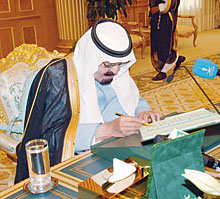
JEDDAH, 11 December 2007 — Custodian of the Two Holy Mosques King Abdullah yesterday unveiled Saudi Arabia’s largest budget in history, earmarking expenditures at SR410 billion ($109.33 billion) and revenues at SR450 billion ($120 billion). It has allocated a record SR105 billion for education and training.
“This is the largest budget for the Kingdom and larger than last year’s budget by SR30 billion,” the king told a budget session of the Council of Ministers. “We have given instructions that the country’s revenues must be utilized to achieve sustained development in all sectors,” he added.
King Abdullah said more than a quarter of the new budget has been set aside for human resource development including higher education, and technical and vocational training.
“The budget will also boost scientific research and technological development,” the king said referring to financial allocations made for new research centers at universities.
Special allocations have also been made to train teachers, develop academic curricula and improve education atmosphere, with SR39 billion set aside for building schools, universities and training centers and institutes.
The new budget has allocated SR44.5 billion for health and social development as well as for fighting poverty and supporting sports and youth welfare projects. The king also disclosed plans to establish a number of new hospitals, health centers, medical colleges and university hospitals.
“We have also allocated SR7 billion to upgrade judicial facilities and meet the requirements of the new Judiciary Law and Court of Grievances Law,” the Saudi Press Agency quoted the king as saying.
Speaking at the budget session, Finance Minister Dr. Ibrahim Al-Assaf predicted that the gross domestic product in 2007 would reach SR1.414 trillion on current prices.
He said the private sector would make a growth rate of 5.9 percent in 2007 at stable prices with nonoil industries making a growth of 8.6 percent, telecom, transport and storage sectors 10.6 percent, construction 6.9 percent, electricity, gas and water 4.4 percent, wholesale and retail trade, hotels and restaurants six percent, and financial services, real estate and insurance four percent. The minister underscored the growing private sector contribution to the economy. “This year its contribution reached 46.1 percent of the GDP,” he pointed out.
He also announced that public debts would fall to 19 percent of the GDP or SR267 billion by the end of 2007, compared with 28 percent of the GDP in 2006.
A near five-fold increase in oil prices has allowed the Kingdom to cut public debt — all of which is owed to local institutions — from a peak of 119 percent of the GDP in the late 1990s.
The government has set aside SR53.5 billion ($14.27 billion) from the 2007 surplus to pay back debt, just over half the amount allocated last year, the Finance Ministry said.
“They have to strike a balance and try to make sure that money supply does not generate too much inflation in the economy,” said Muhammad Younas Malick, a senior economist at National Commercial Bank.
“If they pay it all back too quickly there will be too much liquidity in the market,” Reuters quoted Malick as saying.
GDP growth in 2007 is expected to decline to 3.5 percent compared with 4.3 percent last year in fixed prices, the ministry said.
“Mostly it was OPEC production cuts,” said John Sfakianakis, chief economist at SABB bank, HSBC’s Saudi affiliate. “Next year, with production going up, growth should be closer to five percent,” he said.
The Organization of Petroleum Exporting Countries agreed to cut output by a total of 1.7 million barrels in two moves that took effect on Nov. 1, 2006 and Feb. 1 2007.
Saudi Arabia, being the largest OPEC producer, shouldered the bulk of the cuts.
The 2008 budget has allocated SR45 billion for water, municipal services, agriculture, industry and infrastructure, the ministry said, adding that new projects worth SR27 billion would be implemented in these sectors.
The transport sector will receive SR14.6 billion in 2008 for constructing new roads, airports and railways.
The Kingdom’s cost of living index rose by 3.1 percent in 2007 compared with the previous year, the minister said. He expected inflation rates to increase 1.6 percent in 2007 compared with those of 2006. “The 2008 budget comprises new development projects in all parts of the Kingdom,” the minister said.
Economists noted the efforts made by the budget to contain growing inflation and its continuing focus on key sectors such as education and health. “The new budget shows good fiscal constraint which is important to contain inflation,” Brad Bourland, chief economist and head of research at the Riyadh-based Jadwa Investment, told Arab News. “Spending growth for 2008 is strong but still prudent.”
Professor Mohamed Ramady of King Fahd University of Petroleum and Minerals, described it as a pretty conservative budget that consolidates on the structural and economic reforms under way for the past couple of years.
“It is a pretty conservative budget in its revenue forecast, given current market turbulence in both the financial and oil markets with potential for an economic slowdown in the major Western economies. Expenditures for 2008 have been hiked to take account for the new food subsidies and accelerated pace of infrastructural projects. This is good news for the Saudi private sector,” he explained.
“Long term capital infrastructure — whether human or for the mega cities — is at the cornerstone of the new budget and the Kingdom has not been rushed into making hasty recurrent expenditure decisions such as large salary hikes,” he said.
Ramady commended the government’s efforts to cut down debts to very acceptable level of 19 percent to the GDP. “The government is also in no hurry to eliminate this to zero given that the Saudi banks continue to hold a significant portion of the public debt, and it would be counter inflationary to pump more money into the banking system by repurchasing the public debt from the banks.”
Ramady added: “The new budget will try to counter inflationary pressure building up in 2008, and hence is placing great store on increased output and productivity from the private sector which has achieved a steady growth of over 7 percent.”
Budget Highlights:
• Total revenues: SR450 billion
• Total expenditures: SR410 billion
• Total surplus: SR40 billion
• Total allocations for new and existing projects: SR165 billion
• Budget surplus for 2007: SR178.5 billion
• Expenditures for 2007: SR443 billion
• Trade surplus for 2007 expected at $148.2 billion
• Education and manpower development: SR105 billion
• Health and social affairs: SR44.5 billion
• Water, agriculture and Infrastructure: SR28.5 billion
• Credit and financing institutions: SR25 billion
• Municipality services: SR17 billion
• Transportation and communication: SR16.4 billion
• Gross domestic product for 2007 to reach SR1.41 trillion
• King Saud University: SR3.7 billion
• General Organization for Technical Education and Vocational Training: SR3.43 billion
• Women’s University in Riyadh: SR1.36 billion
• King Fahd University for Petroleum and Minerals: SR821.99 million
• Saudi Arabian Airlines: SR17.4 billion
• Royal Commission for Jubail and Yanbu: SR5.58 billion
• Saline Water Conversion Corporation: SR5.05 billion
• General Authority for Civil Aviation: SR4.76 billion
• King Faisal Specialist Hospital and Research Center: SR3.36 billion