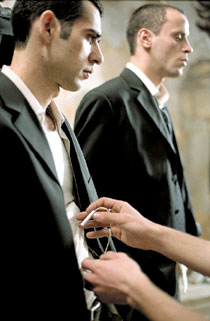
Paradise Now, by any standards, is a remarkable film. What makes it extraordinary is that, as far as I can recall, it marks the first time a mainstream film production studio, Warner Brothers International, has brought the rights to distribute throughout American movie theaters a film that accurately portrays the anguish and difficulties of Palestinians living under Israeli occupation.
The movie is written and directed by Hany Abu-Assad, 43, a prominent Arab Israeli movie director who lives in Holland. This is Abu-Assad’s third film and it offers a very disturbing insight into what may be the last 48 hours of the lives of a pair of young suicide bombers. He refers to the movie as a “hyper-realistic thriller.”
The movie opens as a typical day in Nablus, where daily life there grinds on amidst crushing poverty and the occasional rocket blast. The two childhood best friends pass their time drinking tea, smoking a hookah, and working dead-end menial jobs as auto mechanics. Said, (Kais Nashif), and Khaled, (Ali Suliman), are deeply frustrated at the Israeli occupation of their land, and believe they have no future.
Paradise Now is set against a vivid backdrop of life in the West Bank today; much of the filming was carried out in secret, and as a result there’s a powerful sense of this enclosed, prison-like community with its tightly controlled borders and limited horizons.
“It was kind of insane to shoot a film there,” Abu Assad told journalists recently. “Every day we had some sort of trouble. Both the Israelis and Palestinians were used to news crews of a few people. But we didn’t have a small crew that could shoot film and run. There were 70 people and 30 vehicles, making it impossible to run and hide.
“Some Palestinians thought we were making a film against the Palestinians. And some Palestinians supported the film because they thought we were fighting for freedom and democracy. One group though, thought the film was not presenting the suicide bombers in a good light and came to us with guns and asked us to stop.
“Not one day went by without our having to stop filming. We would stop and wait until the firing stopped and then start again.”
And that’s what makes Paradise Now so convincing. It does not portray its Palestinian citizens as evil extremists in this harrowing fictional portrait of two suicide bombers. Said and Khaled are just a couple of likable guys, but the movie shows the tension that is always just beneath the surface of their existence, where everything is a matter of life or death for Palestinians trapped in the impoverished city of Nablus.
As such, the two young men are ripe candidates for radicalization, and Paradise Now follows their recruitment with a mixture of drama and humor.
For example, it’s impossible to say whether Said and Khaled’s recruiter, Jamal (Amer Hlehel), a detached point man for an unnamed Palestinian organization, views the pair as model martyrs or stooges — or a combination of both.
He preys upon their discontent and resentment of the continuous presence of the Israeli Army, having evidently previously persuaded the two to strap on explosives and make videos proclaiming their loyalty to resistance by death. “Take out as many soldiers as you can” is Jamal’s chilling order. He also tells them that the device strapped to their bodies will explode if they try to take it off themselves — just in case they chicken out.
It seems Said and Khaled have been preparing for this moment for most of their lives. They spend a last night at their homes — although they must keep their impending mission secret even from their families, and each one is accompanied by a guerrilla member to ensure they don’t reveal too much to their families, or get cold feet.
What makes Paradise Now so powerful are its many different elements. The scene in which Said and Khaled videotape their militant proclamations of martyrdom is both sad and funny — these two dismal characters have to be shown how to hold the guns they wield; the camera stalls or they flub their lines, and they ask, like diligent amateur actors, for retakes.
“The scene catches the heart of the film’s idea by simultaneously breaking down the martyrdom-heroism as well as the monster-evil and making it human. And humans are often quite banal, but also funny and emotional. In real life there often is comedy in the most tragic moments,” said Abu-Assad.
Shockingly, Abu-Assad said the place where he filmed that scene is real, and they were not alone in that building:
“I shot the scene in a real location. This was one of the film’s concepts; putting actors in the real surroundings in order to create a moment of truth with the actor. When Ali Suliman stands where real martyrs also stand giving their speech, he was so nervous there was no need to act anymore. I was also nervous, because all around us, real organizers of these kinds of attacks were watching us. I was very afraid they would get angry about the comedy in the scene. The entire cast and crew were nervous.
“By the end of Take One, where Ali makes the speech, one of the organizers stopped us. I thought: ‘Now it is over.’ But he just wanted to show Ali how to hold his gun correctly. There was no protest over the humor at all. Later I realized that in reality things like this happen. It wasn’t irregular to them. By the way, Ali’s gun was theirs. We borrowed it. When Ali held it, knowing that this gun was used daily to aim at the Israeli Army, it had quite an impact on him.”
Abu-Assad said he conducted extensive research for the film, reading studies by Palestinian psychologists and transcripts of Israeli police interrogations.
“I studied the interrogation transcripts of suicide bombers who had failed; I read Israeli official reports; I spoke to people who personally knew bombers who died — the friends and families and mothers. What became clear was that none of the stories were the same,” said Abu-Assad.
Later in the film, we’re taken to a local shop that sells or rents bootlegged copies of such tapes for local entertainment and inspiration — another example of the casual cynicism in this film.
One character, Suha (Lubna Azabal), whose father is a famed martyr to the same cause, exists primarily to argue for peaceful negotiations and to distract the young men from their ideals of martyrdom.
She’s the only moralistic tool used in the film, and the irony is that she has been raised in Europe and only recently returned to Nablus as member of peace organization.
The murky radicals even have an Israeli traitor on the other side of the wall that meets Ali and Khaled, and “is paid highly,” says Jamal, to pick them up and drive them to their destination.
Symbols are used throughout the film, such as the bomb plotters organizing a “last supper” for them in their cavernous stone hideout, a scene which eerily mimics Michelangelo’s painting.
Paradise Now forces us to follow, as we uncomfortably squirm in our seats, Said and Khaled as they undergo their transformation. These bedraggled guys shave their shaggy hair into handsome crew cuts and put on black suits and ties — their cover story for journeying to crowded Tel Aviv is that they’re on their way to a wedding. Both men are very slim, and the clothes amply cover the explosives taped to their bellies.
Another tragically funny moment in the film is when they are still in Nablus and a passer by spots them in their new suits, and asks: “Why are Said and Khaled dressed like Israelis?”
With their funereal garb and newly scrubbed faces, the duo suddenly become stoically determined, tragic, and doomed.
A statement one of them has made earlier in their videotaped proclamation—“Our bodies are all we have left to fight with against the never-ending occupation”— now becomes vividly real.
The two characters bicker over the best place to enter Tel Aviv without being caught and have to climb over roadblocks, dirtying their new suits. The two dust each other off and squabble both nervously and amiably, just as two lifelong friends would.
Not surprisingly, things don’t go according to plan. After being dropped off at their location, Said and Khaled are separated. Jamal and the other members of the organization abandon their hideout in fear that they have been betrayed. The young men who had planned to end their lives are now in a race against time for survival — so that they might try again. Amidst the drama and chaos that follows the failed mission, Said and Khaled both must face a much deeper conflict inside themselves.
No wonder young men forced to live like this grow to hate a world that allows such dismal existence to exist. Abu-Assad doesn’t glorify these young radicals — far from it. But he does explain why they’re so desperate, and that makes this a very timely, and really quite frightening examination of how an ordinary young man becomes an extremist.
“The film is simply meant to open a discussion, hopefully, a meaningful discussion, about the real issues at hand. I hope that the film will succeed in stimulating thought. If you see the film, it’s fairly obvious that it does not condone the taking of lives,” says Abu-Assad.
“The full weight and complexity of the situation is impossible to show on film. No one side can claim a moral stance because taking any life is not a moral action. The entire situation is outside of what we can call morality. If we didn’t believe that we were making something meaningful, that could be part of a larger dialogue, we wouldn’t have gambled our lives in Nablus,” he said.
Paradise Now makes us confront the daily grinding down of the dignity and hope of an entire population, and the everyday Palestinians who surround the main characters. Ultimately, the film is an endorsement for peaceful solutions; but its subtext of despair and hopeless is so troubling that the viewer is guaranteed to return to questions posed by the film, over and over and over again.
Paradise Now is more a study of inner psychological struggles than a polemic on politics or religion. It is also a sophisticated argument for peace.
I understand the need for resistance, but I don t understand these suicide bombing operations, even from a military point of view, said Abu-Assad, adding he was surprised his movie passed censorship requirements in Israel. But Katriel Schory, the director general of Israel s Film Fund, told the British newspaper, The Guardian, that the script tells us of the big dilemmas of the situation that these two young friends find themselves in, and the environment they live in. For many Israelis, I think it is not a bad idea to understand the circumstances, the psyche and everything involved in these terrible steps, he said. The movie is scheduled to be released in Israel within weeks.
Abu-Assad has gained recognition over the past decade for such films as Ford Transit and Rana s Wedding. He wrote “Paradise Now” in 1999 and shot the film in Nablus in 2004. This year, he won two major prizes in Europe for Paradise Now, produced with his Israeli partner, Amir Harel.
The movie made its World Premiere at the Berlin Film Festival 2005, where it won the Blue Angel Award for Best European Film, the Berliner Morgenpost Readers’ Prize and the Amnesty International Award for Best Film.
Paradise Now is scheduled to be released on DVD this summer.
Read more at www.paradisenowthemovie.com.