Are you looking for something old? Do you want something that is 50 years old? We have it! Do you want something that is 500 years old — we have that too! If you want something even older, we have some as well, with evidence to prove its authenticity!” said Sami Nawwar, an architect with the responsibility of the preservation of old Jeddah at the Jeddah Municipality, who guided us through old Jeddah.
He showed us a well that dates back 50 years and said a friend of his father’s told of a buried well that was supposedly much older. When Sami excavated the site, he found much more than a well: He discovered an entire water system dating back to the Mameluke Era (1382-1517AD).
Jeddah’s city walls were built during the Mameluke Era when Sultan Alghouri of Egypt ruled (around 1509AD.)
The construction of the wall intended to protect the city from Portuguese invasions. Turkish and Moroccan armies deployed by Sultan Alghouri were supervising the construction workers and employed severe punishments. As a punishment for a worker’s late arrival, he was buried within the wall while still alive. The armies forced all the citizens to participate and the wall was finished in less than one year. Many gates at the Jeddah wall were built and some still exist: Bab Jadeed to the north; Bab Makkah to the east; Bab Sharif to the south and Bab Al-Bant to the west.
There are many suggestions where the name Jeddah comes from. It could be named after the mother or grandmother of humankind, ‘Hawaa’ or Eve. People in Jeddah are usually buried in a graveyard called Omana Hawaa, ‘Mother Eve’s Grave’ where Hawaa is supposed to have been buried. This has not been proved, but is indicated by Thamodian and Nabatean engravings found in the northwestern part of Jeddah.
Al-Balad, is the heart of Jeddah, where the city as we know it now originates. Al-Balad is divided into four main neighborhoods: The eponymously named Harat Alsham (The Sham Neighborhood), facing north; Harat Al-Yaman (The Yemeni Neighborhood), facing south. Harat Mazloum (The Aggrieved Neighborhood), facing east and Harat Al-Bahr (The Sea Neighborhood), facing west sounds an odd note.
Sami explained that the name comes from a man who was sent to his death in 1719 AD under the rule of Sharif Mubarak bin Ahmad bin Zaid without having been proven guilty of the crime he was accused of. The story says that after the execution, the man’s blood formed the words ‘Not guilty’ in the sand. The incident became the feature of the neighborhood and the name stuck.
Due to Jeddah’s proximity to the two sacred cities Makkah and Madinah many mosques were ordered to be built by the second of the Rashidun Caliphs, Omar bin Al-Khattab. Masjid Alshafii is the oldest and was built of teak brought from Sudan. The minaret of the mosque is around 900 years old and the mosque itself has contained a school for 500 years. Other mosques that still stand are Othman bin Affan’s Mosque, Akkash Mosque, Alhanafi Mosque, Almaghrabi Mosque and Albasha Mosque.
Excavations from underneath the city wall revealed a document from 859 AD that gave names of pilgrims who came to Jeddah from other countries and records of how many pilgrims there were, along with their names and the number of camels (1,345) carrying them.
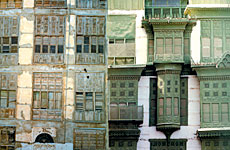
In 1948 the last of Jeddah’s wall was removed. It became clear then that most of the Jeddah houses were very similar in design, internally as well as externally. The building materials used were alkashour (lime-stones) — a square coral block brought from the Red Sea — and Sudanese wood. Most houses had large windows covered with a wood lattice (roshan) that facilitated ventilation. The rawashin (plural) were designed so that they allowed a maximum amount of light and movement of air while keeping out the heat. These rawashin were also made for modesty — to prevent females of being visible to strangers or passers by.
The old Jeddah houses are often decorated with engravings and their doors are colorful. Even the roofs are adorned by flowers and geometrical designs.
Al-Alawi Souk in Al-Yaman is where the Nassif House, one of the younger “old” buildings is situated. The house used to belong to the deputy Wali (ruler) of Jeddah Mohammad Nassif, but is now owned by the Jeddah Municipality.
Nassif House has 15 rooms on seven floors and was erected about 150 years ago. The house, made famous when King Abdulaziz lived there, was built by one Al-Ashara, a name that means the ten men. The architect got this name because he did such a good job that it was as if ten people had been working with him.
On the ground floor there is a well that collects rainwater. Stairs, wide enough to march camels up bringing food supplies, lead up to the kitchen on the top floor; on the roof above is the highest room, the open-sided Al-Teramah which was used as a dining and smoking area and caught the cool breezes high above the streets. The original owners of the house also used to sleep on the roof on a namousia, a bed covered with a sheer fabric to prevent mosquito bites.
In the same area as the Nassif House stands the Nourwali House, whose owners have been very careful to preserve the interior from deterioration. The Nourwali House is not open for visitors like the Nassif House is, but tours can sometimes be arranged through the Jeddah Municipality.
Would you like to get an unforgettable whiff of traditional herbs? Well, then you have to pass by Alawi Souk, one of the oldest markets in town. The market offers a variety of herbs and in addition, there are stands selling traditional costumes, perfumes and food. Souq Al-Nada, Souk Al-Yaman, Souk Gabel, Souk Al-Bado are names of other markets. Khawaja Yanni’s store was the first — and allegedly also best — store for Italian cheese in town. Khawaja Yanni was an Italian who spent many years of his life in Jeddah with his family.
Soccer is the most popular of all the sports in Al-Balad. Am Hassan, a builder, told us that Al-Ittihad had the largest number of supporters. “I loved going to the stadium where they played to make the net each time there was a game. Because the players were sons of our friends and the town boys, we used to cheer them whenever they won. Some fans would come up with songs and invite the players for dinner.” It could be seen as small gestures, but it meant a lot to him and many of the inhabitants of old Jeddah.
In past times, visitors did not have a way to enter Jeddah any other than with camels and shogdofs, a type of carriage. These shogdofs arrived from countries to the east with pilgrims. Some people hosted the pilgrims in their homes, accepting them as their guests for their entire stay.
The Balad area is a warren of alleys with names that reflect their function. The Alley of Perfumers, where traditional Oud and perfumes were sold. Jew’s Mallow Alley was normally found by the distinctive scent of the moloukhiya — a green plant with leaves similar to spinach. “It used to be the only place where you could buy it and even though it is not sold there anymore, I can still smell it,” said Am Hassan. One of the alleys that is unfortunately no longer there is Hug Me Alley. This passage was snake shaped and so narrow that only one person at a time could pass through it. If two people were to walk through, they would have to move so close as if they were holding each other.
Jeddah’s inhabitants are conscious and proud of their heritage. Some are unhappy with the changes taking place and that is why many people in Al-Balad live in old homes and are still practicing their crafts. Am Hassan, is a man who happily narrates stories from the past. He and his friend Am Ahmad Malibari, engrave decorative frescoes on buildings. “We use every material but cement and iron; by following the examples of our ancestors we built houses that have lasted to this day.”
Their fathers took them to the most skilled craftsmen who taught them their craft. “He told these men: I give you my son in flesh and blood and I want him back in bones,” Am Hassan continued.
Once the houses were built, it was Am Ahmad’s turn to decorate them with flowers or other designs from his imagination. Am Ahmad was happy with what they have achieved together. He told us about a leaning house that some likened to the Tower of Pisa. Tourists used to come and take pictures where they looked like as if they were holding it up.
A journalist once wrote an article about it, saying that it had to be reconstructed or destroyed or it would fall on someone. A support structure was built; the support soon fell down and the building took its initial shape. “I knew that would happen,” he said.
“It bothers me that some of these places have been abandoned or are ruined. I’m always captivated by cultures elsewhere when it turns out that there is so much right here. I’m happy that our history is just as fascinating as any other,” said Ammar Mansour, a young Saudi who was visiting Al-Balad for the first time in his life.
Naseef House has 15 rooms on seven floors and was erected about 150 years ago. The house, made famous when King Abdulaziz lived there, was built by one Al-Ashara, a name that means the ten men. The architect got this name because he did such a good job that it was as if ten people had been working with him.
On the ground floor there is a well that collects rainwater. Stairs, wide enough to march camels up bringing food supplies, lead up to the kitchen on the top floor; on the roof above is the highest room, the open-sided Al-Teramah which was used as a dining and smoking area and caught the cool breezes high above the streets. The original owners of the house also used to sleep on the roof on a namousia, a bed covered with a sheer fabric to prevent mosquito bites.
In the same area as the Naseef House stands the Nourwali House, whose owners have been very careful to preserve the interior from deterioration. The Nourwali House is not open for visitors like the Naseef House is, but tours can sometimes be arranged through the Jeddah Municipality.
Would you like to get an unforgettable whiff of traditional herbs? Well, then you have to pass by Alawi Souk, one of the oldest markets in town. The market offers a variety of herbs and in addition, there are stands selling traditional costumes, perfumes and food. Souq Al-Nada, Souk Al-Yaman, Souk Gabel, Souk Al-Bado are names of other markets. Khawaja Yanni’s store was the first — and allegedly also best — store for Italian cheese in town. Khawaja Yanni was an Italian who spent many years of his life in Jeddah with his family.
Soccer is the most popular of all the sports in Al-Balad. Am Hassan, a builder, told us that Al-Ittihad had the largest number of supporters. “I loved going to the stadium where they played to make the net each time there was a game. Because the players were sons of our friends and the town boys, we used to cheer them whenever they won. Some fans would come up with songs and invite the players for dinner.” It could be seen as small gestures, but it meant a lot to him and many of the inhabitants of old Jeddah.
In past times, visitors did not have a way to enter Jeddah any other than with camels and shogdofs, a type of carriage. These shogdofs arrived from countries to the east with pilgrims. Some people hosted the pilgrims in their homes, accepting them as their guests for their entire stay.
The Balad area is a warren of alleys with names that reflect their function. The Alley of Perfumers, where traditional Oud and perfumes were sold. Jew’s Mallow Alley was normally found by the distinctive scent of the moloukhiya — a green plant with leaves similar to spinach. “It used to be the only place where you could buy it and even though it is not sold there anymore, I can still smell it,” said Am Hassan. One of the alleys that is unfortunately no longer there is Hug Me Alley. This passage was snake shaped and so narrow that only one person at a time could pass through it. If two people were to walk through, they would have to move so close as if they were holding each other.
Jeddah’s inhabitants are conscious and proud of their heritage. Some are unhappy with the changes taking place and that is why many people in Al-Balad live in old homes and are still practicing their crafts. Am Hassan, is a man who happily narrates stories from the past. He and his friend Am Ahmad Malibari, engrave decorative frescoes on buildings. “We use every material but cement and iron; by following the examples of our ancestors we built houses that have lasted to this day.”
Their fathers took them to the most skilled craftsmen who taught them their craft. “He told these men: I give you my son in flesh and blood and I want him back in bones,” Am Hassan continued.
Once the houses were built, it was Am Ahmad’s turn to decorate them with flowers or other designs from his imagination. Am Ahmad was happy with what they have achieved together. He told us about a leaning house that some likened to the Tower of Pisa. Tourists used to come and take pictures where they looked like as if they were holding it up.
A journalist once wrote an article about it, saying that it had to be reconstructed or destroyed or it would fall on someone. A support structure was built; the support soon fell down and the building took its initial shape. “I knew that would happen,” he said.
“It bothers me that some of these places have been abandoned or are ruined. I’m always captivated by cultures elsewhere when it turns out that there is so much right here. I’m happy that our history is just as fascinating as any other,” said Ammar Mansour, a young Saudi who was visiting Al-Balad for the first time in his life.