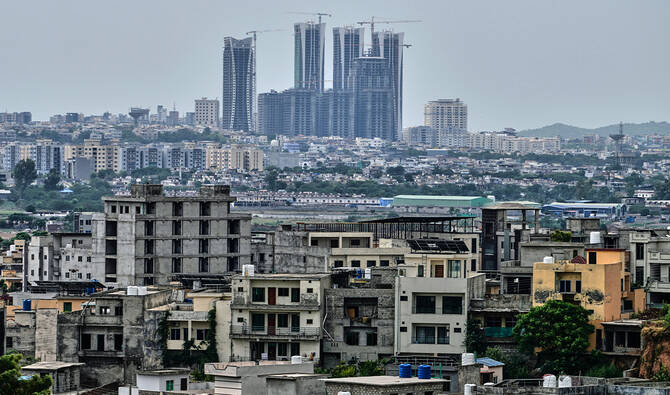
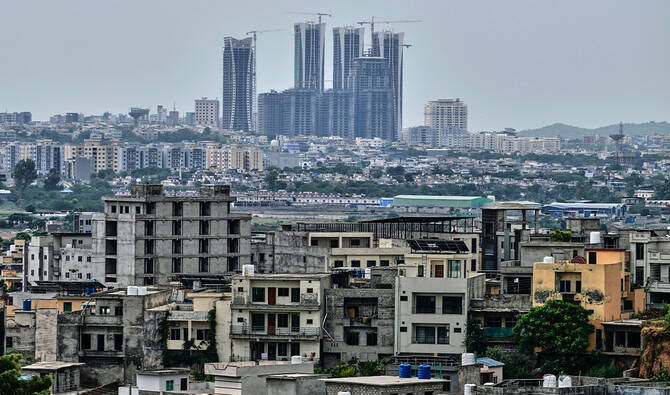
ISLAMABAD: Pakistan’s cabinet on Monday approved a new national housing policy prioritizing vertical development and energy-efficient construction, as the government seeks to expand access to affordable homes and use increasingly scarce urban land more efficiently.
Pakistan faces a longstanding shortage of affordable housing alongside rapid urbanization, with major cities expanding outward as rising land and construction costs put formal home ownership beyond the reach of many households.
The National Housing Policy 2026 is accompanied by an implementation action plan and was prepared by a working group of Pakistani and international experts following consultations with federal ministries, provincial governments and development partners.
Its approval comes as the government expands its subsidized Apna Ghar housing finance program, which offers first-time homeowners loans of up to Rs10 million ($35,400) for purchasing or constructing homes and has been widened this year to include overseas Pakistanis and private developer-led housing projects.
“The cabinet approved the National Housing Policy 2026 and an action plan for its implementation,” the prime minister’s office said in a statement following a meeting chaired by Prime Minister Shehbaz Sharif.
The cabinet directed authorities to ensure housing projects fully complied with zoning regulations and prioritize vertical housing to make more efficient use of land.
It also ordered energy-efficiency codes to be made a mandatory component of the new policy so that future construction meets energy-efficient and environmentally sustainable standards.
The government said banks had approved Rs220 billion ($780 million) in loans for applicants seeking homes under the prime minister’s Apna Ghar program, while more than Rs32 billion ($113 million) had so far been disbursed to successful applicants.
The scheme is open to first-time homebuyers who do not already own a housing unit and provides financing for the purchase of a house or apartment, the purchase of a plot followed by construction or construction on an already owned plot.
The government has set a financing limit of up to Rs10 million ($35,400), with a fixed markup rate of 5 percent for the first 10 years and loan tenures extending to 20 years.
The State Bank of Pakistan has also eased some lending requirements under the program. In April, it raised the maximum debt burden ratio to 65 percent of a prospective borrower’s net disposable income and directed banks and the state-owned House Building Finance Company to complete credit approvals within 15 working days once complete applications are received.
The program was further expanded in June to allow overseas Pakistanis to seek financing and banks to provide institutional financing to government employees and fund private developer-led housing projects.
CYBERSECURITY FRAMEWORK
The cabinet separately approved the Pakistan Information Security Framework 2026, a new set of unified baseline standards for information security and centralized cybersecurity oversight.
“The framework aims to establish a comprehensive and unified system of basic uniform information security standards and ensure centralized oversight,” the prime minister’s office said.
The framework was developed under Pakistan’s Computer Emergency Response Teams Rules 2023, which established a national structure for coordinating responses to cyberattacks and threats against information systems and critical infrastructure.
The Pakistan Information Security Framework includes controls covering data protection and privacy, identity and access management, incident response, physical security, data centers and web hosting, software development, supply chains and audits.
It also includes dedicated protections for critical information infrastructure, including systems and networks whose disruption could have serious consequences for essential state and public services.
The cabinet directed authorities to ensure the framework was effectively implemented within the prescribed timeframe.