

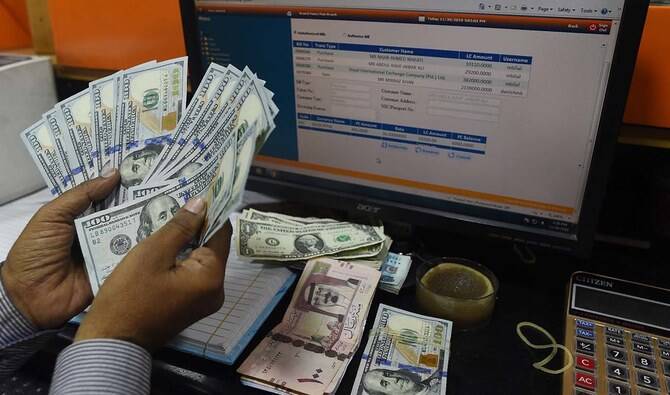

KARACHI: Pakistan received $3.6 billion in workers’ remittances in July, up 13 percent from a year earlier, with Saudi Arabia remaining the largest source of inflows, the central bank said on Monday.
The increase marks a strong start to the new fiscal year after Pakistan received a record $41.6 billion in remittances during the fiscal year that ended in June, with the inflows playing an important role in supporting the country’s external account and foreign exchange position.
“Workers’ remittances were recorded at $ 3.6 billion during July 2026,” the State Bank of Pakistan said in a statement. “In terms of growth, remittances increased by 13.0 percent on y/y [year-on-year] basis and 4.5 percent on m/m [month-no-month] basis.”
Saudi Arabia accounted for $913.9 million of the July inflows, followed by the United Arab Emirates with $737.3 million, the United Kingdom with $555.5 million and the United States with $317.2 million, according to the central bank.
The Gulf states have traditionally been the largest sources of remittances to Pakistan because of the large number of Pakistani workers employed in the region.
Prime Minister Shehbaz Sharif welcomed the July increase, saying the continued contribution of overseas Pakistanis to the country’s economic stability and development was commendable.
“Overseas Pakistanis are an invaluable part of our national economic mainstream,” Sharif said in a statement issued by his office.
Remittances are a key source of foreign exchange for Pakistan and have helped finance its trade deficit and support stability in the foreign exchange market.
The State Bank said in May that strong remittance inflows were expected to partly offset a widening trade deficit, although it warned that uncertainty in Gulf economies arising from the regional conflict could affect future inflows.


