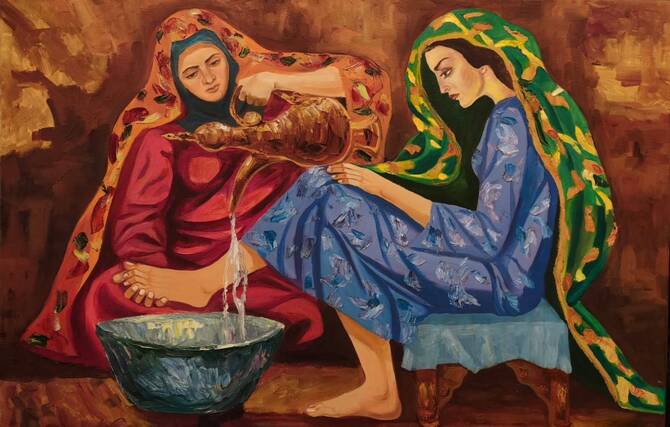

RIYADH: This summer, Ali Al-Mussa, son of the pioneering Saudi artist Abdulsattar Al-Mussa, made a surprising and significant discovery: an oil painting by his late father of a woman washing another woman’s feet.
Ali believes the painting dates back to 1979, and is likely the original on which Al-Mussa based his later series “Al-Ars fe Al-Rafae.” It is certainly a prime example of Al-Mussa’s figurative work, which focused on the everyday lives of Saudi residents.
“We know almost every single painting in the house,” Ali told Arab News. “But this artwork was never seen by any of us, except for my mom.”

Abdulsattar Al-Mussa in Moscow. (Supplied)
The painting was created in Moscow, where Al-Mussa lived for much of his life, and where he met his wife. It is based — as are so many of his works — on nostalgia for his homeland.
“My mom actually remembers the painting, because she saw him working on it. But then it disappeared and he never talked about it, and we never saw it. I don’t know why,” Ali said.
It’s still unclear to the family whether Al-Mussa hid the painting away intentionally or not.
“Maybe he didn’t want to sell it,” Ali said. “Artists are often tempted to sell paintings when they’re displayed and they get offers, and maybe he really cherished this work and didn’t want to sell it. That’s one version we think (might be accurate).”
The newly discovered work was a sentimental surprise to the family, as it was one of the artist’s earliest works from his time studying for a master’s degree in of fine art from Moscow University, where he graduated in 1982 with distinction.

An example of Al-Mussa's black-and-white work. (Supplied)
“We don’t have any paintings from that era — everything we have, especially oil on canvas, is from the 2000s or later,” Ali said. That is roughly when the artist and his family moved back to the Kingdom.
“I think he missed home a lot. He missed his family. He saw us growing up as kids, and he wanted a better future for us. So, he said, “OK, there’s no place like home. Let’s just go there.” But he did enjoy life abroad and seeing different countries,” Ali said.
Most of Al-Mussa’s best known works are in black and white — fishermen casting their nets, women preparing for a wedding, others singing and dancing, a man smoking his argeela, another serving coffee. They don’t merely capture an act, but a time.
“The legacy that he leaves behind is that he was successfully able to translate a lot of his emotions and memories onto canvas for people to see a period of time that was very hard to express,” Ali said.
Ali describes his father as “fearless.” Al-Mussa grew up in mid-20th-century Saudi Arabia and, as he told Arab News in 2024, went against his father’s wishes to study art rather than medicine in Moscow during the Seventies. “It was actually forbidden to travel to Russia at the time, because there were no diplomatic ties between Saudi Arabia and the Soviet Union,” he said. “I went and studied there under another name. No one knew — not even my family.”
That boldness was reflected in Al-Mussa’s work, and in his personality, Ali said. “He was never afraid to speak his mind,” his son said.
Ali recalled his father’s routine: A cup of coffee, breakfast, and a cigarette to start the day, after which he would spend most of his time painting in the living room with the TV running in the background. “He would do that because he wanted to be around us,” Ali said.
In his 2024 interview with Arab News, Al-Mussa said he wished for his work to be “eternal.” His legacy certainly looks to be secure. His work was most recently featured in the “Bedayat” exhibition — showcasing pioneering Saudi artists — which is currently on show at Ithra.
As for the new piece, it is currently safely in storage at the family house. But that is unlikely to be the case for long.
“I would love to see it, hopefully, in a museum someday. Because his works were never meant to be locked at home in a box somewhere that people wouldn’t find them,” Ali said. “It’s a beautiful piece, and I think all his work should be somewhere people can see and enjoy it.”