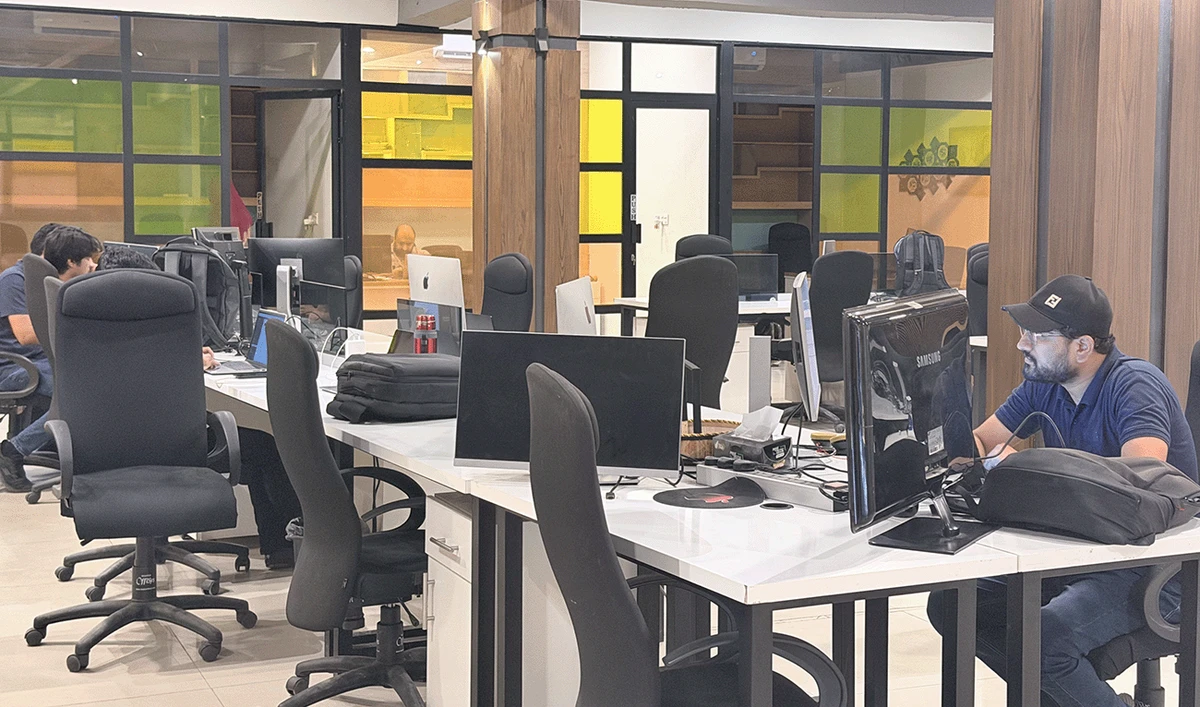
- Industry leaders say AI is cutting coding and design jobs but boosting demand for cloud, cybersecurity and AI engineering skills
- Pakistan IT minister says government aims to create three million AI-related jobs by 2030 via large-scale training and reskilling
ISLAMABAD: Artificial intelligence is reshaping Pakistan’s software industry, cutting demand for routine coding and entry-level roles by at least 25 percent but also creating new opportunities in AI engineering, cloud computing and cybersecurity, a federal minister and industry stakeholders said this week.
The shift comes as Pakistan’s technology sector continues to grow. Pakistan’s IT and telecom export remittances reached a record Rs1.2 trillion ($4.6 billion) during the 2025-26 fiscal year, increasing by around 20.6 percent from the previous year.
However, the growth is occurring alongside concerns that AI is reducing opportunities for junior programmers and other entry-level workers. A recent report by the Pakistan Software Houses Association (P@SHA) found that entry-level hiring at major technology companies has fallen by around 25 percent, while employment among developers aged 22 to 25 has declined by nearly 20 percent since 2024.
Pakistan IT Minister Shaza Fatima Khawaja brushed aside the concerns, saying that AI should be regarded as a “transition” that requires preparation rather than a threat.
“Any honest assessment of this moment must acknowledge that AI will change jobs,” Khawaja told Arab News.
She added that the government’s goal is to ensure that this transition becomes an upgrade for Pakistani workers rather than a “displacement.”
Under the National AI Policy 2025, she added that the government aims to create three million AI-related jobs by 2030. The plan includes Rs277.85 billion ($1 billion) in investment and annual AI training for 200,000 people. It also includes 1,000 fully funded AI scholarships.
Khawaja said the government’s focus is on helping workers use AI tools effectively.
“It is teaching our freelance workforce to work with AI rather than to be replaced by it,” she explained.
MORE WORK, FEWER RESOURCES
P@SHA Chairman Sajjad Mustafa said many routine tasks such as basic website development, app development and parts of graphic design are increasingly being handled by AI systems.
He said Pakistan’s technology sector needs to move away from low-value outsourcing and focus on higher-skilled work.
“A lot of new kinds of work will emerge, especially within the AI space,” Mustafa predicted.
The P@SHA report shows that entry-level freelance projects have dropped from about 15 percent of listings to below 9 percent. It also found that basic writing and translation work declined by 32 percent year-on-year, as AI-powered tools became more common.
The report identified data entry workers, generic content writers, graphic designers, manual software testers, junior programmers and basic accountants among roles most exposed to automation.
Meanwhile, it said the demand is rising for professionals with skills in AI integration, cybersecurity, cloud systems and advanced software development.
A report by the World Bank issued on August 4, titled, “World Development Report 2026: The Promise of Artificial Intelligence” states that AI could allow developing countries to achieve a lot. However, governments must act swiftly to close the gaps in power, connectivity, skills, and institutional quality that threaten to leave them behind, it added.
The report says 4.5 percent of jobs in low- and middle-income countries are at risk from AI, compared with 14.2 percent in high-income countries.
At the same time, it estimates that 16.2 percent of jobs in developing economies could see major productivity improvements through AI.
Technology companies in Pakistan are already experiencing changes in hiring patterns. Shah Nawaz, chief executive of Altegon Software Company, said AI has reduced the need for some software delivery roles while improving productivity.
“We reduced 80 percent [jobs] on the delivery side, with the replacement of AI,” Nawaz said. “We compensate that as well. On top of it, we still have much more room to even cover 60 percent to 80 percent more work.”
Muhammad Uzair Aabid, HR manager at Eurus Technologies, said companies increasingly prefer experienced professionals who can work alongside AI tools rather than a large number of junior employees.
“Junior resources are less because now you have AI software and large language models like Claude and ChatGPT,” he said.
Aabid said employees who previously handled one project in a month can now manage several projects at the same time.
Some companies believe the impact of AI adoption will become more visible in the coming years.
Veroke Chief Executive Aqeel Arshad said his company has not yet experienced major disruption but expects changes by the end of 2027. He added that areas such as cybersecurity and data services will continue to see demand despite the presence of AI.
“We need to strategize what we do as a company,” Arshad said.