

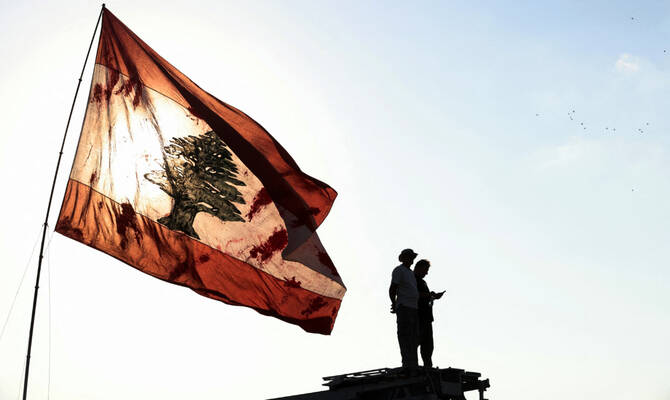

BEIRUT: Six years after the Beirut port blast devastated the Lebanese capital, survivors are still suffering, families are still mourning and those accused of responsibility have yet to face trial.
The Aug. 4, 2020, explosion, one of the largest non-nuclear blasts ever recorded, killed at least 235 people, injured more than 6,500 and destroyed large parts of Beirut.
But for many of those who survived, the catastrophe has still not ended.
One survivor, an engineer who was working in Beirut’s Ashrafieh district when the blast struck, lost both legs and is now living in a care home in northern Lebanon because he can no longer look after himself.
“He refuses to speak to anyone and even refuses to have his name mentioned,” lawyer Cecile Roukoz told Arab News.

Among the injured were doctors, nurses, administrative employees and patients inside hospitals located within the blast zone. (AFP)
Roukoz, whose brother Joseph was killed in the explosion, represents the families of the victims.
Another survivor, Lara Hayek, remains completely paralysed after suffering a severe head injury.
She is “alive, but it is not a life,” Roukoz said. Hayek remains in hospital, where she is visited daily by her mother and by families of other victims who come to pray beside her.
Lilian Choueito, who became known as the “sleeping princess” after emerging from a coma that lasted several months, is still learning how to walk and speak again.
Videos posted on social media show her struggling through rehabilitation six years after the blast.

Hundreds of people were never registered at hospitals because overwhelmed medical facilities could not accommodate them. (AFP)
Her physical suffering was compounded by a bitter family dispute after her husband abandoned her and prevented her from seeing their infant son, forcing the judiciary to intervene to grant her visitation rights.
The official death toll has continued to rise as some of those severely injured have since succumbed to their wounds.
The number of injured is also believed to be higher than the recorded figure of 6,500. Hundreds of people were never registered at hospitals because overwhelmed medical facilities could not accommodate them.
Some sought treatment at pharmacies and dental clinics, where their wounds were stitched as hospitals across Beirut and Mount Lebanon overflowed with casualties.
Among the injured were doctors, nurses, administrative employees and patients inside hospitals located within the blast zone.

Survivors, relatives and activists marked the sixth anniversary with silent marches, demonstrations and gatherings around the port.
They demanded the truth about the explosion and accountability for those they described as “killers and criminals who stole lives, destroyed a capital and wounded and disabled thousands of innocent people.”
Flowers were laid near the site of the explosion and at General Security, Civil Defense and fire brigade centers in memory of emergency personnel killed on the day of the blast. The Lebanese flag was lowered to half-mast at the presidential palace.
For the victims’ families, however, annual commemorations are no substitute for justice.
Roukoz said she expected an indictment to be issued soon after the investigative phase was formally concluded.

The Aug. 4, 2020 explosion killed at least 235 people, injured more than 6,500 and destroyed large parts of Beirut. (AFP)
The case is now awaiting the opinion of the public prosecutor at the Court of Cassation, Judge Mohammad Saab. Lebanese law does not impose a specific deadline for the submission of that opinion.
“We are pressing for a reasonable timeframe,” Roukoz said.
“It is unacceptable that those who caused the explosion are living normal lives while the innocent victims are either underground or suffering in silence from their physical, emotional and psychological losses.”
Roukoz also called for Ghassan Oueidat, the former public prosecutor at the Court of Cassation, to be held accountable for ordering the release of 17 detainees who had been held in connection with the case.
She said the victims’ relatives had been the “real soldiers” in the battle for justice.

Hundreds of Lebanese marched on Aug. 4, 2021, to mark a year since a cataclysmic explosion ravaged Beirut. (AFP)
For 2,190 days, they maintained pressure through protests despite facing assaults, arrests and intimidation.
They also campaigned to preserve the damaged port grain silos as evidence of the disaster and a monument to those who were killed.
Their efforts to internationalize the case included meetings with foreign governments, international organizations and religious authorities, culminating in a papal visit to the port.
“They will not stop demanding truth and justice until the indictment is issued, the trials begin and everyone responsible for this crime is held accountable,” Roukoz said.
The investigation has been described as one of the most complex criminal cases in Lebanese history.

Survivors, relatives and activists demanded the truth about the explosion and accountability for those they described as “killers and criminals who stole lives.” (AFP)
It involves thousands of pages of witness testimony, statements from defendants, technical reports, satellite images and responses to judicial requests sent to Arab and foreign governments.
It has also been repeatedly delayed by lawsuits, political pressure and disputes over judicial authority and immunity.
Imad Martinos, head of the Beirut Bar Association, said anyone who obstructed the investigation should face scrutiny.
“Every person who obstructed justice — whether a politician, military officer, judge, administrator, decision-maker, influential figure or executor — is guilty until proven innocent, rather than innocent until proven guilty,” he said.
Lawyer Moussa Khoury, a member of the prosecution office at the Beirut Bar Association, recalled the assurances given in the immediate aftermath of the blast.

Family members carry portraits of the victims as they gather alongside ambassadors from several foreign countries on the sixth anniversary of the explosion. (AFP)
“The Lebanese heard promises that the truth would emerge within a few days and that justice would be swift,” he said.
“It was said at the time that the matter would require only five days. But the years have proved that the road to justice is much longer and more difficult.”
The Beirut Bar Association has played a central role in representing victims and opposing attempts to suspend or derail the investigation.
Lawyer Shukri Haddad, speaking on behalf of the association’s prosecution office, said the indictment would identify the facts, responsibilities and individuals who should be sent for trial.
“We confronted attempts to obstruct the investigation, established the principle that everyone must be subject to accountability without immunity, affirmed the jurisdiction of the Judicial Council away from politicization, obtained rulings that established responsibility for the abusive obstruction of justice, and pursued legal cases inside and outside Lebanon,” he said.

Investigative Judge Tarek Bitar was prevented from working on the case for more than 30 months as political figures and officials filed legal challenges questioning his authority and impartiality.
Bitar nevertheless remained assigned to the investigation.
The political circumstances surrounding the case later shifted following the election of Joseph Aoun as president and the formation of a government headed by Prime Minister Nawaf Salam.
Aoun pledged in his inaugural address to protect the independence of the judiciary. Salam’s government made a similar commitment in its ministerial statement, promising to prevent political interference in judicial proceedings.
Bitar subsequently resumed questioning suspects and officials.

Six years after the disaster, the Lebanese authorities have still not issued a final official report explaining precisely how the explosion occurred and who was responsible. (AFP)
Those who appeared before him included former Prime Minister Hassan Diab, former Interior Minister Nohad Machnouk, former General Security chief Maj. Gen. Abbas Ibrahim and former State Security chief Maj. Gen. Tony Saliba.
Judges and other senior officials were also questioned.
Bitar concluded the investigative phase on March 30 and referred the case to the Public Prosecution at the Court of Cassation for its opinion on the substance of the investigation.
He did not at that stage announce whether those questioned would be detained, remain free or be released on pledges of residence.
A judicial source told Arab News that Bitar had already completed a draft of his indictment and could issue it quickly once the prosecution submits its non-binding opinion.

Anyone who obstructed the investigation should face scrutiny, said Imad Martinos, head of the Beirut Bar Association. (AFP)
The source expected the decision to be issued before the end of the year.
Six years after the disaster, the Lebanese authorities have still not issued a final official report explaining precisely how the explosion occurred and who was responsible.
A French technical investigation concluded that between 700 and 1,000 tonnes of ammonium nitrate exploded inside Warehouse 12 after a fire broke out.
The French report ruled out external intervention as the cause of the blast.
It argued that an external attack would probably have caused the ammonium nitrate to explode immediately, rather than after a prolonged fire.

The sixth anniversary renewed international pressure on the Lebanese authorities to complete the judicial process. (AFP)
The first French technical report, submitted to the Lebanese judiciary in 2021, concluded that the fire inside Warehouse 12 caused two explosions.
Investigators were unable to determine where the initial fire started because the evidence was destroyed by the blasts.
The report identified several potential causes, including welding work, an electrical fault or an unextinguished cigarette.
It also found that proper safety standards had not been followed in the storage of flammable materials inside the warehouse.
The materials had not been adequately isolated or packaged and had not been protected from exposure to high temperatures.

Volunteers clean the streets following the blast. (Reuters)
A French delegation inspected the port on Aug. 14, 2020, at the request of judicial officials Jean-Luc Gado and Marie-Catherine Ediart of the Paris Court of Justice.
The findings did not answer the central political and legal questions at the heart of the case: Who allowed the ammonium nitrate to enter Lebanon, who knew it was stored at the port, and why was it left there for years despite repeated warnings?
Those questions are expected to form the basis of Bitar’s indictment and any subsequent trials before the Judicial Council.
The sixth anniversary renewed international pressure on the Lebanese authorities to complete the judicial process.
Jean Arnault, acting head of the Office of the UN Special Coordinator for Lebanon, said a disaster of such magnitude could not be allowed to become “a forgotten chapter of history.”

“The right of the victims, survivors and all Lebanese people to accountability must be safeguarded without any further delay,”
said Jean Arnault, acting head of the Office of the UN Special Coordinator for Lebanon.
“Efforts must instead be intensified to accelerate the judicial process, complete the investigation and deliver justice,” he said.
“Justice delayed is justice denied. The right of the victims, survivors and all Lebanese people to accountability must be safeguarded without any further delay.”
Arnault called on all concerned parties to take the necessary steps to achieve “tangible and rapid progress” in the case.
He also stressed the importance of an independent, transparent and impartial judicial process to end Lebanon’s culture of impunity, restore public confidence and uphold the rule of law.
Structural reforms were needed to strengthen and protect the independence of the judiciary, he said, describing it as a fundamental pillar of state-building and Lebanon’s wider reform agenda.

After six years of grief, legal battles and political obstruction, the families say they will continue their campaign. (AFP)
For the victims’ families, the completion of the investigation represents only the beginning.
An indictment must still be issued, suspects must be formally referred for trial and the Judicial Council must determine who bears criminal responsibility for the disaster.
After six years of grief, legal battles and political obstruction, the families say they will continue their campaign until those steps are completed.
Their demand remains unchanged: The truth about what happened at Beirut port, and accountability for everyone who allowed it to happen.


