

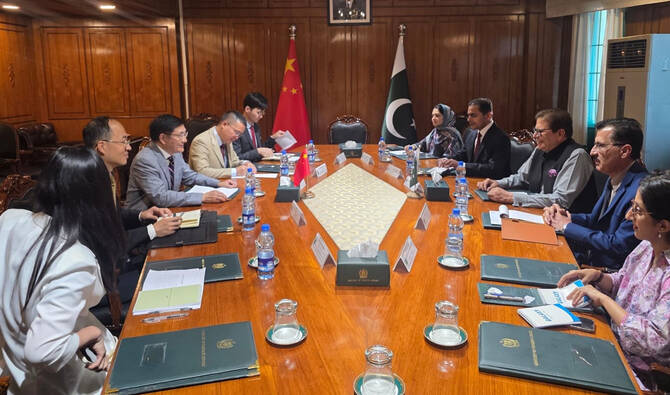

ISLAMABAD: Pakistan and China have agreed to deepen cooperation against militant groups they say are operating from Afghanistan, with senior officials discussing threats posed by the Pakistani Taliban (TTP) and the East Turkistan Islamic Movement (ETIM) during talks in Islamabad this week, Pakistan’s special representative for Afghanistan said.
The meeting between Pakistan’s Special Representative for Afghanistan Mohammad Sadiq and China’s Special Representative Ambassador Yue Xiaoyong comes as Beijing has assumed a more active diplomatic role in Afghanistan, seeking to stabilize the region amid deteriorating ties between Islamabad and Kabul and growing concerns that cross-border militancy could threaten regional security and major Chinese investments, including the multibillion-dollar China-Pakistan Economic Corridor (CPEC).
China also has its own security concerns. Beijing has long accused ETIM, a militant group it says seeks independence for China’s Xinjiang region, of operating from Afghanistan and maintaining links with extremist networks in the region. Chinese officials have repeatedly called on Afghanistan’s Taliban government to prevent Afghan territory from being used by groups that threaten China’s security interests.
“We exchanged views on the threats posed by TTP and ETIM operating from Afghan soil and agreed to strengthen bilateral coordination and deepen cooperation to counter terrorist threats and safeguard regional peace, security, and stability,” Sadiq wrote on X after the meeting.
Pakistan has repeatedly accused Afghanistan’s Taliban authorities of allowing TTP fighters to use Afghan territory to plan and launch attacks inside Pakistan, an allegation Kabul denies, insisting it does not permit any group to use Afghan soil against another country.
The TTP has intensified attacks since the collapse of a ceasefire with Islamabad in late 2022 and has claimed responsibility for some of the deadliest assaults on Pakistani security forces and civilians. Most recently, the group claimed responsibility for a suspected suicide bombing outside Kabal Police Station in Pakistan’s northwestern Swat Valley on Sunday that killed 17 people after a peace rally.
China has increasingly sought to reduce tensions between Pakistan and Afghanistan through diplomacy, fearing prolonged instability could undermine regional connectivity projects linked to the Belt and Road Initiative as well as security around CPEC, Beijing’s flagship investment program in Pakistan.
Relations between Pakistan and Afghanistan deteriorated sharply earlier this year following deadly border clashes and Pakistani airstrikes inside Afghanistan targeting what Islamabad said were militant hideouts.
In response, China intensified diplomatic engagement, with Yue conducting shuttle diplomacy between Islamabad and Kabul and later hosting Pakistani and Afghan officials for talks in Urumqi aimed at easing tensions and expanding cooperation on border security, counterterrorism and trade.
Pakistan, Afghanistan and China have since resumed trilateral engagement, with all three countries expressing support for continued dialogue even as differences remain over Islamabad’s allegations that militant groups continue to operate from Afghan territory.


