

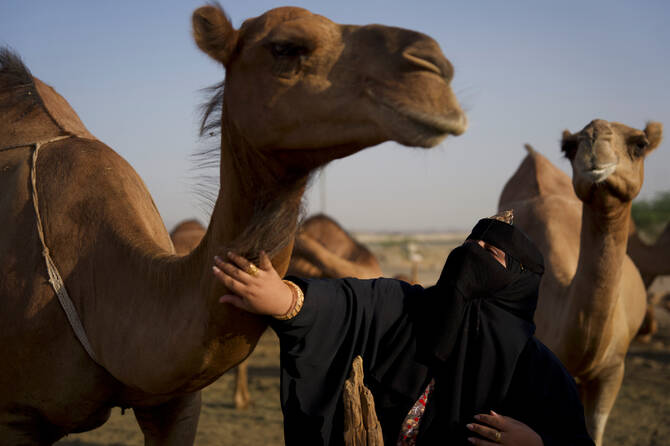
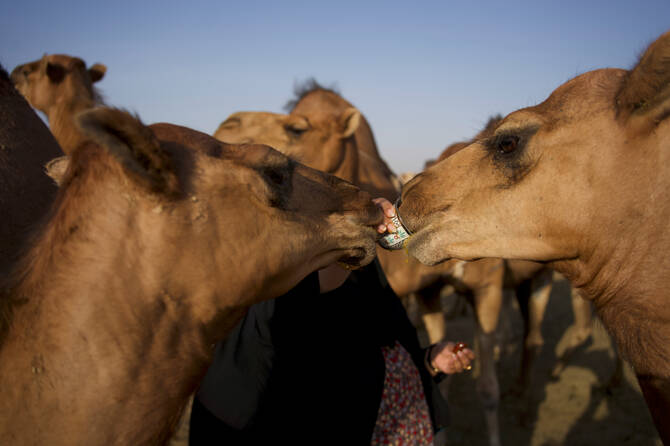

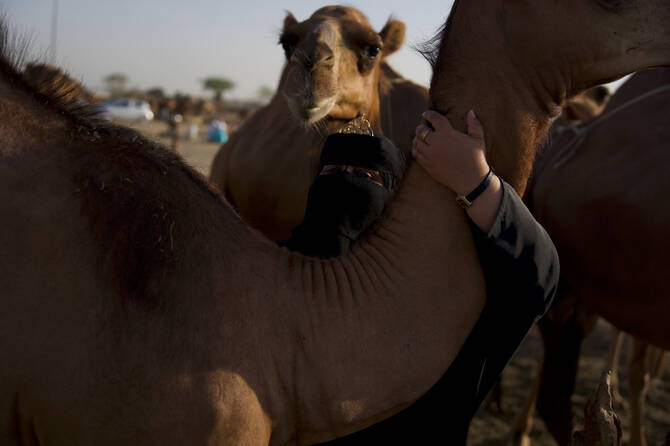

JEDDAH: Millions have watched Saudi content creator Mizna bint Oqab’s videos of life with her camels, transforming her daily routines into viral snapshots of one of the Kingdom’s cultural icons.
Through humorous videos of camel-milk lattes, breakfast recipes, and playful trends, she is bringing centuries-old Bedouin traditions to younger audiences while sharing a more personal side of life with the animals.
“I want to deliver a message to the whole world that camels are gentle and beautiful creatures that deserve to be loved,” she told Arab News.
When Oqab arrives among her camels, she does not simply inspect the herd and leave. She studies their faces, watches which animals are eating and notices those that have wandered away. From a single glance, she can often tell whether one is unwell, irritated, bored or simply seeking attention.
For Oqab, the camels are not livestock defined only by their economic value or ability to endure the desert. They are sensitive animals with distinct personalities, moods and stories.
“I treat them as though they are small, spoiled children,” she said. “And when I say spoiled, I mean it in every sense of the word.”
Her videos place camels in familiar social-media settings — preparing coffee, trying food combinations, joining viral trends or simply reacting with affection, curiosity and jealousy. The signature gold crown she wears in each video has become part of her public image, reflecting what she describes as “confidence, strength and dignity.”
Several of her Snapchat Spotlight videos have attracted between 1 million and 8.4 million views.
“I am trying to make people forget the idea that camels harden the heart,” she explained. “No, that is not true. I want to present them in a softer and more artistic way so that everyone can love them, whether they are young or old.”
Oqab grew up immersed in camel-herding traditions and inherited knowledge. Her father’s family were nomadic Bedouins who traveled across western Saudi Arabia in search of seasonal grazing. They moved between areas near Jeddah, Makkah, Al-Jumum, Al-Juhfah and villages around Madinah, following rainfall and vegetation.
“I love Bedouin life in an extraordinary way, and I have been attached to it since childhood,” she said. “I fell in love with this life because I loved my childhood.”

As a child, her father assigned her a young camel to care for and told her that it belonged to her. She would feed it, give it water and remain beside it when it became ill.
“I would not have been able to build this relationship with camels today if I had not lived these experiences,” she said.
Although families today often employ herders rather than traveling constantly with their animals, Oqab still spends much of her time with the herd, moving them to cooler, sheltered ground during periods of intense heat.
“We always try to find a comfortable place for them,” she said. “When the difficult weather passes, we return them to their usual location.”
She realized early that simply talking about Bedouin traditions would not capture the attention of younger audiences. Her solution was not to dilute the culture, but to reframe it.
“We need to give our customs and traditions a refresh,” she said. “Otherwise, young people will remain on their iPads and forget the world and everything around them.”
Her camels have become willing participants. In one video, she asked a camel to move backward before calling it forward again, and it responded to both commands.
“We understand each other in a special way,” she said. “This shows that the camel is deeply lovable and very close to the human being.”
Food has become another way to introduce camel culture to new audiences. Rather than presenting camel milk simply as a traditional product, she incorporates it into familiar recipes including coffee, karak, cakes and breakfast dishes.
“When I use camel milk with Nutella, I do not attract only people interested in camels,” she said. “I also reach the entire Nutella audience.”
She believes curiosity often leads people to learn more. “Camel milk is not salty, as some people imagine,” she added. “Its flavor is balanced.”
Within the herd, individual camels have become recurring characters in Oqab’s digital world.

Sheihana frequently appears as the “spoiled star,” while Salem has developed a reputation for sulking. Other camels are teased about their untidy hair or apparent failure to use conditioner.
“I bring them into the content in a humorous way so people love them and enjoy watching them,” she said.
Their emotional responses, however, are not entirely created for comedy.
Oqab recalled giving Sheihana a biscuit while Salem watched. Apparently offended at being excluded, he turned his neck away, walked off and avoided her for the remainder of the day.
“He would come by another path,” she said. “He was literally refusing to speak to me.”
She also creates activities for camels that seem bored, offering treats, cooling them down and spending extra time with them.
“People organize activities for themselves, but camels also become happy when you create something different for them,” she said.
Looking ahead, Oqab hopes to enter some of her herd in Saudi Arabia’s camel beauty competitions, known as mazayen. She said competing requires extensive preparation and experience, but that she hopes to participate within the next year.


