

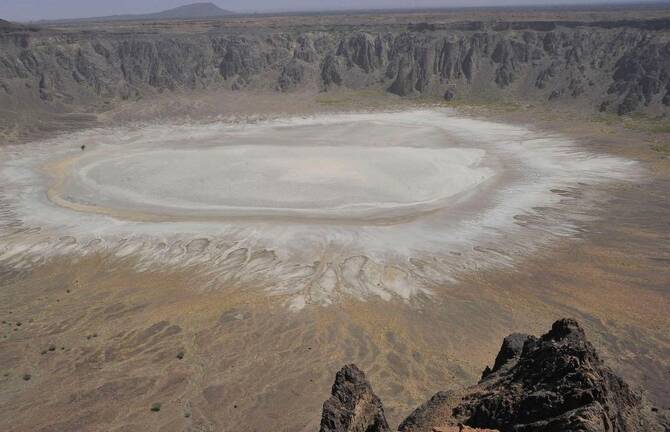

MAKKAH: Among Saudi Arabia’s volcanic landscapes, few are as striking as Al-Wahbah Crater, a vast natural formation whose dramatic cliffs and sweeping views preserve a geological history stretching back hundreds of thousands of years.
As nature tourism expands under Vision 2030, the crater has become a popular destination for hikers, photographers and adventure seekers, while serving as a valuable site for geological research.
Located about 250 km northeast of Taif, Al-Wahbah is the Kingdom’s largest mara crater, stretching about 2.5 km across and reaching a depth of around 380 meters. Its floor is covered with bright white salt deposits that contrast sharply with the surrounding volcanic rock.
Geologist Abdullah Al-Shahri described the site to Arab News as one of the Kingdom’s “most significant geological landmarks.” He said research indicates it was formed by ancient volcanic activity that caused the ground to collapse over a magma chamber.
Al-Shahri described the site as an open-air laboratory where students, researchers and earth-science enthusiasts could study volcanic formations firsthand.
He said raising awareness of such sites encourages the preservation of Saudi Arabia’s natural heritage while helping visitors better understand the Kingdom’s geological history.
Tour guide Khaled Al-Omari, speaking to Arab News, said the crater has become one of the region’s most popular destinations year-round, particularly in the cooler months of winter and spring, when mild weather and sweeping panoramas draw the largest crowds.
According to Al-Omari, the site appeals to landscape photographers, off-road travelers, hikers and adventure enthusiasts. Many visitors descend to the crater floor to explore its layered rock formations and salt flats, while recent improvements to visitor services have contributed to growing tourist numbers.
He said Al-Wahbah highlights the Kingdom’s geographic diversity and the growing appeal of eco-tourism, urging visitors to help preserve the site by keeping it clean and following posted guidelines.
Kuwaiti tourist Ali Al-Ajmi, who visited with his family, said standing on the crater’s rim was one of his most memorable travel experiences.
He said photographs could not capture the scale of the landscape, and that descending to the crater floor to see the towering rock walls and salt deposits up close was an unforgettable experience.
As Saudi Arabia continues to expand eco-tourism, Al-Wahbah Crater is strengthening its position as one of the Kingdom’s leading natural attractions while showcasing its rich geological heritage.


