



ROME: Saudi Arabia and Italy on Wednesday called for the protection of commercial shipping through the Strait of Hormuz, Bab Al-Mandab and the Red Sea following a series of attacks and threats against vessels in waterways vital to global trade and energy supplies.
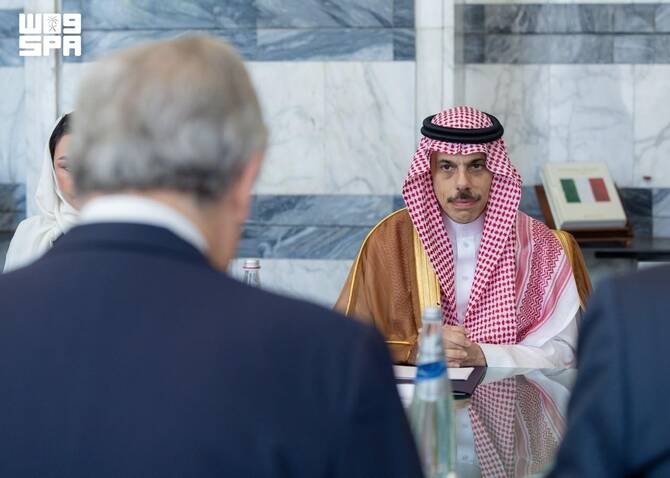
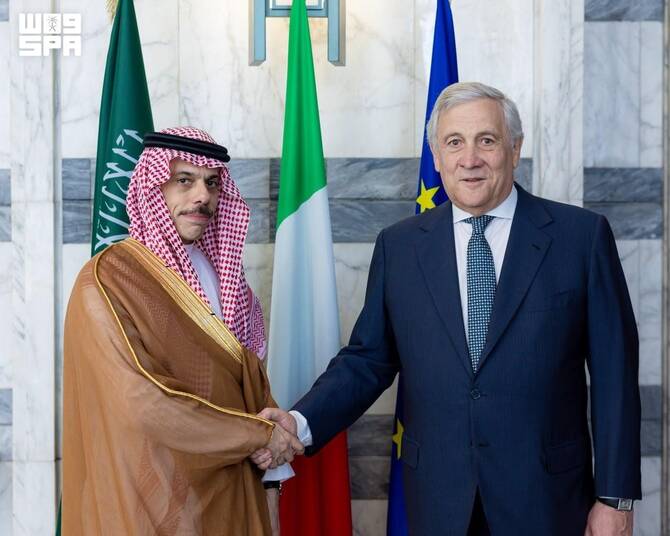
In a joint declaration following talks in Rome, Saudi Foreign Minister Prince Faisal bin Farhan and his Italian counterpart Antonio Tajani stressed the need to safeguard freedom of navigation in the Strait of Hormuz, Bab Al-Mandab, the Gulf of Aden and international sea lanes in accordance with international law, the Saudi Press Agency reported.
The ministers opposed any unilateral action that could restrict maritime transit through the Strait of Hormuz and acknowledged the contribution of the EU’s EUNAVFOR Aspides naval mission, particularly Italy’s role, in protecting merchant shipping.
Their statement came amid renewed threats to Saudi and international vessels in the Red Sea. Iran-backed Houthis attacked two Saudi oil tankers in the Red Sea last week, pledging a naval blockade on the Kingdom’s shipping and further raising concerns over navigation through Bab Al-Mandab, the narrow passage connecting the Red Sea with the Gulf of Aden.
Prince Faisal and Tajani condemned Houthi attacks against Saudi Arabia, including those targeting civilian infrastructure and critical facilities.
They urged Yemen’s parties to engage constructively in a political process aimed at achieving a comprehensive and lasting settlement, while reaffirming their support for humanitarian and development assistance to the Yemeni people.
The ministers also reiterated their commitment to the Rome Coalition on Fertilizer Access and Food Security in Hormuz, an initiative intended to protect supply chains and limit the impact of maritime disruption on vulnerable countries, particularly in Africa and the Mediterranean.
The Strait of Hormuz is one of the world’s most important energy corridors, while Bab Al-Mandab provides access to the Suez Canal and serves as a key route for trade between Asia and Europe. Disruption in either passage can force vessels onto longer routes and increase freight, insurance and energy costs.
The meeting took place on the sidelines of talks involving the co-chairs of the New York conference working groups and members of the Global Alliance for the Implementation of the Two-State Solution, held in Rome on July 28 and 29.
Turning to the Israeli-Palestinian conflict, Prince Faisal and Tajani condemned escalating violence by Israeli settlers across the occupied West Bank following clashes in the Tal village of Nablus that killed four Palestinians and two Israelis.
The two ministers called for urgent international action to protect Palestinians, while reiterating their rejection of any partial, complete or de facto annexation of the West Bank, as well as the forced displacement of Palestinians.
Settler violence has risen sharply in 2026. By July 20, the number of Palestinians killed in incidents linked to settler attacks had already surpassed the total recorded during all of 2025, according to the UN.
The UN humanitarian office said more than 1,000 attacks causing casualties or property damage had been recorded by June, affecting over 230 Palestinian communities.
Recent violence has included house demolitions, suspected settler arson attacks on mosques and deadly confrontations in Palestinian villages, followed by widespread Israeli military raids and arrests across the West Bank.
On Gaza, the ministers called for the preservation of the ceasefire, the unhindered delivery of humanitarian assistance and the start of early recovery efforts.
They also backed reforms by the Palestinian Authority and reiterated their support for a just and lasting peace based on the two-state solution.
Prince Faisal and Tajani also reviewed the Saudi-Italian strategic partnership and agreed to expand cooperation in key sectors.
The ministers agreed to maintain close coordination on regional peace and security and efforts to implement the two-state solution.


