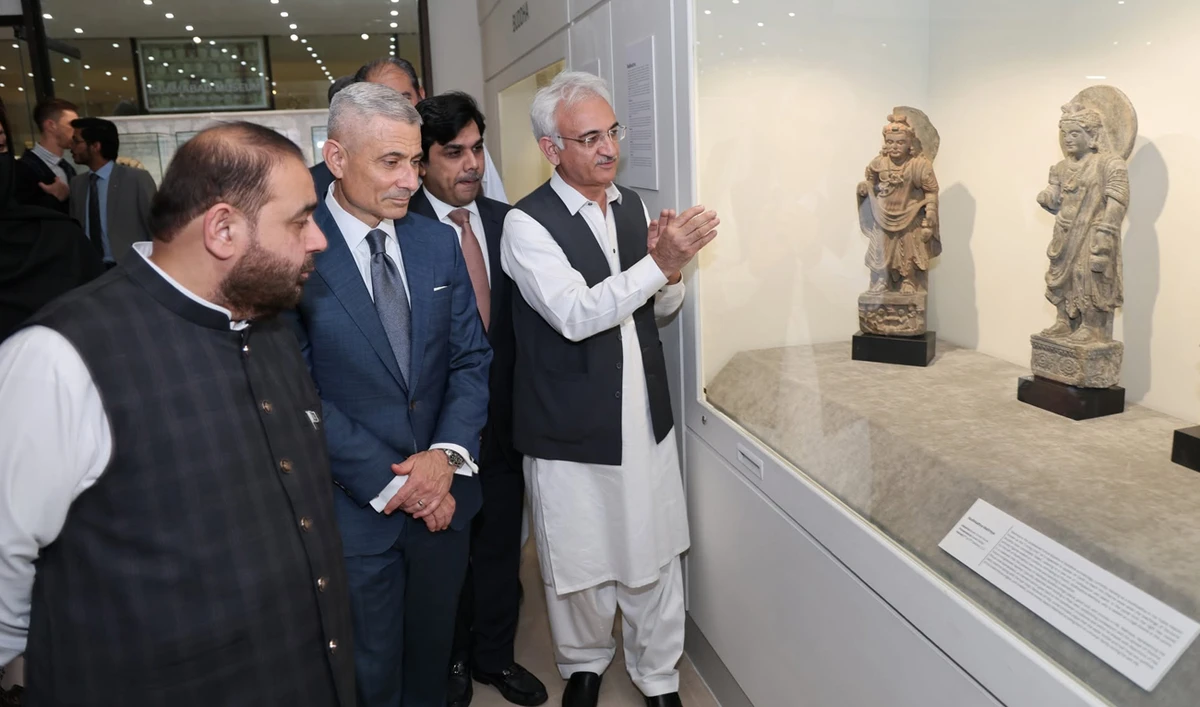
- Senate committee told most artifacts belong to Gandhara and were smuggled over decades
- Lawmakers also review UNESCO concerns over conservation work at Taxila World Heritage Site
ISLAMABAD: Pakistani lawmakers on Monday ordered a detailed investigation into the smuggling of archaeological artifacts after officials said the United States had returned 513 antiquities looted from the country, while also reviewing UNESCO’s concerns over conservation work at the ancient Taxila World Heritage Site.
The Senate Standing Committee on National Heritage and Culture directed the relevant authorities to submit a comprehensive report on the trafficking network, the individuals involved, the estimated value of the recovered artifacts and the status of ongoing investigations after receiving a briefing on the repatriation.
Officials told the committee the recovered objects, mainly from the Gandhara civilization, had been seized by US authorities after being smuggled through illegal channels over several decades.
“The recovered objects, mainly belonging to the Gandhara civilization, had been seized by US authorities after being smuggled through illegal channels over several decades,” said a statement circulated after the committee’s proceedings.
“The artifacts are invaluable national treasures reflecting Pakistan’s rich civilizational heritage and are now in government custody,” it added.
The return of looted antiquities is not uncommon for Pakistan, whose Gandhara-era Buddhist sculptures, coins and other archaeological objects have long been trafficked through international smuggling networks before surfacing in private collections and museums abroad.
Over the years, Pakistani authorities have worked with foreign governments and law enforcement agencies to recover stolen heritage objects.
The committee also reviewed UNESCO’s observations regarding conservation work at Mohra Moradu and Sirkap, two archaeological sites within the Taxila World Heritage Site, after the UN cultural agency sought additional information about restoration work undertaken by Punjab’s archaeology authorities.
Officials said UNESCO’s concerns related mainly to the construction materials used during conservation, the methodology for rebuilding certain walls and the height of reconstructed structures.
Officials said the Punjab government had submitted comprehensive documentation addressing UNESCO’s queries and that no further concerns had been communicated after the information was shared. The committee nevertheless directed the ministry to provide UNESCO’s formal response once it is received.
Separately, lawmakers sought a briefing on reports that a historic Mughal-era arch near Rohara village had been demolished for a housing development, directing the ministry to collect complete information and report back at its next meeting.