

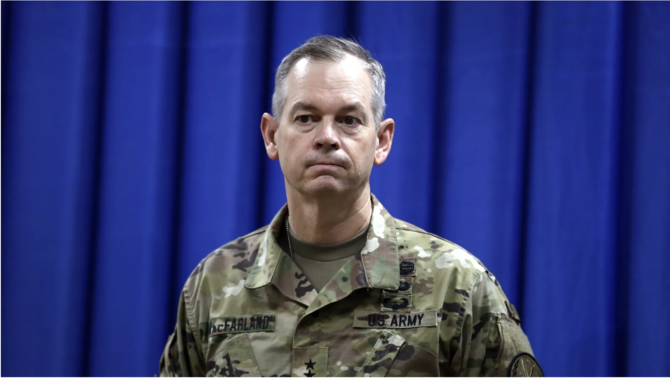

CHICAGO: The retired US general who led the campaign against Daesh in Iraq said on Thursday that a similar international effort could help Lebanon confront Hezbollah, but would likely require American and coalition forces on the ground.
Speaking during a webinar hosted by the Middle East Institute and attended by Arab News, retired Lt. Gen. Sean MacFarland said any successful campaign would also require restraining unilateral Israeli strikes, cutting Hezbollah off from Iranian support and strengthening the Lebanese Armed Forces.
MacFarland, who commanded the US-led Operation Inherent Resolve coalition against Daesh in Iraq and Syria, said Lebanese troops would need American soldiers and advisers alongside them, as well as reliable funding, salaries, equipment and logistical support.
“We may not be doing most of the heavy lifting, the direct combat operations, but there is risk involved,” he said.
“If you’re going to advise and assist a force, you also have to accompany them to be effective.”
MacFarland said the physical presence of US personnel would help convince the Lebanese army that Washington was committed to the mission and prepared to share the risks.
“Initially, I did not have the authority to accompany Iraqi forces. We eventually got that authority, but you have to accompany, and therefore you have to incur risk,” he said.
“If you don’t think that the risk is worth it, then the fight probably isn’t worth it either. We have to make sure that our objectives and our risk tolerance are aligned.”
He acknowledged that Hezbollah would present a more difficult challenge than Daesh.
The Iran-backed group has maintained a deeply entrenched political and military presence in Lebanon for more than four decades, while Daesh controlled territory in Iraq and Syria for a comparatively shorter period.
MacFarland said Iraqi forces had insisted that US personnel accompany them during the campaign to retake Mosul, one of Daesh’s principal strongholds.
“Probably the most important confidence builder was when the prime minister himself said: ‘We’re not going to Mosul unless you go with us,’” he recalled.
“It wasn’t enough to provide advice, funding or supplies. Unless Americans were with them, sharing the risks, they weren’t going to go.”
The presence of US troops also reassured Iraqi forces that medical evacuation, air support and other assistance would be available if they encountered serious resistance, he said.
MacFarland argued that any coalition supporting Lebanon would likely need to include regional powers such as Turkiye and Syria, while also working to sever Iran’s military and financial support for Hezbollah.
He said the US role as the coalition’s lead nation in Iraq had also helped manage tensions between the different forces fighting Daesh, including Kurds, Sunnis, Shiites, Christians and other groups.
“Quite frankly, some of the key leaders in the Iraqi army didn’t like the Kurds and didn’t trust the Kurds, and the feeling was mutual for obvious reasons,” he said.
The presence of US and coalition forces helped contain those rivalries and establish a unified direction for the campaign, he added.
MacFarland said a similar American role in Lebanon could help coordinate the country’s different political and communal forces behind the Lebanese army.
He also stressed that the Lebanese military would require substantial financial support, including the payment of overdue salaries.
Kenneth Pollack, the Middle East Institute’s vice president for policy, said an unnamed Lebanese official had recently raised the issue during a visit to London.
“He made it very clear that the Lebanese Armed Forces need pay,” Pollack said. “Their soldiers need back pay. They need salaries.”
He said the US had already demonstrated in Iraq and Syria that it had the capacity to finance and sustain a partner force.
MacFarland said the campaign against Daesh had been supported by a “robust budget,” including more than $1.5 billion for operations in Iraq and $500 million in Syria.
A retired three-star general, MacFarland commanded III Corps and oversaw Combined Joint Task Force — Operation Inherent Resolve in 2015.
He later served as deputy commanding general and chief of staff of the US Army Training and Doctrine Command before retiring from active duty in February 2018.


