

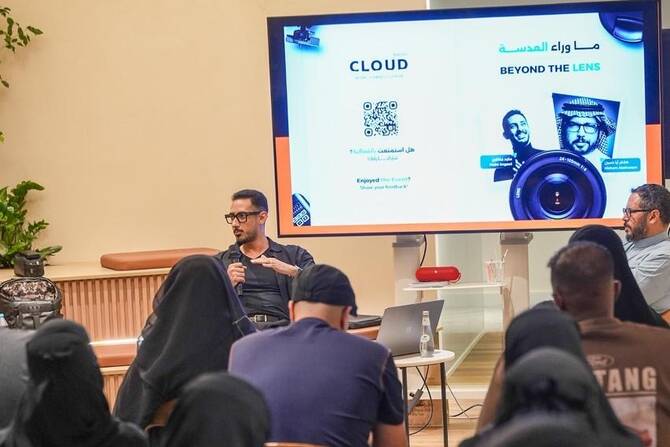

RIYADH: Artificial intelligence can now create images that are nearly impossible to distinguish from traditional photographs. But if no camera ever captured the scene, what makes it a photograph?
The question is becoming increasingly relevant as AI-generated images blur the boundaries between photography, painting and digital art, challenging long-held ideas about what defines the medium.
Majid Angawi, a Saudi Arabia creative director and photographer, believes the answer has less to do with the camera than with the creative vision behind the image.
“AI will be the main tool for generating images for commercial use,” Angawi told Arab News on the sidelines of the “Beyond the Lens: AI in Photography” session on Wednesday night in Riyadh.

Majid Angawi, a Saudi Arabia creative director and photographer. (Supplied)
He said commercial clients increasingly seek speed, scalability, quality and lower production costs, making AI an attractive alternative to traditional photography.
“When it comes to the commercial sector, we want speed, we want scalability, we want volume, we want quality and we want price,” he said. “AI collects all of these in a simpler process.”
Angawi added that technology removes many of the practical barriers that once shaped photography, which allows creators to focus on ideas rather than logistics.
“As long as you have the storytelling skills, you have the eye, you have the vision,” he said. “If you can make me feel something, you are a great AI creator, regardless if you have that camera or if you like this lighting, or if you can’t reach that location.”
“All of these obstacles and barriers are not there right now.”
That shift, he said, is changing what it means to be a photographer.
Rather than emphasizing technical expertise, he believes the industry’s most valuable skills are becoming creative direction, art direction, storytelling and imagination.
“You see things beyond how they look,” he said. “You see things how they feel, what they mean. These are the main skills that you need right now because the tool became extremely easy compared to the previous tool, which is cameras and lighting.”
One image shown during Angawi’s presentation reflected that transformation. At first glance, it appeared to be a painting rather than a photograph.
The effect, he explained, was intentional.
“The painterly effect was intentional,” he said, explaining that he adjusted the focus falloff and gave the model heavy makeup to create the appearance of a painting while preserving details such as camera-like grain.
“If you zoom in and get close to it, you will see the grains that you see in cameras,” he said. “That was intentional to give it the camera feeling.”
The question of authenticity, however, remains one of the most contentious debates surrounding AI-generated images.
“Authenticity is an overstated word in the creative industry because nothing is completely authentic,” he said.
“What is authentic is an idea that moved you, then you adjusted it, added to it and created your version of that idea.”
As AI becomes more capable, concerns continue to grow that it could replace photographers.
“I think AI is just a tool,” he said, comparing today’s concerns with earlier transitions from film to digital cameras and later to image-editing software.
“When photographers were using film, they were threatened when digital came. Photographers who used digital were threatened when Photoshop came. Now photographers who are using cameras and Photoshop are threatened by AI.”
“The cycle will go on and on,” he added. “It’s a matter of if you can adapt, and you adapt fast, you will be the leader.”
Despite this, Angawi believes some areas of photography will continue to rely on human photographers.
“Wedding photography, 100 percent,” he said. “It’s that moment when my life is changing, and I don’t want anything to interrupt it. I just want to keep that moment for life.”
He also noted that the photography industry has yet to fully embrace AI, both in Saudi Arabia and internationally.
“Not only Saudi Arabia, the entire world is not equipped,” he said, adding that awareness and adoption remain in the early stages despite the technology’s rapid development.
Angawi expects AI to become the primary outlet through which many creatives express their ideas.
“We as humans have this urge to express our feelings and our creativity,” he said. “AI is allowing us to do so. If I have this tool that allows me to express myself with as few barriers as possible, 100 percent I will lean to it.”


