

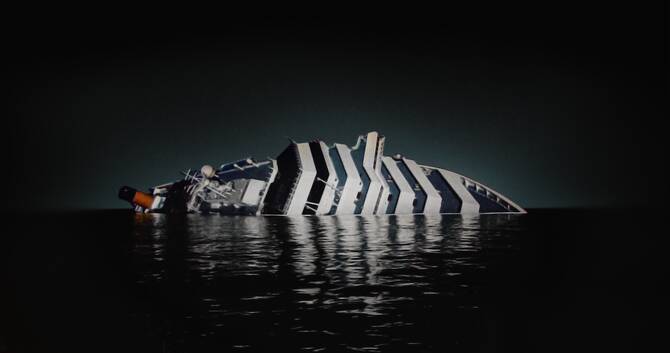

DUBAI: On Jan. 13, 2012, the huge Italian cruise ship Costa Concordia struck a rock just off Giglio Island, which tore a 53-meter gash in the ship’s hull. The engine room was soon flooded, cutting off power from much of the ship. There were 3,229 passengers and 1,023 crew aboard. Evacuation took six hours with the ship listing dangerously to starboard, and did not begin until more than 45 minutes after the accident. Thirty-two people died.
This documentary, helmed by Italian director Chiara Messineo, uses interviews with survivors, cell-phone footage from the night, and translations of the ship’s black box recordings to tell this awful story.
Messineo takes an ‘If it ain’t broke…’ approach: present-day talking head interviews interspersed with video clips and some subtitled text — an immediately accessible format. Its strength lies in the emotional weight of the survivors’ testimony, and the shocking immediacy of the shaky, grainy video footage. “Shipwrecked” is as harrowing as any horror film — the terror of that night is apparent in the archival videos and the rawness of the interviewees’ memories: whether the American couple recounting the panic of trying to save their young baby; the ship’s hotel manager’s tale of ending up in a flooded restaurant where he blacked out; the Italian passenger whose mother went missing in the chaotic dash for the lifeboats; or the British dancer whose ‘dream job’ turned to horror as her managers demanded the troupe carry on even after it’s apparent to all that something is very wrong.
Messineo paces the story expertly, switching between accounts as she builds towards the horrifying scramble to escape the doomed ship. One of the most maddening aspects is the lack of leadership from the ship’s captain Francesco Schettino, whose panicked response and desire to cover his own back come across as the main reasons for the long delay in alerting passengers to the reality of what was happening. That said, we do also learn that the company’s claim that the tragedy was solely the result of human error is, at best, questionable.
There are holes in the narrative. We don’t learn exactly why or how 32 people died, for example — which is a considerable hole. But “Shipwrecked” is still a well-constructed, gripping documentary; terrifying, haunting, and moving.


