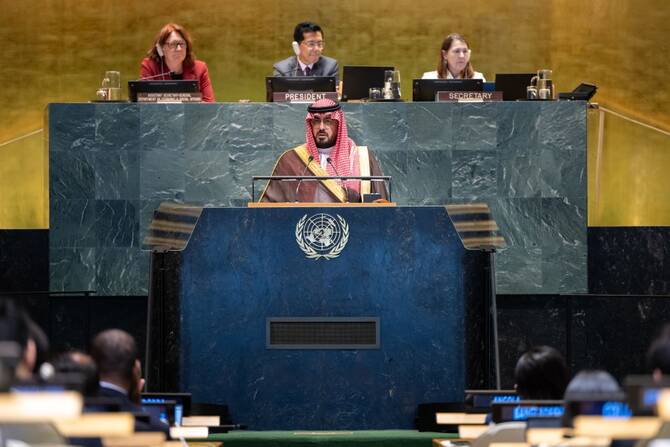
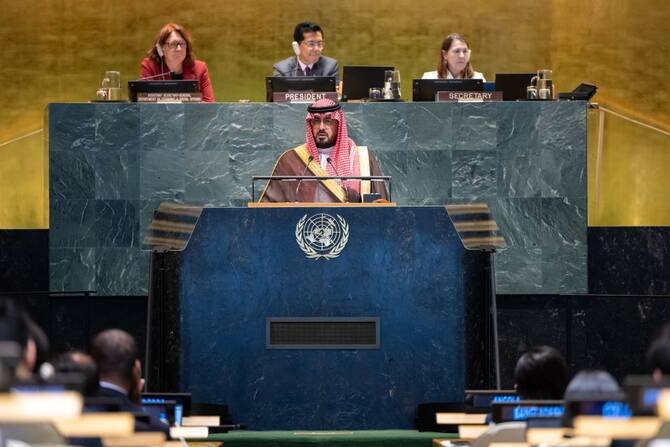
NEW YORK CITY: Saudi Arabia’s development trajectory over the past decade proves that national progress is shaped less by external conditions and more by the willingness of states to make hard, strategic decisions in the face of those conditions, the Kingdom’s minister of economy and planning, Faisal Alibrahim, told the UN’s High-Level Political Forum on Sustainable Development.
Addressing the forum as Saudi Arabia presented its third Voluntary National Review, Alibrahim placed international turbulence in a historical context, arguing that economic and political fluctuations, cross-border crises and rising uncertainty were not unique to the present moment.
“Development was never a journey that is free of challenges, but a journey that comes among crises and challenges,” he said, and this premise leads to broader conclusions about what determines whether or not nations succeed.
“The future of countries is not based on circumstances but based on the decisions that it takes or does not take to deal with these circumstances,” he added.
The minister traced this philosophy in Saudi Arabia back to a decision taken a decade ago, when authorities in the Kingdom concluded that sustaining development would require strategic clarity and a long-term view of both the risks and opportunities.
This thinking led directly to the creation of Saudi Vision 2030, Alibrahim said, which he described as a national framework for comprehensive transformation, established under the leadership of King Salman and Crown Prince Mohammed bin Salman.
It was officially launched in 2016, and since then sustainable development has been embedded across the machinery of Saudi governance, factoring into the Kingdom’s policy design, investment direction and impact measurement, he added.
Alibrahim framed his country’s third Voluntary National Review, submitted to this year’s forum, as a continuation of that process rather than a finished record. He described the review as an opportunity to take stock of a decade of reform while acknowledging that the work remains unfinished, and noting this period of extensive reform that Saudi Arabia has undergone has left it with improved knowledge and greater experience to help sharpen the effects of future efforts.
On the issue of the UN’s Sustainable Development Goals more broadly, and where the international community stands in its efforts to achieve them, he said the goals remain a vital global framework for articulating what a more sustainable future should look like, but that the progress that has been made, while real, continues to fall short of what is needed.
“The biggest challenge is not just the availability of opportunities and tools, but how to employ and use them in an efficient manner,” he said.
Alibrahim reaffirmed the commitment of the Kingdom to the multilateral process, and pledged continuing cooperation with the international community on financing efficiency, institutional capacity-building, and development pathways designed to achieve more sustainable outcomes.
His remarks came during the general debate segment of the 2026 High-Level Political Forum, which convened at UN headquarters in New York under the theme “Transformative, Equitable, Innovative and Coordinated Actions for the 2030 Agenda for Sustainable Development and its Sustainable Development Goals for a Sustainable Future for All.”
The forum, which began on July 7 and concludes on July 15, is this year conducting an in-depth review of five of the 17 Sustainable Development Goals: SDG 6 on water and sanitation; SDG 7 on affordable and clean energy; SDG 9 on industry, innovation and infrastructure; SDG 11 on sustainable cities and communities; and SDG 17 on partnerships for the goals.
The SDGs, which were adopted by UN member states in 2015 as part of the 2030 Agenda for Sustainable Development, comprise 17 goals and 169 targets intended to end poverty, protect the planet and ensure prosperity for all by the end of this decade.
The High-Level Political Forum serves as the UN’s central platform for reviewing progress toward achieving the goals, in part through Voluntary National Reviews in which member states present their own assessments of implementation.
Saudi Arabia is one of 36 countries presenting reviews this year, a group that also includes Bahrain, Egypt, Jordan, Tunisia and the UAE, alongside nations from Europe, Africa, Latin America and the Pacific. The ministerial opening of the forum included speeches by the president of the UN’s Economic and Social Council, the UN secretary-general, the president of the General Assembly and a youth representative.