

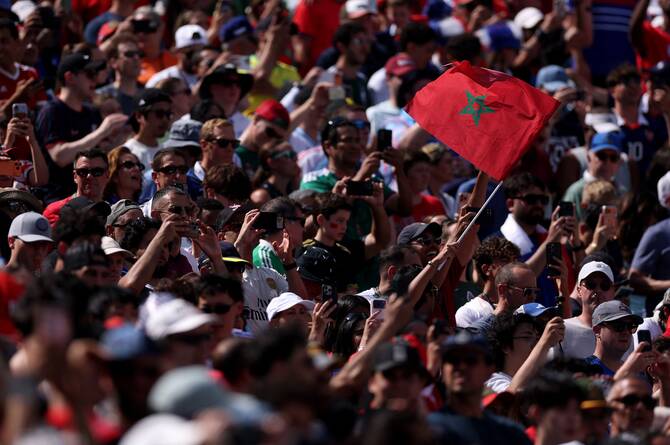

RIYADH: The journey may have ended for all eight Arab nations at the 2026 FIFA World Cup, but the tournament will remain ingrained in the memories of Arab fans who supported each nation as one of their own.
The JAX District Coca-Cola Fan Zone has been one of the prime spots to watch the World Cup in Riyadh, with fans turning out for more than 50 games — including the final Arab representative, Morocco, in their quarterfinal encounter with France.
A fan wearing both Lebanese and Moroccan flags as face paint was particularly moved by the Arab support throughout the World Cup.
“It warms my heart to see all Arabs stand together as one,” he told Arab News.
“Whether they are the local Saudis or the Arab residents, whether they are watching Egypt, Morocco, Algeria or any Arab nation for that matter — every one of them gets the same love and support.”
That sentiment was shared by a Saudi fan who also wore the Moroccan flag, barely containing his excitement: “What Morocco means to me as an Arab? I’ll be honest with you, my blood is Moroccan.”
Another fan in a Morocco jersey said: “I’ve been supporting them — as a Saudi — since the group stage.
“They make me proud as an Arab, and it is truly an honor for us as Saudis to follow them and cheer them on,” he said.
However, it is not just Morocco’s success that has brought Arabs together. For decades, as Arab nations have become more consistent qualifiers for the world’s biggest tournament, fans have come together to support their fellow Arabs.
Algeria’s stunning run in 2014 — which saw them take eventual champions Germany to the brink — is one that remains in the memory of fans. More recently, Egypt’s historic run to the Round of 16 that took defending champions Argentina on a rollercoaster ride also captured the imagination of the Arab world.
“It’s because we want to always stand together with our Arab brothers,” said a fan wearing a Moroccan-designed denim jacket.
“Whether it is a Moroccan, Egyptian, or Saudi team — whoever it may be — we all support them because these teams represent us as Arabs.
“We consider the Moroccan national team as if it is our own,” he added.
Arab nations produced mixed results at the 2026 World Cup. Only three — Algeria, Egypt and Morocco — made it to the Round of 32, and all three exited in the subsequent rounds.
But with another World Cup to be hosted in an Arabic-speaking country in 2030, and a historic number of appearances in 2026, there is no doubt that the sense of inter-Arab support will only continue to grow.


