



LONDON: The main focus of the two-day NATO summit in Ankara this week was, overwhelmingly, the alliance’s renewed pledge of “unwavering support for Ukraine in defending its freedom, sovereignty, and territorial integrity,” backed by additional military equipment and training.
There was also a renewal of the commitment made at the 2025 summit in The Hague, following sustained pressure from US President Donald Trump, that all members will invest 5 percent of their respective gross domestic product in defense by 2035.
The very large elephant in the room, however, was Iran — Turkiye’s eastern neighbor.
“I thought it was notable that the very short summit declaration included robust language on Iran,” said Luke Coffey, a senior fellow at the Hudson Institute, who was in Ankara for the summit.

A general view shows NATO leaders during the NATO Summit in Ankara, Turkiye, on July 8, 2026. (AFP)
The summit’s final communique, issued on Wednesday, stated that NATO “continues to respond and adapt to the strategic competition, pervasive instability, hybrid threats and recurrent shocks that define our broader security environment.
“Allies reiterate that Iran must never have a nuclear weapon and call on Iran to fully respect freedom of navigation in the Strait of Hormuz.”
Not only did the statement emphasize that Iran can never obtain a nuclear weapon — something NATO has said before — “but it also added that freedom of navigation through the Strait of Hormuz should be maintained as a priority,” Coffey said.
“This language from NATO is new.”
As if to remind delegates of the conflict unfolding on their host’s eastern border, the US and Iran traded missiles once again.

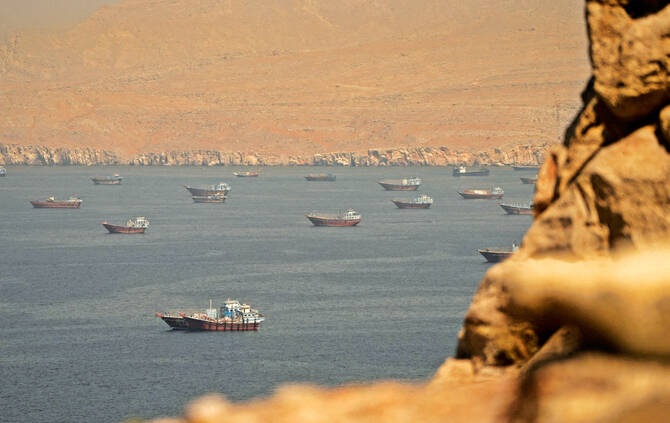
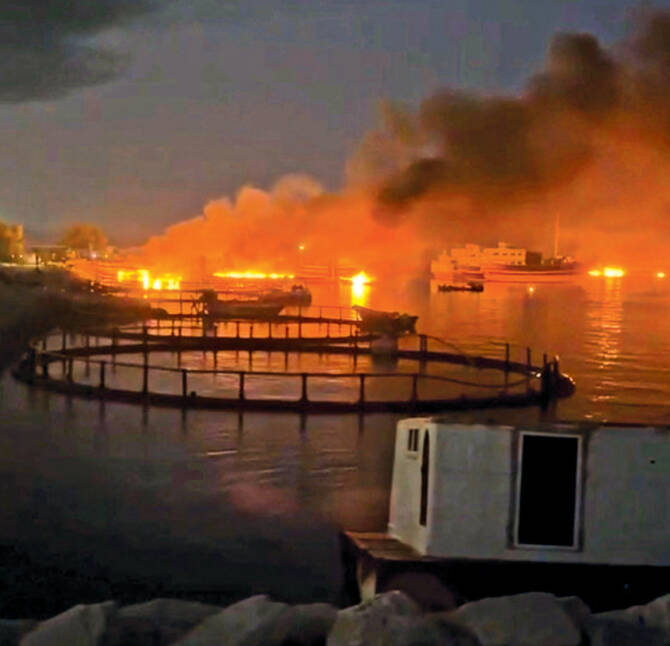
The latest exchange followed Iranian attacks on three tankers in the Strait of Hormuz. In response, the US struck more than 90 Iranian military targets, prompting Iran to launch missiles at Jordan, Kuwait, Bahrain and Qatar.
At the summit on Wednesday, Trump declared the fragile ceasefire over before renewing criticism of NATO, complaining that its members “didn’t want to help us with the number one state sponsor of terror, that’s Iran.”
Individual members of the alliance have contributed in various ways.
On Wednesday, NATO Secretary General Mark Rutte acknowledged the “disappointment for the Americans when it comes to Iran,” but noted that “at the same time, we’ve seen up to 5,000 sorties from European (air) bases.”

US President Donald Trump and NATO Secretary General Mark Rutte (R) attend a meeting of the North Atlantic Council (NAC) during the NATO leaders’ summit in Ankara, Turkiye, on July 8, 2026. (Reuters)
Throughout the conflict, NATO air defense systems have also intercepted numerous Iranian missiles aimed at allies and members, including Turkiye.
But, Coffey said, while there are no signs NATO is likely to be drawn into direct action against Iran, “there are things NATO can do in the Middle East generally, and in the Gulf more specifically, because many of the challenges facing the Gulf and the broader region are also shared concerns for Europe.
“At the top of the list is air defense. From the Gulf of Finland to the Gulf of Oman, European and Arab countries face an increasing air threat, especially from unmanned systems, often originating from Iran or involving Iranian-designed drones.
“This is where I think NATO, along with Ukraine, can work more closely with the Gulf states to improve defensive capabilities.”
Opinion
This section contains relevant reference points, placed in (Opinion field)
He also believes NATO could do more to exploit the full potential of the Istanbul Cooperation Initiative. Established at the 2004 NATO summit in Istanbul, the ICI was designed to “promote security cooperation on a bilateral basis between NATO and partner countries in the broader Middle East region.”
Four Gulf Cooperation Council countries — Bahrain, Kuwait, Qatar and the UAE — have joined the ICI, while Oman and Saudi Arabia participate in some activities within its framework.
“This platform has been around for 22 years, yet it was not until this week’s Ankara summit that the ICI met at the foreign ministers’ level at a NATO summit,” Coffey said.
“Engagement has been ad hoc, and I think the platform would benefit from more consistent and routine engagement as NATO’s main vehicle for outreach to the Middle East region.
“The goal should be to improve relations, conduct joint training, and build confidence between the Gulf states and NATO.”
On Wednesday, Turkish President Recep Tayyip Erdogan invoked the ICI in his opening address to the summit.

Turkish President Tayyip Erdogan holds a press conference during NATO leaders' summit in Ankara, Turkey, July 8, 2026. (Reuters)
After commending Trump’s “resolute stance ... in putting the Iran crisis on a path toward resolution,” pledging Turkiye’s support for demining operations in the Strait of Hormuz and thanking NATO for deploying air defense batteries, he added: “I attach great importance to the presence of our ICI partners with us today, as I believe we need to deepen our engagement with them.”
Technically, several mechanisms could allow NATO to intervene directly in the Gulf.
Attention usually focuses on Article 5, NATO’s mutual defense clause, under which the alliance is obliged to come to the aid of any member state that is attacked. It could not be invoked in support of the US in this case because America, alongside Israel, attacked Iran.
Arguably, Turkiye, a NATO member since 1952, has itself come under attack. Over three weeks in March, Iranian missiles apparently aimed at Turkiye were intercepted on four occasions by NATO air defenses.

Turkish army personnel search a field after a piece of ammunition fell following the interception of a missile launched from Iran by a NATO air defense system, in Diyarbakir, Turkiye, on March 9, 2026. (Reuters)
But triggering Article 5 requires unanimous support from all 32 member states and has been invoked only once, after the Sept. 11, 2001, attacks on the US.
In practice, Article 5 is something of a red herring. NATO has acted on multiple occasions after another provision was triggered.
Article 4 allows any member state to raise concerns with the North Atlantic Council when “the territorial integrity, political independence or security of any of the parties is threatened,” potentially leading to “some form of joint decision or action on behalf of the alliance.”
Since 2003, Article 4 has been invoked nine times, including five by Turkiye in response to terrorist attacks and security threats emanating from Iraq and Syria.
Historically, NATO has also operated in multiple theaters without invoking either article.
Whether authorized by a UN Security Council resolution or at the invitation of a host state, NATO missions approved unanimously by the North Atlantic Council have taken place in Bosnia, Kosovo, Libya, Iraq and on the high seas.
From August 2003, NATO led the UN-mandated International Security Assistance Force in Afghanistan.

Italian soldiers of the NATO-led International Security Assistance Force (ISAF) distribute toys to Afghan children during a patrol in a village northeast of Kabul, 08 June 2004. (AFP file photo)
Yet it is the experience of these missions that makes direct NATO involvement in the Gulf highly unlikely, said Sir John Jenkins, former British ambassador to Saudi Arabia, Libya, Iraq and Syria.
“NATO’s previous forays into out-of-area ops did not go well,” he said.
“The idea really emerged after the end of the Cold War, when NATO planners were looking for new roles. Libya in 2011 was probably the biggest test of the concept, and already the strains were apparent.”
Following the Muammar Qaddafi regime’s attacks on civilians, NATO responded to UN Security Council Resolution 1973, joining a coalition that included Sweden, Qatar, the UAE, Jordan and Morocco to enforce an arms embargo and no-fly zone under Operation Unified Protector.
Between February and October 2011, NATO and its partners flew more than 26,000 sorties, striking 6,000 military targets. At sea, NATO naval units intercepted and boarded hundreds of vessels.

National Transitional Council forces remove tanks from the Drua military base hit by NATO bombing during it's offensive to help rebel fighters oust Libyan leader Muammar Qaddafi in the southern Libyan town of Soqna in the oasis of Joffra on November 1, 2011. (AFP/file photo)
But during the operation, “the US led from behind and the UK and France eventually ran low on munitions,” said Sir John, who became the UK’s ambassador to Libya in October 2011. “Plus, Libya didn’t go well afterwards.
“So I think many NATO members will be very reluctant to commit themselves — and the organization — to an open-ended conflict in the Gulf that doesn’t look as if it will end any time soon.”
That does not, he added, mean the Gulf does not matter to NATO members.
“It clearly does. That, after all, is why the US, UK, France, The Netherlands, etc., got involved in policing and demining the Gulf during the Iran-Iraq War in the 1980s.
“But times have changed. Europe in particular has let its military capability erode. The US is half in, half out. Ukraine is taking a lot of bandwidth.
“And Iran and Ukraine have both shown how you can negate conventional military superiority on paper through the use of drones and AI and so on.

Smoke rises from the direction of an energy installation in the Gulf emirate of Fujairah on March 14, 2026 amid the war between the US, Israel and Iran. (AFP file photo)
“So whatever individual NATO members may say they want — like the Franco-British idea of a stabilization force of some sort, which I think is a fantasy — the capability just isn’t there, and nor is the political will.
“In the end, this looks like a regional security problem, which poses its own immense challenges for the GCC, Iraq, Jordan, Egypt and, of course, Israel.”
Brian Katulis, a senior fellow at the Middle East Institute specializing in US foreign policy and national security, also doubts NATO will become directly involved, not least because “the US and Israel started this war without any consultation, and conducted the war without enough meaningful cooperation with US partners in the Middle East, particularly most Gulf countries.
“In addition, the Trump administration hasn’t coordinated its so far failed Iran diplomacy with most of its key partners in Europe and the Middle East.”
Other NATO members have also not forgotten that “Trump has continued to make clear that he covets the territory of fellow NATO member states and issues threats about taking that territory through force or coercion,” Katulis added, referring to Greenland.

US President Trump’s implied threats to take Greenland by force if it was not handed over to the US has rattled America’s NATO allies. (AFP file photo)
European allies, he believes, have little appetite to deepen their involvement.
“European leaders can read polls as well as anyone else, and neither Trump nor his war are particularly popular in the US,” he said.
“Why attach NATO to a losing cause that has nothing to do with its core mission, especially at a time where Trump seems eager to abandon Europe to its fate?”
Coffey is “hesitant to say that NATO as an institution should lead any military operation in the Gulf, even in the context of maritime security.
“There are already existing maritime security frameworks under US and British command through the Combined Task Forces operating in the Gulf, headquartered in Bahrain, which often see European navies working alongside local Gulf navies.
“I think this is the best arrangement for any naval operation, and NATO as an institution should remain focused on the defense and security of Europe.”


