


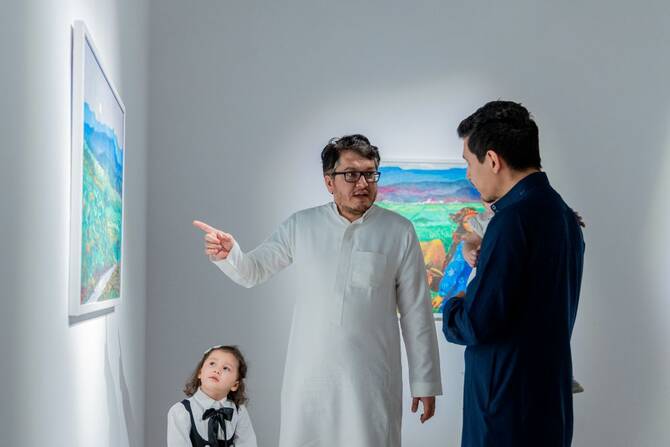
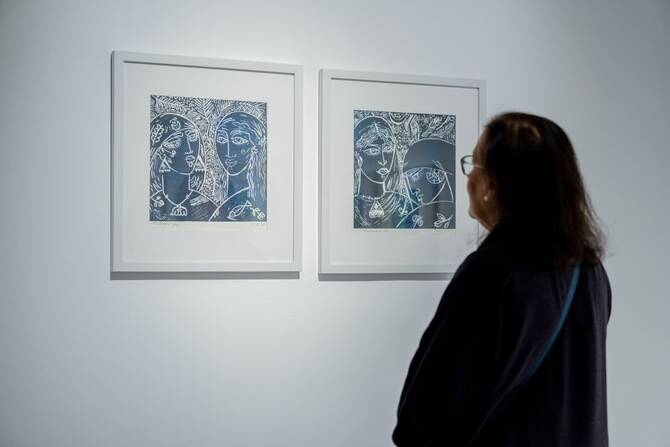

JEDDAH: Hafez Gallery in Jeddah is running an exhibition called Between Mist and Meridian, exploring memory, identity and belonging through three distinct artistic practices shaped across generations and geographies.
The exhibit features works by Hakim Al-Akel, the late Abdelsattar Al-Mussa and Thuraya Al-Baqsami. It runs from June 30 to Aug. 1 at the gallery’s Al-Rawdah space.
Gallery founder Qaswra Hafez told Arab News: “Our mission is to champion modern and contemporary Arab art by presenting exhibitions that deepen its discourse and celebrate its enduring relevance.
“The exhibition brings together three pioneering artists whose shared academic foundation in Moscow gave rise to distinct visual languages shaped by memory, place and lived experience,” he said.
Hafez spoke about how the exhibition highlights the way that personal histories become part of broader cultural narratives, adding that the works together “offer a dialogue across generations on identity, belonging and the lasting power of memory.”
For Kuwaiti artist Al-Baqsami, the female figure remains central to her artistic and literary practice, not only as a subject, but also as a symbol of layered meaning.
“In my artwork, woman is the main subject because I believe women carry many symbols such as maternity, land, love and challenge,” she said.
“All my writing and paintings are about women, human rights and freedom of expression.”
She added that her work is deeply rooted in both personal conviction and cultural memory.
“I was always a feminist. I did a lot of artwork about women’s rights in society, politics and life.
“It is not only about Gulf folklore; it is about tradition in our life, and the memories I carry from childhood in Kuwait.”
Al-Baqsami described herself as a storyteller across mediums, adding that she has long expressed narratives through writing, color and subject matter in her artwork, transforming stories into visual form.
Yemeni artist Al-Akel told Arab News that an exhibition “is a space where souls breathe and eras converge.”
He added that his relationship with place has evolved over time, saying that “in the beginning, I used to paint the place, and now the place paints me,” as his work moved from documenting landscapes to expressing their deeper essence.
Reflecting on nature, he said: “Observation is the body, and myth is the soul. A painting cannot live without one.” He highlighted the role of observation alongside memory, folklore and imagination in shaping his visual language.
Al-Akel also described the exhibition as a form of intergenerational dialogue: “Art is a single flowing river, and though the faces on its banks change, the water continues to carry the same existential questions.” The exchange between artists reflects an ongoing conversation across generations, he added.
Al-Mussa’s work is represented through black-and-white pieces from the 1980s that preserve the quiet dignity of everyday life, offering an archival layer to the exhibition’s broader reflection on memory and identity.


