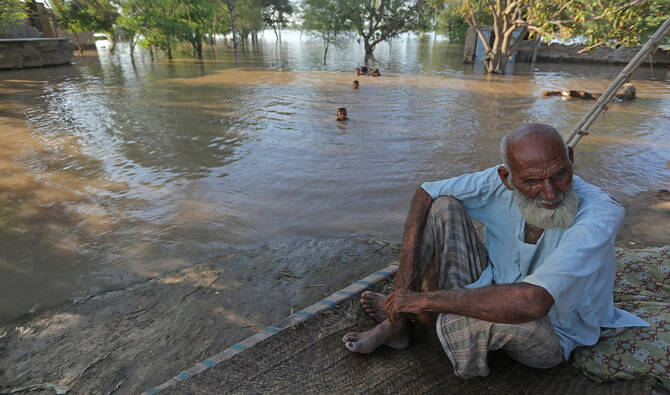

ISLAMABAD: Pakistan is bracing for another spell of heavy monsoon rainfall this week after downpours killed 18 people since late June, with forecasters warning on Monday that river flows would rise across much of the country’s north in the coming days.
The annual monsoon season, which runs from June to September, regularly triggers flash floods, landslides and house collapses, particularly in Pakistan’s mountainous north and low-lying river plains. The National Disaster Management Authority (NDMA) said 18 people had been killed and 49 injured in rain-related incidents nationwide since June 26, while 100 houses were damaged and 163 livestock perished.
“Scattered rain-wind/thunderstorm with isolated heavy falls are expected over the upper catchments of all the major rivers, Islamabad, Khyber Pakhtunkhwa, Kashmir, Gilgit Baltistan, North Punjab and North Balochistan from 07th to 08th July and 11th to 13th July,” the Pakistan Meteorological Department’s Flood Forecasting Division said in its latest flood bulletin.
“Flows are expected to increase in all the major rivers during the above mentioned period,” it added.
The latest warning comes as Pakistan remains one of the countries most vulnerable to climate change despite contributing less than one percent of global greenhouse gas emissions. Catastrophic floods in 2022 killed more than 1,700 people, affected 33 million and caused over $30 billion in economic losses and damage, according to the government and the World Bank.
Floods last year also killed over 1,000 people and caused massive damage to infrastructure and agricultural lands.
Scientists say climate change is increasing the frequency and intensity of extreme weather events across South Asia, making accurate forecasting and early warning systems increasingly important.
Separately, Pakistan is investing Rs1.6 billion ($5.7 million) to strengthen weather forecasting and disaster preparedness, according to the state-run Associated Press of Pakistan (APP).
“Pakistan plans to strengthen its weather forecasting, disaster preparedness and climate resilience capabilities through a series of projects and policy initiatives,” APP reported on Sunday.
According to the report, Rs1 billion ($3.6 million) has been allocated to modernize hydrometeorological services to improve forecasting accuracy and strengthen climate data systems. Funding has also been earmarked for a weather surveillance radar in Multan, another radar project in Sukkur, and the National Center for Rainfall Enhancement to support water security, climate adaptation and agricultural productivity.
APP said the climate change ministry will also receive Rs2.5 billion ($8.9 million) for forestry, biodiversity conservation, afforestation and ecosystem restoration. It added that a National Forest and Tree Cover Assessment using remote sensing and machine learning would be carried out to improve forest monitoring and restoration planning.