
JEDDAH: The Kingdom’s sweeping reforms have transformed the nation’s scarcity challenges into development opportunities, with experts and officials at Saudi Water Week highlighting advances in sustainability, digital transformation and international cooperation.
The fourth day of the inaugural event, which began on June 28, showcased the Kingdom’s progress in modernizing its water sector under Saudi Vision 2030 and its growing role in shaping regional and international policies, the Saudi Press Agency reported recently.
From scarcity to development
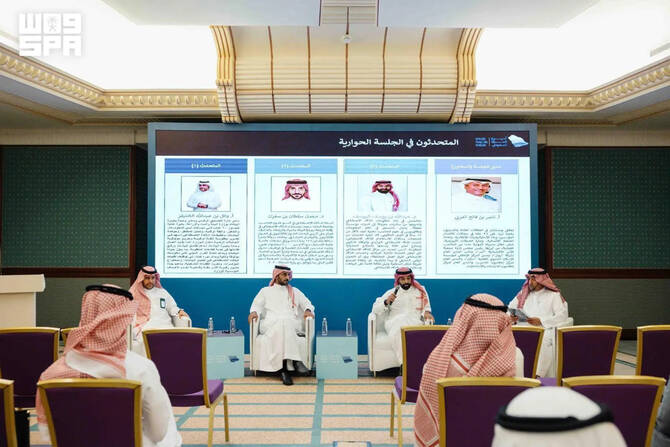
In a panel discussion titled “From Water to Food: Turning Scarcity into Security in Drylands,” experts said Saudi Arabia’s policies and reforms have established an integrated system that strengthened natural-resource sustainability and boosted agricultural and food production.


Experts emphasized during a panel discussion at Saudi Water Week 2026 that efficient water-resource management is a cornerstone of food security. (SPA photos)
The panelists emphasized that efficient resource management was a cornerstone of food security and highlighted the Kingdom’s experience in balancing sustainable water management with enhanced agricultural output in arid environments.
Participants also discussed the experience of the Arab Center for the Studies of Arid Zones and Dry Lands and the Kingdom’s strategic transformation in water management in line with the objectives of the National Agriculture Strategy 2034.
The discussions built on reforms outlined at the opening of Saudi Water Week. Minister of Environment, Water and Agriculture Abdulrahman AlFadley had said Saudi Arabia has adopted a gradual and integrated approach that extended beyond infrastructure expansion to include institutional reform, governance, regulation, financing and localization of expertise.

Prince Saud bin Mishaal bin Abdulaziz, deputy governor of Makkah region, and Minister of Environment, Water and Agriculture Abdulrahman Alfadley (R) attending the opening ceremony of the inaugural Saudi Water Week on June 28, 2026. (SPA photo)
According to the minister, non-renewable groundwater consumption fell from around 21 billion cubic meters in 2016 to nearly 11 billion cubic meters in 2025, while desalinated water production capacity increased from 9 million cubic meters per day to 16 million cubic meters per day over the same period.
Access to safe drinking water has reached 100 percent of the population, while approximately 85 percent was covered by networks, with strategic storage capacity increasing by more than 125 percent.
Digital transformation and AI
Digital transformation emerged as another key theme during the event, with Saudi Arabia stressing that technology and artificial intelligence have become essential tools for enhancing water security, improving resource management and supporting sustainability goals.
During a panel discussion titled “Digital Transformation in the Water Sector: From Data to Decision,” the ministry outlined its vision for integrated data platforms and AI applications to build a more efficient and sustainable sector.
Participants said the real challenge was no longer the availability of data but the ability to collect, analyze and transform it into actionable decisions.
The session also examined the role of technology in water security, the impact of data centers on consumption, and the use of AI in forecasting, detection and improving operational efficiency.

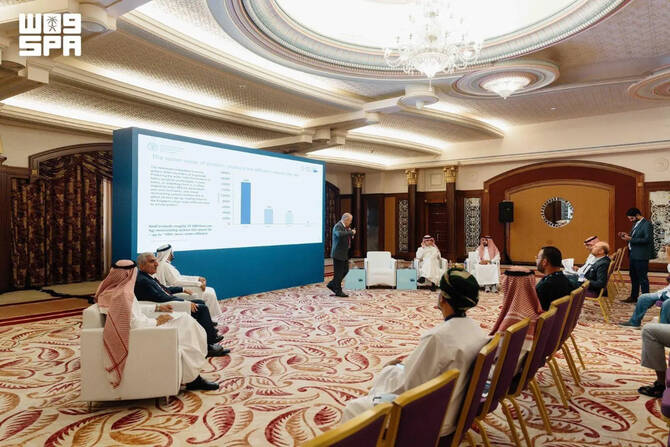
The session on Wednesday highlighted the Agricultural Development Fund’s efforts to promote water sustainability. (SPA photo)
Participants noted that international experience shows that every Saudi riyal invested in digitalization could generate a fivefold return through reduced water losses and lower operating costs.
Investment in sustainable resources
The Agricultural Development Fund reaffirmed its commitment to investing in sustainable water resources and promoting modern agricultural technologies.
The ADF’s CEO Munir Al-Sahli said the fund encourages agricultural projects to adopt technologies that optimize water and energy use and improve irrigation efficiency.
He said financing provided through the Modern Agricultural Technologies program reached approximately SR8.7 billion ($2.3 billion) between its launch in 2018 and 2025, representing around 30 percent of the fund’s total financing of about SR29 billion.
Al-Sahli also underscored the importance of partnerships with government entities, the private sector and research institutions to accelerate the adoption of modern agricultural practices.
International recognition
The UN Secretary-General’s Special Envoy on Water Retno Marsudi said the objectives of Saudi Water Week come at a critical time as global risks continue to rise because of population growth and economic development.
Speaking at the event’s opening ceremony, Marsudi said the focus on innovation and digital transformation reflects the urgent need to harness modern technologies to improve water management and strengthen resilience.

Retno Marsudi, the UN secretary-general’s special envoy on water, speaks at the event's opening ceremony on June 28, 2026. (SPA)
She stressed that progress in the sector was essential to achieving the UN Sustainable Development Goals, noting that water was fundamental to food production, energy generation, urban development and environmental protection.
Marsudi said the priorities of Saudi Water Week are closely aligned with the global water agenda and called for translating shared understanding into practical action through partnerships, investment and knowledge sharing.
Platform for global cooperation
The inaugural Saudi Water Week, which runs until July 2 in Jeddah, has brought together policymakers, experts, government agencies, private-sector representatives and international organizations.

Attending the event are policymakers, experts, specialists, representatives of regional and international organizations, government agencies, private-sector representatives, and research institutions. (SPA photo)
The event features the 7th Arab Water Forum and the second Stakeholders’ Consultation Meeting of the 11th World Water Forum, alongside an exhibition showcasing the latest technologies and smart solutions in resource management, desalination, reuse and digitalization.
Saudi Arabia is positioning the event as a national and international platform to foster innovation, promote investment and partnerships, and strengthen cooperation on water security and sustainability issues in the Arab region and beyond.