


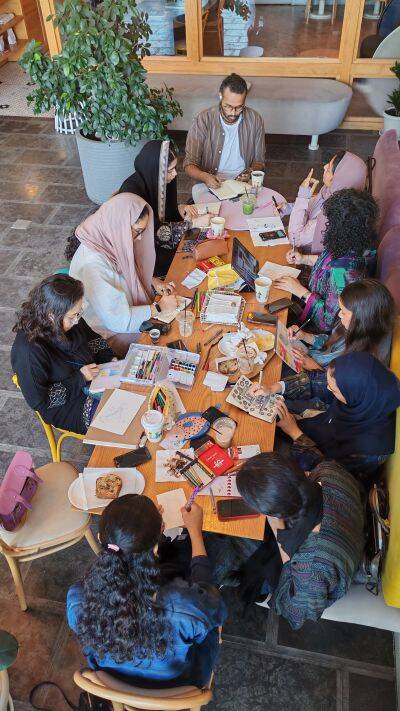
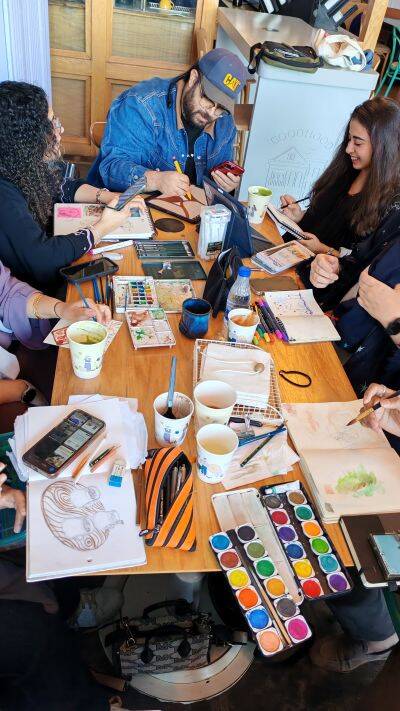

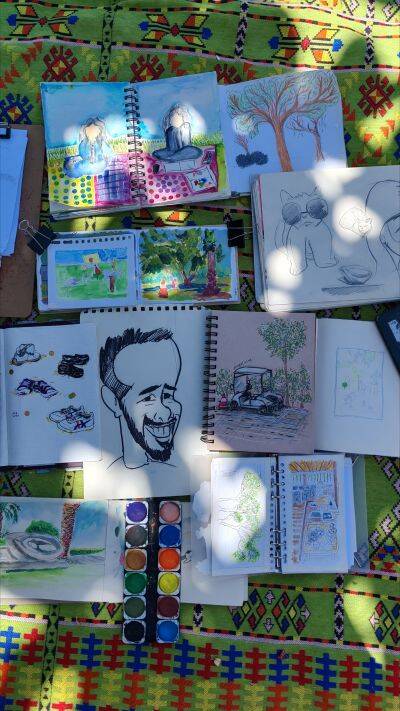
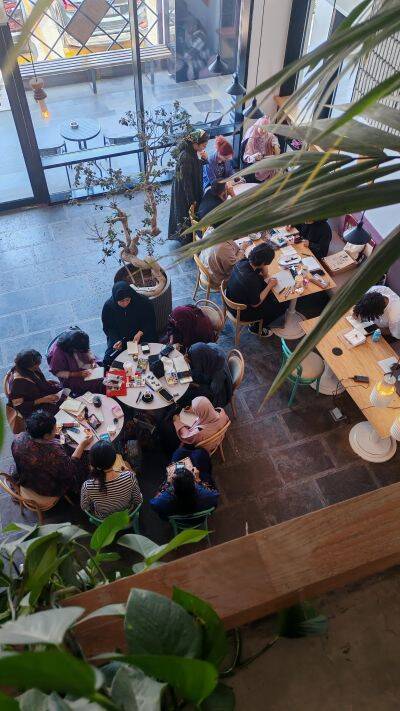
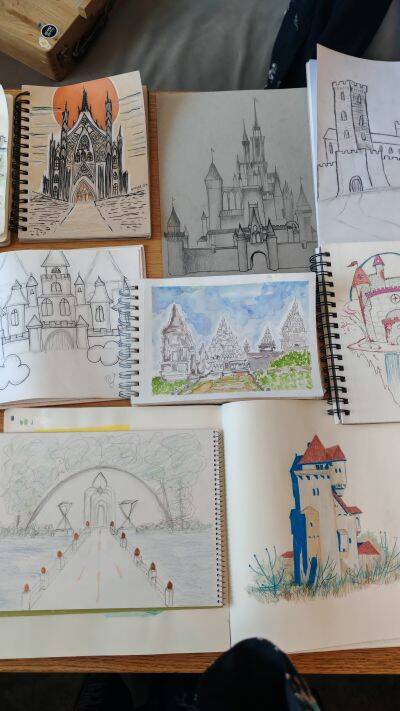

JEDDAH: Every Saturday, a group of creatives and people meet in cafes to sketch together. There is no fee or instructor, simply the desire to fill the page and enjoy a moment of peace and community.
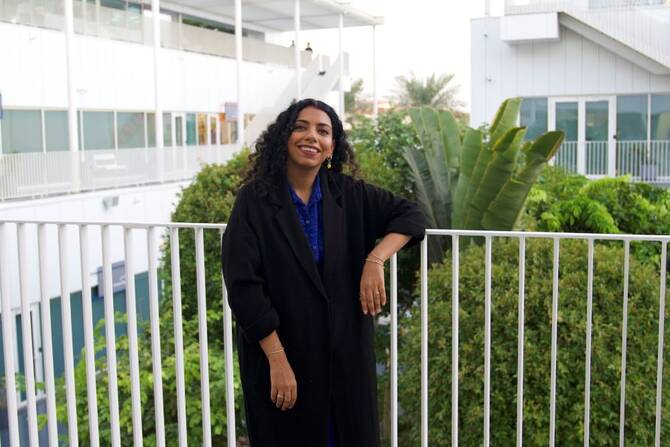
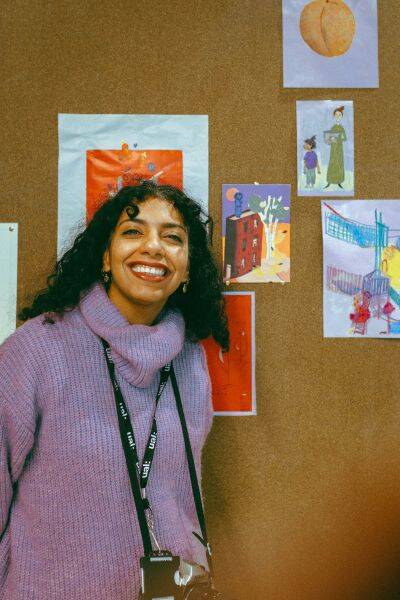
Known as the Jeddah Sketching Club, they are led by Omamah Ashmeel, an independent illustrator and visual artist who has spent more than a decade chasing artistic education across continents.
After completing a bachelor’s degree in graphic design in Jeddah, she studied visual development in Italy for two years, continued her education in the US and later earned a master’s degree in illustration from a UK university.
Her portfolio includes illustrating children’s books and projects for clients in fashion, jewelry and cultural institutions. Describing her approach to art, she told Arab News: “I want to inspire joy. I want my work to reflect that innocence, that pure feeling.”
In the summer of 2023 while sketching alone at a cafe, Ashmeel decided to invite others to join her art activity through her personal social media account.
“I expected one friend, maybe two. But every week, more people joined,” she said. “It really started because I was feeling lonely as an artist. I wanted to connect with a creative community.”
Sketching, rather than other traditional art forms, became the club’s format mainly for practical reasons as it “doesn’t require much.”
“There’s no mess. We can go to a cafe, the sidewalk, anywhere in the city, and it wouldn’t disturb the space itself,” she said.
Interior designer Alhanouf Aladali, 24, said that the experience has changed how she approaches creating art: “I’ve learned to let go of perfection, embrace the process, connect more openly with others, and experiment with new styles.”
“Creativity demands playfulness,” added Alia Makki, 45, a member since the beginning. “You can’t be brave with the empty page if you’re not ready to play around and make mistakes. This mindset — to not worry about the small mistakes — has bled into the rest of my worldview, in the way I handle myself and others.”
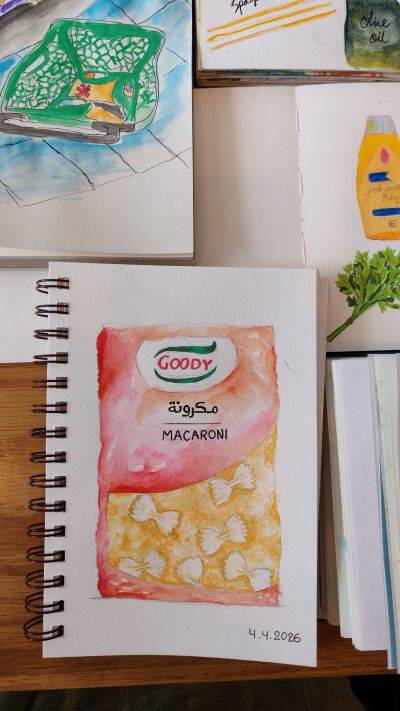
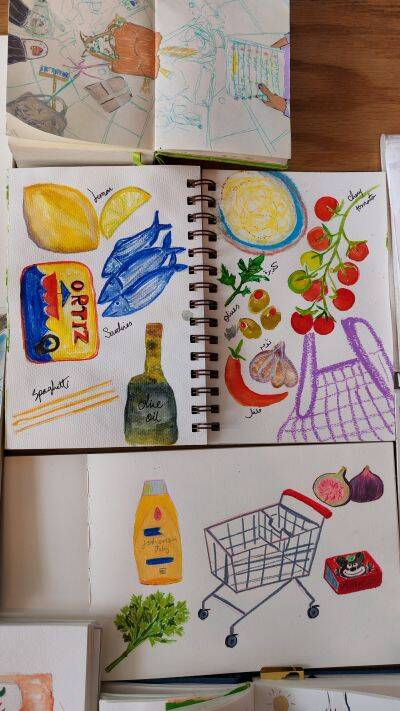
The club’s sessions are built around rotating prompts by Ashmeel; organic subjects such as plants, structured subjects and open-ended creative prompts. In one session, participants designed their own version of a canned food label or a juice box rather than copying an existing one. Most recent themes include FIFA World Cup and the Hajj pilgrimage.
“Every theme expands the way I think and see things creatively,” said member Tala, a 22-year-old student in Jeddah. “Art feels more honest when it’s not controlled.”
The club has grown through word of mouth and its Instagram account, drawing both trained artists and people with no artistic background.
“It’s not a class, this is a sketching community. You do your own sketches and develop your skills on your own. It doesn’t have to be a masterpiece,” Ashmeel said. “Two men joined us recently and said: ‘I cannot draw anything even if my life depends on it.’ But they sketched really nicely, actually.”
For 29-year-old Raghad, the sessions are “therapeutic.”
“It’s also a way to bring back an old passion that has died,” she said. “Being part of the club brings back the excitement … it feels like a welcoming space for creativity.”
While the low barrier to entry is the engine of the club’s growth, it also rebuts a particular modern condition; the slow drift toward “bed-rotting weekends” and endless scrolling, where rest and connection both happen through a phone screen.
“It’s important we disconnect from our digital world,” the club founder said. “These are things that remind us that we are not just an algorithm, that we don’t have to do things to monetize them or make money.”
To, Maryam Nawawi, 28, sketching alongside others feels “so human.”
“Sketching club for me is about doing art free of judgment … seeing different kind of artists experimenting with art makes it very inspiring,” she said, adding that “the experience of art for the artist is what matters the most, not so much the outcome.”
A one or two-hour sketching session offers members a few hours away from work, family obligations or a phone, without having to go anywhere far. It is the chance to sit across from a stranger or a friend and fill the page without pressure.
Mohammed Abdo, 28, said: “The beautiful energy recharges me for a whole week. I love the experiences we have together. I’ve also discovered different things about myself through interacting with this group, and I’m happy to be developing more.”
Ashmeel, who runs the club on her own, said that the broader creative community in the city often discusses a shared lack of dedicated studio and gathering spaces.
“There was something I wanted, and I felt a lack of it, so I created it. For me (the challenge) was a matter of courage, not limitations,” she said.
She added that she sees particular value in women building communities of their own: “It’s not just nice, it’s a necessity that we connect, that we collaborate, that we build spaces together.”
Soha Banjar, a visual artist and music business student, 35, said that she looks forward to the club’s Saturday morning ritual. “That sense of belonging and to be part of something while doing something we love and navigating life together as artists keeps bringing me back.”
The club recently collaborated with Ward Magazine, whose founder Khaled Al-Qahtani proposed the idea to sketch different Jeddah neighborhoods over several sessions. Ashmeel said that the criteria for choosing each location is that it be a walkable, welcoming area.
Layan Badri, an industrial engineer, said “art and curiosity about the city” compelled her join the Sketch and Walk activity in April.
“I’d also like to give workshops and collaborate with other members of the club and other creators,” Ashmeel said, noting what the future might have in store for the community.
The Jeddah Sketching Club continues to meet most Saturdays, with sessions open to anyone who wants to attend.


