


RIYADH: As the clock ticked down on Saudi Arabia’s 0-0 draw with Cabo Verde, and on their 2026 World Cup campaign, the online backlash was in full swing.
A toothless display against the first-time participants meant the national team would be packing and heading home at the end of the tournament’s group stage for the third time in a row, following similar exits in 2018 in Russia and 2022 in Qatar.
This summer marked the Kingdom’s seventh World Cup appearance. Apart from its first, in 1994, also in the US, Saudi Arabia has failed to advance to the knockout stage every time.
The fallout and anger among supporters and media figures are set to be greater this time for many reasons, including heightened expectations, the growing profile of Saudi football globally, and what many see as a chronic failure to learn from past mistakes.

Abdulelah Al-Amri #4 and Ali Lajami #3 of Saudi Arabia react after the 0-0 draw during the FIFA World Cup 2026 Group H match between Cabo Verde and Saudi Arabia at Houston Stadium on June 26, 2026 in Houston, Texas. (Getty Images via AFP)

Abdulelah Al-Amri #4 and Ali Lajami #3 of Saudi Arabia react after the 0-0 draw during the FIFA World Cup 2026 Group H match between Cabo Verde and Saudi Arabia at Houston Stadium on June 26, 2026 in Houston, Texas. (Getty Images via AFP)
At Qatar 2022, Saudi Arabia kicked off their campaign with a historic 2-1 win over eventual champions Argentina, leaving the great Lionel Messi scratching his beard in bewilderment as the rest of the world hailed the Green Falcons and coach Herve Renard.
Saudi Arabia then lost to Poland and Mexico and exited the tournament, but the players were still celebrated for a result that secured their place in national soccer folklore. For many, it remains one of the biggest shocks in World Cup history.
This summer brought no such highlight. Higher expectations mean greater scrutiny and the Saudi Arabian Football Federation, coach Georgios Donis, and the players collectively failed to deliver.
The 1-1 draw with two-time world champion Uruguay hinted at promise, but it was never fulfilled.
A devastating 4-0 loss to European champions Spain saw a feeble display from the team.
Even then, the nuances of Saudi Arabia’s group, as well as the format of the newly expanded 48-team tournament, meant the Green Falcons still had a significant chance to advance if they beat Cabo Verde on Friday, at least on paper the easiest of their three matches.
Instead, Saudi Arabia produced a flat display that lacked urgency, quality and, worst of all for many angry fans, passion.
Prince Abdul Rahman bin Musaid, a former Al-Hilal president, posted his disappointed on X, where he has 6.7 million followers. “Scoring just once against Uruguay was acceptable, but everything else was very poor,” he wrote.
“It was expected that we would lose heavily to Spain, but against Cabo Verde — a team that has been excellent in all of its matches, by the way — and in the first World Cup appearance, to fail to create any real threat from an organized chance that reflects a clear tactic or approach used by the team, that is the height of frustration.
“We escaped defeat today.”
He also wrote: “This is our true level, and unfortunately, this is the maximum potential of the current players. It could not have been much better than it was, and likewise it could not have been much worse.
“I hope a new national team is formed starting now, one that can deliver a performance worthy of 2034,” he added. “We do not expect this current team to achieve anything in the upcoming Asian Cup or even the Gulf Cup.”
On the pitch, once again, the old problem of lack of goal threat — or anyone who can provide genuine danger in attack — reared its head.
Saudi Arabia’s last two World Cup wins, against Egypt in 2018 and Argentina four years ago, were achieved through winning goals from Salem Al-Dawsari.
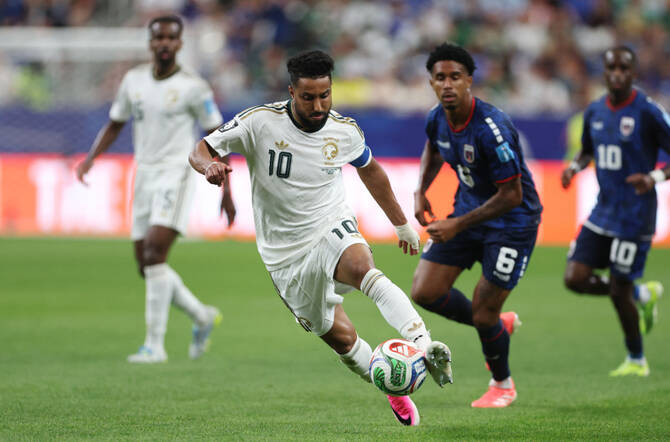
It says something that going into this tournament, the 34-year-old was still tasked with carrying the team’s attack with seemingly little help from any other player capable of sharing the goalscoring or creative burden.
The captain’s withdrawal against Cabo Verde after 66 minutes left the team with little inspiration or hope of winning the match.
Saudi coach and television pundit Ibrahim Al-Angari said that the problem “was far bigger than the result.”
In a post to his 33,500 followers on X, Al-Angari spelled out the key reasons: “There is no clinical striker who can convert chances, compete with defenders and hold up the ball; there is clear weakness in the full-backs and wide areas, so most attacking attempts rely more on collective effort than individual quality.
“There are too many individual errors in passing and positioning; there is a clear physical drop-off, especially in the final 15 minutes, despite the team’s need to score; the bench did not provide solutions, and the players in general did not make the difference; Coach (Georgios) Donis did not succeed in managing the matches against Uruguay and Spain in the required way.
“In conclusion,” Al-Angari wrote, “I would say the problem is not today’s match, but an accumulation of issues starting with player development, squad selection, technical decisions and stability with a staff that has not added enough.
“If these issues are not addressed, the same results will be repeated no matter how the tournament or the opponent changes,” he added. “Better luck to our national team in the upcoming tournaments.”
His remarks raise the issue of a lack of development of a sufficient number of players with the quality and experience required to take on and beat not just some of the world’s best teams, but also those Saudi Arabia is expected to beat routinely.
There are many reasons for this, but it is hardly ironic that the very thing that has transformed the Saudi Pro League into a global attraction — the influx of international stars from around the world — is also responsible for the lack of production of top-class players from the Kingdom.
Quite simply, young Saudi talents are not being given the opportunities, career pathways and development needed to succeed at the highest level. That helps explain why no top-class forward have emerged in the past decade, and the overreliance on Salem Al-Dawsari.

Pico Lopes #4 of Cabo Verde competes for the ball against Mohamed Kanno #23 of Saudi Arabia during the FIFA World Cup 2026 Group H match between Cabo Verde and Saudi Arabia at Houston Stadium on June 26, 2026 in Houston, Texas. (Getty Images via AFP)
Such issues inevitably lead back to the game’s authorities across the Kingdom, whether at club or federation level. The fact that Donis was tasked with taking over from Herve Renard just weeks before the start of the tournament indicates a lack of stability and long-term planning. It showed on the pitch and, in many ways, the Greek coach — who admittedly failed to inspire his team — remains the least of the problems.
Saudi journalist and media personality Tariq Al-Nofal was blunt in his assessment.
“In my view, and with full respect to everyone, it’s time for change,” he wrote to his nearly 1 million followers on X.
“That means changing the sports leadership in the football federation and everyone involved in football,” he added. “Renewal is part of life. We appreciate your efforts and hard work over the past years, but, simply put, you have not succeeded.”
Meanwhile, fans vented their frustration in more outspoken terms, directing their anger at the federation, team and coach.
Award-winning sports journalist Battal Al-Qoos was scathing in his criticism of the Saudi Arabian Football Federation.
“For seven years, the federation board has managed the national teams from one failure to another,” he wrote on X.
“Did it make the senior national team competitive? No. Did it produce competitive youth teams? No. Did it support reliable national coaches? No. Did it make decisions backed by the majority? No. Did it make proper use of the leadership’s strong support to achieve success? No.
“A federation that has failed at every turn. What next?” he added. “There is no dignity left in this. Resign, resign. Enough.”
Saudi Arabia is set to host the FIFA World Cup in 2034, but more immediately, it will host the AFC Asian Cup for the first time next year. Saudi fans will certainly demand more passion and a first continental title since 1996.
What is not certain is how Saudi football authorities can overhaul the national team by then.


