


HOUSTON: Before the team buses had arrived at the NRG Stadium on Friday night, local media had billed Houston as Saudi Arabia’s “home away from home,” a city with deep economic, educational and cultural ties to the Kingdom.
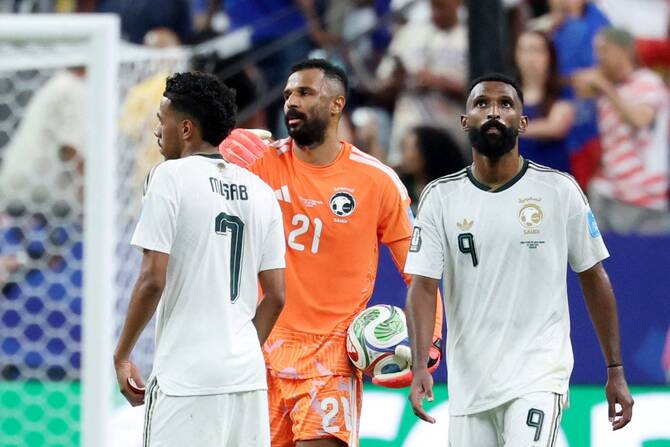
Yet by full-time, as the white-shirted Saudis lay prostrate after crashing out of the World Cup at the group stage for a sixth successive time, there was no doubting where the neutrals’ sympathies lay.
World Cup debutants Cape Verde knew they might need only a draw to prolong their remarkable journey and progress to the Round of 32.
With Uruguay failing to get anything against Spain, the third smallest country in Africa — with a 40-year-old goalkeeper and a defender who was called up after receiving a direct message on LinkedIn — secured a place in the knock-out stages. Next they face reigning champions Argentina led by Lionel Messi. The tiny Atlantic nation has become one of the most captivating stories of the summer.
In direct comparison to the Cape Verde players who danced through the media mixed zone with sunglasses, cowboy hats and blaring music, for Saudi’s sullen troupe this was an evening to banish to the back of their minds. Mohammed Al-Shamat, who only entered the field with 25 minutes remaining, was the player put in front of reporters for the team’s mandatory media commitments. Nawaf Boushal spoke, too, but the vast majority of the team walked past reporters with heads bowed, whispering apologies.
“I can’t describe how disappointed and saddened we are,” said Al-Shamat, 23, before delivering a passionate defense of his teammates after a match in which they showed little ambition and could have easily lost had their opponents been more clinical in front of goal. “There are shortcomings we have to learn from and improve. I know you’re tired of promises, I know you’re tired of hearing the same things, but that’s football. Success doesn’t come overnight. I’m not trying to make excuses for failing. I’m ready to be held accountable and face the criticism because I’m a player who’s out there doing everything I can to make the Saudi people happy.”
He continued: “I’m one of you. The other players are one of you too. Every one of them cares deeply about this country and wants to give everything for it, so please don’t say Saudi players don’t care. They do. They want to give everything they have. You have every right to be disappointed — from the youngest fan to the oldest — and we respect that. Inshallah, we can make it up to you.”
It was not supposed to be like this. The Houston Chronicle had detailed Saudi’s links to the city in a pre-match op-ed, outlining how Khalid Al-Falih, the former president of Saudi Aramco and longtime Saudi minister, attained his BA at Texas A&M, how Prince Sultan bin Salman Al-Saud trained at Johnson Space Center before becoming the first Muslim in space, and how Saudi’s national oil company is a significant part of the city’s economic and cultural landscape, with subsidiary refineries and corporate offices in Houston as well as funding the construction of the city’s FIFA Fan Festival.
Draped in Saudi green, carrying Palestine flags and traditional red keffiyeh, thousands of Saudi supporters had filed into the NRG Stadium. Yet if there were any doubt as to who the majority of the 68,278 fans in the Texas dusk were rooting for, it took only seven minutes of action as huge jeers rang throughout the arena when Cape Verde’s Wagner Pina was booked despite leaving Saudi captain Salem Al-Dawsari sprawled on the grass clutching his face. And the biggest roar of the first half was reserved for a few minutes before the break when the Blue Sharks’ goalkeeper Vozinha comfortably held Mohamed Kanno’s looping header.
Forty-year-old Vozinha has proved a global sensation since Cape Verde’s stalemate with Spain. Giant cardboard cut-outs of the goalkeeper’s face could be spotted dotted around the stadium, alongside signs reading “Can I have your jersey, Vozinha?” and “We love Vozinha!” One young boy proudly posed for photos in the concourse dressed in the goalkeeper’s yellow shirt — complete with name number and oversized gloves. “He just loves that guy,” said the boy’s mum, smiling bemusedly.
“We knew it wouldn’t be easy because Saudi Arabia are a strong team and have much more experience than us at this level,” said Vozinha, who had only three saves to make in 90 minutes. “We had more of the ball, more chances and wanted to score, but couldn’t do it, so it’s gratifying to progress, but we wanted to win. ”
Vozinha’s goalkeeping coach, Helder Cruz, said that the fans — some wearing sharkhead masks, others using their hands to create dorsal fins — gave him huge satisfaction: “Cape Verde is 10 little islands, so to see our supporters create so much more color and noise against Saudi Arabia, a country so much bigger, gives us enormous satisfaction. The real satisfaction, though, is that we played well again and represented African football with dignity. Now we await our next opponent, the world champions, and hope for another good game.”
After capturing hearts in Saudi Arabia’s “home away from home,” Cape Verde now face Argentina on July 3 in Messi’s adopted hometown of Miami, where they will be hoping to win over the neutrals once again.


