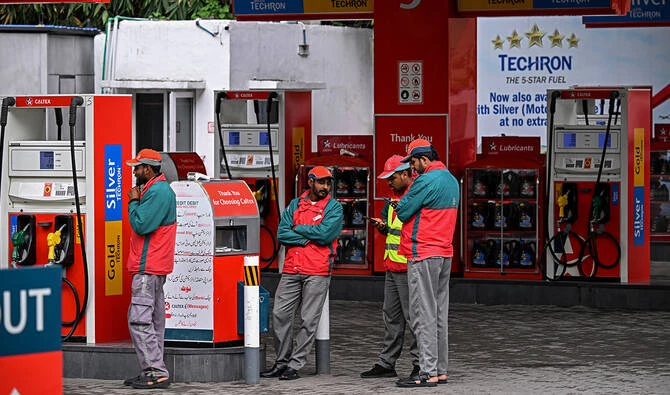
- Pakistan hiked fuel prices multiple times when US-Iran war began in February
- Fuel prices are closely watched in Pakistan as they affect transport costs, inflation
ISLAMABAD: Pakistan’s Petroleum Minister Ali Pervaiz Malik said on Sunday that the global prices of refined fuel are expected to drop further, vowing that the government remains committed to passing on the benefits of lower energy prices to consumers when that happens.
Pakistan’s government increased prices of petroleum products multiple times since February, when the US-Iran war disrupted energy supplies and shipping through the Strait of Hormuz trade artery to drive global oil prices higher.
Islamabad slashed fuel prices by up to Rs74 per liter earlier this month after a peace agreement between the United States and Iran helped ease pressure on global oil markets. However, consumers still await further relief as the price of Brent crude drops to $72 per barrel worldwide.
Malik noted that the price of crude oil has reduced sharply worldwide, prompting the government to slash petrol and diesel prices earlier this month. However, he said Pakistan will pass on more benefits of reduction in fuel prices when the global prices of refined petroleum products also decrease worldwide.
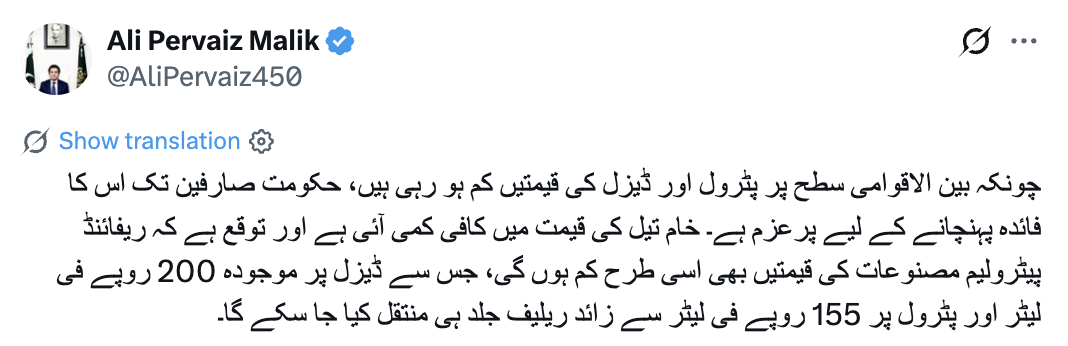
“Crude oil prices have fallen significantly, and refined petroleum product prices are also expected to decline accordingly, enabling relief beyond the current reduction of more than Rs155 per liter on petrol and Rs200 per liter on diesel to be passed on soon,” Malik wrote on X.
In an earlier post on Saturday, Malik said petrol prices in Pakistan have been determined on the basis of Platts rates for decades.
Platts benchmark prices are widely used in the fuel industry as a reference point for pricing physical and financial contracts.
The minister said the price of petrol on Feb. 27, before the US-Iran war began, was $76 per barrel which increased to $136 per barrel by Apr. 2. He said this price again declined to $92 per barrel on Jun. 27.
Likewise, Malik said the price of diesel on Feb. 27 was $89 per barrel, which increased to $284 per barrel on Apr. 2, and then came down to $105 per barrel on Jun. 26.
“As prices adjust in line with crude oil, which is now at pre-war levels, benefit will be transferred to consumers,” he said.
Fuel prices are closely watched in Pakistan as they feed directly into transport costs, electricity generation and inflation, influencing broader consumer prices.