

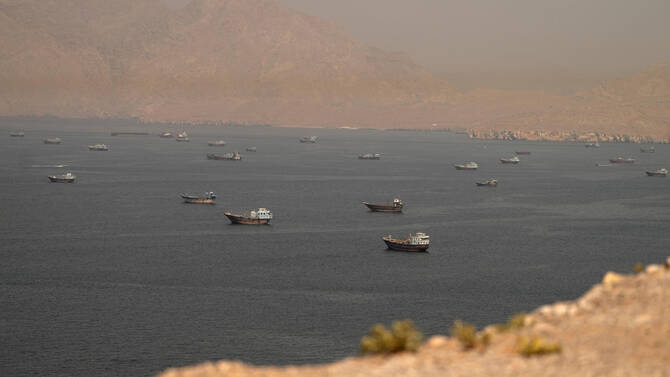

President Donald Trump on Wednesday said that Iran has informed the US that Tehran is not imposing or receiving tolls or any charges are being imposed or on ships traveling on the Strait of Hormuz.
“Iran has informed the U.S. that … there are “NO TOLLS, NO INSURANCE COSTS, & NO OTHER CHARGES OF ANY KIND BEING SOUGHT OR RECEIVED BY IRAN ON SHIPS TRAVELING THE STRAIT OF HORMUZ,” posted on his TruthSocial account, without specifying whether those assurances would remain in place after the 60-day negotiating period.
“If this is false information, negotiations would end, immediately! Additionally, no money has been given to Iran, or released from their money to them,” he added.
Oman on Wednesday said it would keep the Strait of Hormuz open to shipping without imposing any tolls and had designated two temporary routes north and south of the existing shipping lane to facilitate the safe passage of vessels departing the region.
In coordination with the International Maritime Organization, Oman established temporary maritime corridors to help ships leave the area safely amid heightened security risks.
The Strait of Hormuz, a vital route for roughly a fifth of global oil and liquefied natural gas supplies before the war, has been heavily disrupted since the United States and Israel launched a war against Iran on February 28, curbing commercial shipping and rattling global energy markets.
In a notice to mariners, Oman said the existing Traffic Separation Scheme in the strategic waterway was currently unsafe for use and that vessels departing through the strait could instead use temporary routes located to the north and south of the existing shipping lanes.
The scheme, adopted by the United Nations’ shipping agency in 1968, established routing lanes through Iranian and Omani waters in the strait.
The Gulf Arab state said the measures reflected its responsibilities toward the strait, its importance to the global economy and its commitment to international law and freedom of navigation, citing understandings reached between the United States and Iran.
Oman said navigational safety remained the overriding priority and that a gradual, controlled movement of vessel traffic was required because of an elevated risk of collisions.
Under a phased plan developed by the IMO in coordination with Omani authorities, vessels will be grouped and contacted individually with instructions on when they may depart and which route they should follow.
Ships will be directed to a designated waiting area in international waters before being cleared to proceed. Vessels using Oman’s eastbound route will be required to maintain communications with coastal authorities and comply with all navigational instructions.
Oman said shipowners and masters remained responsible for conducting independent risk assessments before voyages.
Vessels were instructed to keep their Automatic Identification System activated during transit and to report any navigational hazards to the Oman Maritime Security Center. Oman’s statement said that no tolls would be imposed on vessels transiting the Strait of Hormuz, in line with the outcome of recent talks between the United States and Iran.
Iran and Oman began discussions on the future administration of navigation and maritime services in the waterway on Tuesday.
While the interim US-Iran agreement provides for commercial vessels to transit without charge for 60 days, the talks are expected to address longer-term arrangements, including any costs associated with maritime services after that period ends.
Ships start sailing through Hormuz under UN evacuation scheme
Ships have begun sailing through the Strait of Hormuz under a new scheme by the UN’s shipping agency to evacuate vessels trapped there by the conflict, a spokesperson said on Wednesday.
The initiative, which has taken months to conclude, will enable hundreds of ships with some 11,000 seafarers stranded in the Gulf to sail through Hormuz, the International Maritime Organization said on Tuesday.
“Ships have already begun to pass under the plan,” an IMO spokesperson said on Wednesday, declining to provide any details of the vessels that had crossed.
At least two dry bulk ships and one cargo ship have sailed through Hormuz under the scheme in the past 12 hours, LSEG ship tracking data showed on Wednesday.
At least 35 other commercial ships, mainly dry bulk, cargo and container vessels were preparing to sail through the strait, according to LSEG and MarineTraffic ship tracking data based on Reuters analysis of ship movements.
Those vessels are smaller commercial ships including five smaller oil tankers, coastal ships and tugs, according to analysis of the vessels waiting.
Under the scheme, which the IMO said was able to begin after the US and Iran reached a ceasefire framework, vessels will be able to use two tracks to sail out — a northern route via Iranian waters and a southern route via “the Sultanate of Oman/United States-coordinated waters.”
“Vessels should wait for instructions before proceeding,” the IMO said in a note on the scheme issued on Wednesday.
“Crowding the waiting area will only result in the need to pause further notifications for the safety of navigation.”
— with AFP


