

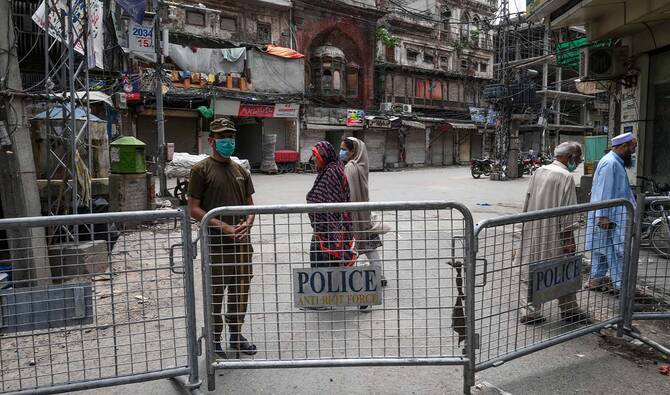

ISLAMABAD: The speaker of Pakistan’s Punjab Assembly on Sunday halted the passage of a controversial government bill that tends to grant sweeping powers to authorities to monitor and take preventive action against “habitual offenders” and individuals accused of “anti-social” conduct.
The Punjab Control of Habitual Offenders and Anti-Social Behavior Bill, 2026 seeks to replace the century-old Restriction of Habitual Offenders (Punjab) Act, 1918 and the Punjab Control of Goondas Ordinance, 1959 with a new legal framework aimed at strengthening public safety and protecting the writ of the state.
The proposed legislation empowers provincial, divisional and district committees to identify and act against anti-social behavior, coordinate with law enforcement and intelligence agencies, and recommend preventive measures.
Those measures include requiring individuals to furnish surety bonds, placing them under electronic surveillance, freezing bank accounts, blocking of national identity cards, canceling arms licenses, confiscating electronic devices, and attaching movable or immovable property in certain cases.
“Why was I not informed about the Punjab Control of Habitual Offenders Bill, 2026, when it was presented before the House,” Speaker Malik Muhammad Ahmad Khan questioned officials while presiding over an assembly session on Sunday.
“At the time the Bill was brought to the floor, I was kept in the dark. I take a very serious objection to this.”
The bill, presented in the assembly on Saturday in the absence of the speaker, has drawn criticism from the opposition Pakistan Tehreek-e-Insaf (PTI) party, which described it as a “repressive colonial relic and a grave assault on fundamental rights, due process, and democratic governance.”
Speaker Khan said on Sunday he would study the proposed law before deciding the next course of action.
“It is not possible to bring back the colonial-era law,” he said, adding that he would examine whether media reports about the legislation accurately reflected its contents.
Khan also sought clarification from the government on the role of the district administration in declaring individuals “habitual offenders.”
The bill defines anti-social behavior broadly to include extortion, fraud, public harassment, aerial firing, organized crime, cybercrime, drug trafficking, land grabbing, spread of misinformation or disinformation through electronic or social media, display of weapons online, and the use of hate material that could incite violent extremism.
Under the proposed law, a person may be declared a habitual offender if a criminal case has been registered against them by police or if they have been arrested more than once for specified offenses. A magistrate would make the declaration after giving the individual an opportunity to be heard.
Parliamentary Secretary for Law and Parliamentary Affairs Khalid Mahmood Ranjha, who presented the bill in the assembly in the absence of the provincial law minister, told Arab News the bill had already been approved by the Punjab cabinet before being referred to the relevant standing committee by the provincial assembly.
“I have presented the standing committee report in the assembly as parliamentary secretary in the absence of the law minister. Now it is for the assembly to pass it or reject it,” Ranjha told Arab News, clarifying that the bill provides multiple safeguards for those aggrieved by official decisions.
“The aggrieved party retains the right to appeal first to the divisional committee, and subsequently to the provincial committee. Should they wish to contest that decision, they can advance to an appellate forum and even that ruling can be challenged before a three-member tribunal headed by a retired district and sessions judge.”
One of the bill’s key provisions requires habitual offenders to wear electronic monitoring devices, such as ankle bracelets, for at least three months. Authorities would also be empowered to collect photographs, fingerprints, biometric information and DNA samples, while maintaining provincial and district databases of such offenders.
Violating orders issued under the proposed law or tampering with electronic monitoring devices would carry prison terms and substantial fines, with stricter penalties for repeat offenders. The bill covers offenses including vehicle theft, robbery, dacoity, extortion and narcotics offenses.
PTI lawmaker Rana Aftab strongly opposed the bill during Sunday’s session, warning it could be misused against ordinary citizens.
“We are bringing a new law which is very dangerous. We will not be safe after the passage of the law,” Aftab told the assembly.
“This is a very alarming situation. Everybody will be targeted. This should not be passed.”
He questioned the proposed role of intelligence agencies in implementing the law, arguing that any legislation “inconsistent with fundamental rights would be unconstitutional.”


