



MARIB: In the heart of Yemen’s Marib Governorate, the Specialized Hospital for Ophthalmology, fully funded by Saudi Arabia and providing its services free of charge, has become a beacon of hope for thousands of Yemenis seeking an opportunity to restore or protect their vision.
Since opening in late 2019 with full funding from the King Salman Humanitarian Aid and Relief Center, the hospital has provided more than 516,000 diverse medical services free of charge, making it one of the most prominent specialized humanitarian initiatives in Yemen’s healthcare sector. The treatment journey begins with examination and diagnosis, and ends with the provision of medication, prescription glasses, or surgical intervention, all at no cost to the patient.
Behind these figures lie countless personal stories: Patients who traveled hundreds of kilometers, some of whom had lost the ability to work due to impaired vision, while others faced the threat of complete blindness before finding free treatment at the hospital, from the initial medical examination through to their departure after receiving treatment or undergoing surgery.
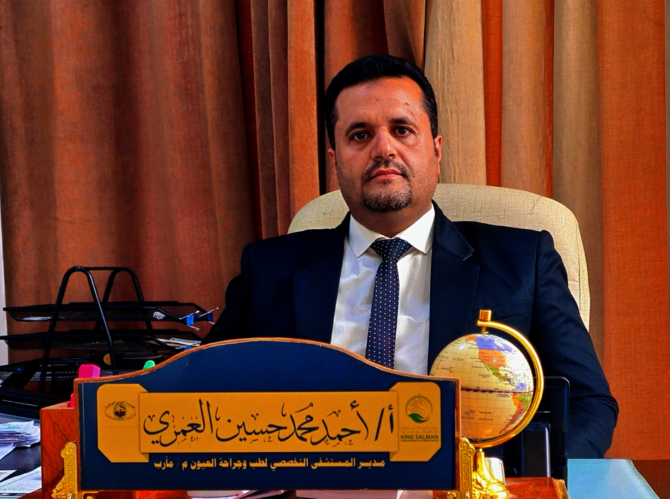
Ahmed Al-Omari, the hospital’s director, told Asharq Al-Awsat that the project represents one of the most significant humanitarian interventions carried out by KSrelief in Yemen’s healthcare sector. He added that all services are provided free of charge, from the moment a patient enters the hospital until the completion of their treatment.
Al-Omari said that the hospital has become a destination for patients from most Yemeni governorates amid difficult economic conditions and a declining ability among many families to cover treatment costs. He added that the growing trust in the services provided is reflected in the continued year-on-year increase in the number of beneficiaries.
According to official statistics, from the hospital’s opening to January, the clinics received about 257,673 patients. A total of 20,491 surgeries were performed, 150,979 pairs of prescription glasses were dispensed and 342,301 prescriptions were provided free of charge. In addition, tens of thousands of laboratory tests, medical imaging services and diagnostic procedures were provided.
Al-Omari said the hospital specializes in ophthalmology and eye surgery. A patient’s journey starts at the optometry clinics, where vision is assessed and refractive errors are measured, before moving to specialists for detailed examinations using advanced, specialized equipment.
He added that the hospital has performed dozens of surgeries daily, notably cataract removal and intraocular lens implantation using phacoemulsification technology, in addition to procedures for glaucoma, strabismus and tear duct dilation, as well as cosmetic and other minor surgical interventions.
Al-Omari said the hospital features a state-of-the-art medical imaging and diagnostics department equipped with advanced specialized devices, notably an optical coherence tomography device, the only one of its kind in the governorate, used to examine and image the retina and diagnose retinal diseases with high precision.
While the hospital receives 180 patients daily across three specialized clinics, it faces challenges, according to Al-Omari, who cited the growing demand driven by patients arriving from across Yemen, along with occasional delays in the delivery of some medical supplies and eyeglass lenses due to regional supply chain disruptions.
Despite these challenges, Al-Omari said the hospital has continued to fulfill its humanitarian mission, describing it as Yemen’s only hospital specialized in providing ophthalmology and eye surgery free of charge.
He added that the Saudi support, through KSrelief, has alleviated the suffering of hundreds of thousands of Yemenis and provided many with a new chance at life, work and education.
Al-Omari expressed gratitude to Saudi Arabia and KSrelief, highlighting that their support to Yemenis “goes beyond numbers and statistics, restoring hope and sight to thousands of families who previously had no access to treatment.”


