
DHAKA: When Dhaka authorities linked traffic cameras to artificial intelligence, the goal was to contain the Bangladeshi capital’s notorious road-rule offences. Two months on, police say the pilot system has not only done that but is also unclogging some of the city’s busiest intersections.
Dhaka’s chronic jams, chaotic driving and road fatalities have been sparking mass protests and challenging successive administrations for decades.
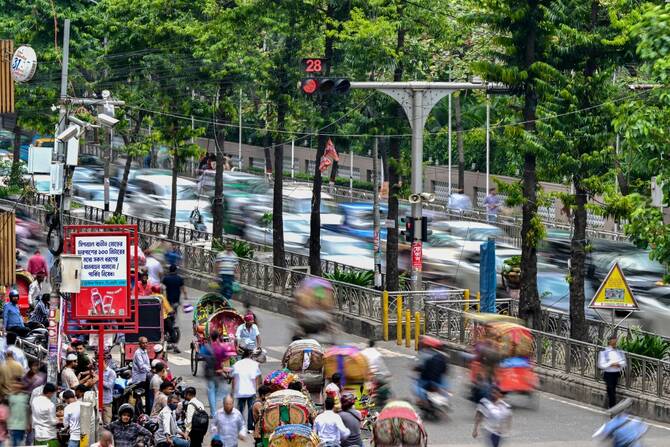
Despite numerous attempts to address the problem, the city of more than 22 million people still relies on traffic officers who often have to stop vehicles with ropes or their own bodies when traffic lights turn red.
But since April, the situation appears to have improved, as Dhaka police linked traffic cameras to AI software designed to automatically detect violations.
“Our software is entirely homegrown, and it can now detect five types of violations: running red lights, blocking the left lane, driving on the wrong side of the road, stopping in non-designated areas, and picking up or dropping off passengers in random places,” Anisur Rahman, additional police commissioner for traffic, Dhaka Metropolitan Police, told Arab News.
“So far, we have spent only around $50,000 on implementing this AI traffic system. Half of this amount was spent on developing the software, while the rest was used to build server storage and purchase cameras.”
As part of the pilot program, ANPR (Automatic Number Plate Recognition) and PTZ (Pan-Tilt-Zoom) cameras have been installed at seven main intersections. When an offence is detected, digital case files are built using footage as evidence. Notices are then sent directly to the registered owner via SMS and by post — but not yet automatically.
“We are aware that sometimes a driver may be wrongly accused by the AI system while facilitating the movement of a pedestrian or an auto-rickshaw. Our road engineering was not designed with future AI systems in mind, so such cases may occur,” Rahman said.
“That is why we are handling case filings manually, and drivers who face charges still have access to a review process.”
Besides the punitive role, the program will also help control vehicle flows to help decongest traffic jams.
Widely regarded as one of the world’s most traffic-congested cities, Dhaka is also the “slowest” one, according to a 2023 study by the US National Bureau of Economic Research. AI is helping to change it, analyzing pressure from each direction at traffic lights.
“In 2024, the average speed of vehicles was 4.2 km per hour. After the introduction of this AI system, the average speed has increased significantly, as can be seen with the naked eye,” Rahman said.
“This system is not fully automatic — it is a semi-automatic traffic signal system. If needed, it can be switched to manual mode, the timing can be adjusted up or down.”
This year alone, police plan to have 60 camera systems installed across the city and double the number next year — enough, according to police, to bring the entire city under the new traffic management system.
The main positive results observed so far are in the drivers’ mindset.
While signals, pedestrian crossings and road signs have earlier received little attention from drivers, now they are beginning to be noticed.
“Earlier, people had a tendency to violate traffic signals whenever they got the opportunity, or if there were no traffic police in the vicinity ... But now things have changed dramatically,” Rahman said.
“Our AI system has successfully changed drivers’ mindsets on the streets. It has made people more cautious, and now they think twice or even three times before running red lights or violating traffic rules.”
Drivers admit to being more careful knowing that they are constantly observed.
Abul Bashar, a professional driver, said he and many others were used to “free-style driving,” not caring about signals or designated lanes.
“Since the installation of the AI cameras, drivers have become more cautious about following the rules, as the AI tools record vehicle movements and may file cases without informing us,” he told Arab News.
“Previously, sometimes there were opportunities to bargain with traffic officials on the streets. With this new system, things have now changed.”
Some also notice the positive side of traffic becoming more orderly.
For Karimul Mawla, a ride-share driver, Dhaka’s traffic jams have been a nightmare that has often affected his income.
“If a 10 km ride takes two hours, eventually it reduces my earnings,” he said.
“After the introduction of AI cameras at some signal points, our waiting times at the signals reduced significantly. For instance, instead of four to five minutes, now it takes two-three minutes. This increased vehicle mobility and decreased the ride completion time. So, at the end of the day, we can earn slightly better.”