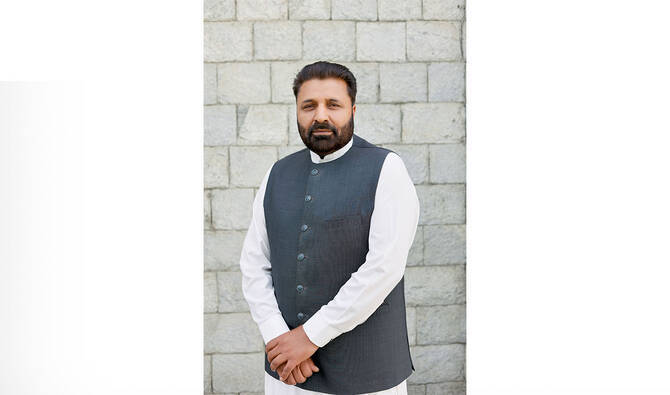

ISLAMABAD: The Gilgit-Baltistan (GB) regional assembly on Monday elected Pakistan Peoples Party’s Amjad Hussain as new chief minister, Pakistani state media reported, hours after newly elected assembly members took oath of their office.
Hussain, who is the regional president of his party, was elected unopposed as no other candidate submitted nomination papers for the post of the GB chief minister.
Addressing the House, Hussain thanked his party for nominating him and said resolving the issues of Gilgit-Baltistan will remain his top priority.
“Gilgit-Baltistan is the richest region in the world in terms of resources, and these resources will be utilized for human development,” he was quoted as saying by Pakistan state TV.
“Comprehensive measures will be taken under a strategy to eradicate unemployment from this region.”
GB, a semi-autonomous region in northern Pakistan that borders China, Afghanistan and Indian-administered Kashmir, is home to some of the world’s tallest peaks, including parts of the Karakoram mountain range, and is one of Pakistan’s most important regions for tourism, water resources and strategic connectivity.
Yet the region faces economic challenges due to its remote location, limited industrial development, inadequate infrastructure, and restricted access to markets and investment opportunities. The local economy mainly depends on agriculture, livestock, tourism, and small-scale trade.
Hussain said the resolution of the region’s issues will remain his “foremost concern” as the chief minister.
The GB election commission on Friday issued final results of June 7 general election, with the PPP winning nine seats, followed by the Pakistan Muslim League-Nawaz (PML-N) with six and the Istehkam-e-Pakistan Party (IPP) with four seats.
The election commission also notified the reserved seats, which increased the PPP’s strength in the 33-member assembly to 13 seats, PML-N to nine seats, and IPP to six seats.
GB lies in the Himalayan region of Kashmir, disputed between India and Pakistan. India has always claimed that it has the right to govern all territories in the Jammu and Kashmir region.
Pakistan rejects these claims and accuses India of forcefully occupying the Jammu and Kashmir region since 1947. It also lays claim to all parts of Kashmir administered by India since both countries secured freedom from the British in 1947.