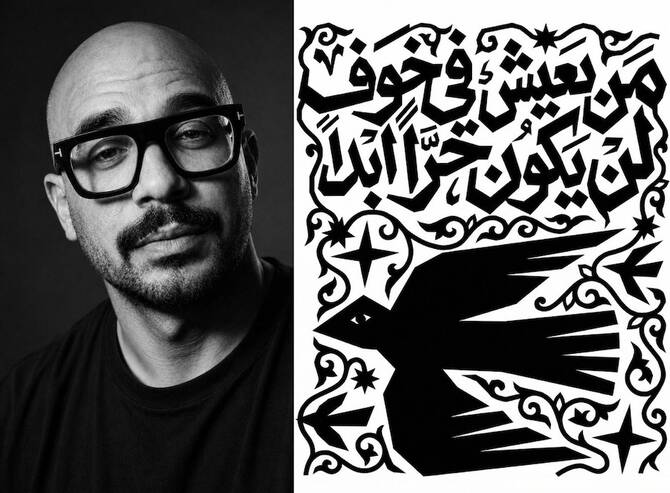

JEDDAH: Calligraphy is an integral part of Saudi culture, and Ibrahim Zaki, a Dubai-based multidisciplinary designer and calligrapher, says that the Kingdom has made immense efforts in recent years to preserve and promote the art form.
“There is serious investment in preservation, documentation, education, public awareness and international exchange,” Zaki told Arab News.
“The Year of Arabic Calligraphy helped bring the art into public spaces and involve different cultural, educational and commercial sectors. The Prince Mohammed bin Salman Global Center for Arabic Calligraphy is also creating a long-term platform for learning, research and global engagement,” he added.
Despite rapid technological change, calligraphy continues to resonate with people, which Zaki attributes largely to the process behind creating the art form.
“It requires time, attention, patience and a genuine connection between the hand, the tool and the surface. This human process gives the work something technology alone cannot reproduce.
“People respond not only to the final image, but also to the history, effort and human presence behind it. This is why it continues to resonate even as technology changes,” he said of the centuries-old tradition.
Like many other fields, calligraphy has also been deeply impacted by the rise of artificial intelligence across sectors and industries.
Zaki believes that traditional calligraphy, digital design and AI can coexist and support one another. “However, I do not believe this is enough to produce complete or meaningful work. AI is only a beginning — a tool for research, experimentation and sometimes a fun part of the creative process. The artist must still bring knowledge, cultural understanding, emotion, judgment and a personal point of view. Technology can suggest possibilities, but the artist must give those possibilities meaning,” he said.
The designer, who has exhibited internationally and for the Hundred Best Arabic Posters project, said Arabic calligraphy has a “great future,” particularly among younger generations.
“Creative communities, cultural institutions, and governments are also taking greater responsibility for integrating calligraphy and Arabic type into education, exhibitions, public spaces, branding, technology and many other aspects of contemporary life,” he said.
One of his many proudest achievements is not just one project or award, “but the journey of building my own visual language through the Arabic letter.”
Zaki has curated exhibitions, such as SALAM and Khalli Balak Men RISO at Tashkeel, allowing him to support different voices and bring them into one shared visual conversation.
“The most meaningful achievement is seeing my practice grow beyond my own work — into teaching, curating, collaboration and building a creative community around the Arabic letter,” said Zaki, for whom the Arabic letter always offers something new to discover.