
DHAHRAN: In a quiet corner of King Fahd University of Petroleum and Minerals, a group of Ph.D. candidates is working to solve some of the most pressing technological challenges of the modern era.
Among them are Asma Yamani and Linah Ali Abuhajar, two researchers operating at the intersection of artificial intelligence and cybersecurity — fields that are increasingly shaping the future of technology.
KFUPM, a STEM-focused institution founded in 1963 as an all-male university, opened its doors to women in 2019. The students featured in this story are among the first generation of women to study and graduate from the university, and one of their earliest priorities was building a community of support and collaboration.
“What we like to highlight is experts — who happen to be women,” Yamani told Arab News.
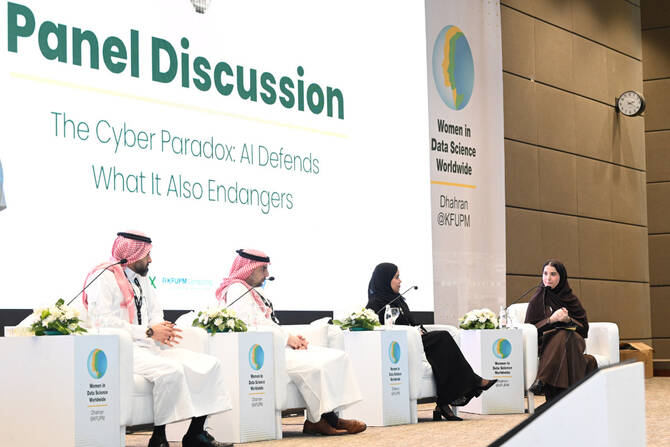
That vision recently came to life through the university’s annual Women in Data Science conference, held as part of the global WiDS Worldwide initiative under the theme “AI-Security Nexus.” The event drew around 250 attendees from across the region.

This year’s organizing team consisted of five students and was led by Yamani, who has been involved with the conference since women first enrolled at KFUPM.
“Let’s start from the beginning in 2019, at the start of enrollment of female graduate students,” Yamani said.
“The funny thing is, the speakers were already booked and they were going to come in like three days. And then the lockdown happened.”
Like many events during the COVID-19 pandemic, the conference began as a virtual gathering, later evolving into a hybrid format before returning fully in person.
“As AI transforms cybersecurity, it’s not just strengthening our defenses, it’s also reshaping the threat landscape in ways we’re only beginning to understand,” the conference press release reads.

Linah Ali Abuhajar speaks during Thursday's Women in Data Science conference at the King Fahd University of Petroleum and Minerals in Alkhobar. (AN photo by Jasmine Bager)
A poster competition attracted 85 submissions from KFUPM and other local universities, with cash prizes awarded to the top three entries.
“The KFUPM 7th annual WiDS is an extension of a larger movement that started from Stanford University (in 2015),” Yamani told Arab News.
“This year was about AI and cybersecurity. Finding those people who work in the intersection is hard, regardless of the gender. But then when you specify female, you get very unique perspectives,” Yamani added.
The one-day event featured speakers from academia and industry, including Norah Al-Zahrani from Humain, who discussed “Securing the AI era.” KFUPM’s Abrar Al-Otaibi spoke about “The arms race to secure LLMs,” while Noha Albadi explored the topic of Arabic religious hate-speech detection on social media.
Other sessions included a presentation by Futun M. Al-Qahtani and Shouq Al-Qarni of Saudi Aramco on the company’s AI-driven cybersecurity solutions. UCLA’s Yuan Tian delivered a keynote address on security and privacy in extended reality systems, while Mastercard’s Saja Al-Julaud joined virtually to discuss AI governance in fintech.
DID YOU KNOW?
• KFUPM began admitting women in 2019, making Yamani and Abuhajar part of the university’s first generation of female graduates.
• The 7th annual Women in Data Science conference at KFUPM attracted around 250 participants from across the region.
• KFUPM recently launched a dedicated bachelor’s degree in AI and Cybersecurity.
Among the workshop facilitators was Abuhajar, known as “the First female KFUPMer to launch a startup at DTV KFUPM.”
Originally from Al-Ahsa, Abuhajar founded a Dhahran-based startup focused on developing virtual reality and AI solutions. Holding a master’s degree in AI and currently pursuing a Ph.D. at KFUPM, her research examines human behavior and interaction in virtual environments.
“We are including AI in all of our applications,” Abuhajar told Arab News.
For many participants, the conference serves as more than an academic forum. It is also a platform for networking, mentorship and confidence-building.
“We usually like to interface with computers more than with people, so the conference helps women to get out of this comfort zone and have to face-to face-time,” Yamani said.
“The thing that is close to my heart is to see people who I know are shy come out of their shell a little bit more,” Yamani said.
Opinion
This section contains relevant reference points, placed in (Opinion field)
Expected to graduate in 2027, Yamani says she is proud to pass the baton to the next generation of organizers.
While the conference primarily targets graduate students and senior undergraduates, this year’s attendance also included high school students — a development that reinforced the organizers’ desire to inspire younger girls to pursue careers in science and technology.
Beyond her academic work, Yamani is also a mother of three. That role has given her a deeper perspective on the future she and her peers are helping to build.
“Not everyone has families, but all Ph.D. students have other responsibilities, like having a startup,” Yamani said.

Asma Yamani speaks during Thursday's Women in Data Science conference at the King Fahd University of Petroleum and Minerals in Alkhobar. (AN photo by Jasmine Bager)
She hopes more undergraduate students will take active roles in future editions of the conference.
“They’re really the fuel of the university. The energy,” Yamani said.
Raised on the KFUPM campus, where her father was a professor, Yamani believes the university is moving in the right direction. This year, that progress was underscored by the launch of a new undergraduate program that mirrors the conference’s central theme.
“This year, the AI and cybersecurity program started at KFUPM as a dedicated bachelors degree — independent of the event. It was nice to have that coincidence,” Yamani said.
Many students enrolled in the new program attended the conference, offering enthusiastic support and positive feedback — further evidence of a growing community of researchers and innovators helping shape Saudi Arabia’s digital future.