

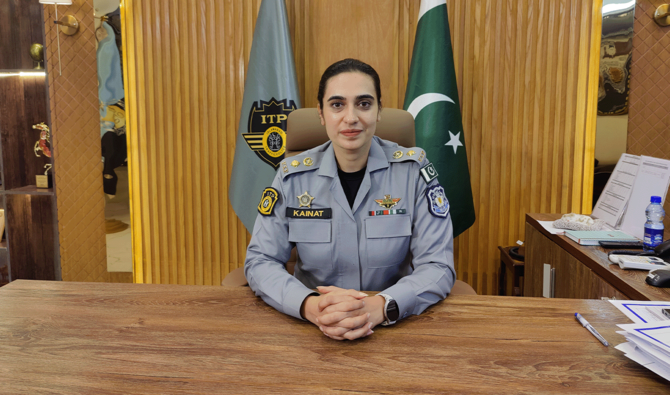

ISLAMABAD: Islamabad’s first woman Chief Traffic Officer Kainat Azhar Khan said this week she wants to see more women behind the wheel in Pakistan’s capital, arguing that greater female participation on the roads would help challenge stereotypes and teach male drivers how to “behave” and coexist with them.
Khan, a Grade-18 officer of the Police Service of Pakistan, was appointed chief traffic officer of Islamabad this month and was also given the additional responsibility of Senior Superintendent of Police Safe City, placing her in charge of traffic management and road safety in the Pakistani capital.
Her appointment marks a milestone in a country where women remain underrepresented in law enforcement and where mobility continues to be a challenge for many women. Traffic policing, in particular, has traditionally been viewed as a male-dominated field.
“We want more women drivers on the road so that their male counterparts, they know how to deal with them,” Khan told Arab News in an interview this week.
Pakistan has made gradual progress in increasing women’s participation in public life, but female labor force participation remains among the lowest in South Asia. Researchers and development organizations have long identified limited mobility, safety concerns and social norms as barriers preventing many women from accessing education and employment opportunities.
Khan said initiatives such as Islamabad’s Uraan Scooty and Motor Riding School, which trains women to ride motorcycles, scooters and drive cars, could help increase women’s presence on the roads.
The senior police officer said such programs would gradually produce more women drivers and help normalize their presence in public spaces.
Women drivers in Pakistan continue to face stereotypes questioning their driving ability, often reinforced through jokes, casual remarks and social attitudes that can translate into discrimination on the road.
Khan said greater visibility would help change those attitudes.
“They learn how to tolerate,” she said of male drivers. “They learn how to behave and if they won’t, then police is going to take its due course of action.”
Her comments come days after former information minister Fawad Chaudhry responded to social media posts about her appointment by saying that most women were “completely useless” as police officers, remarks that drew criticism online.
But Khan’s responsibilities extend far beyond breaking gender barriers.
As chief traffic officer, she inherits one of Islamabad’s most persistent public complaints: traffic disruptions caused by VIP movements.
As Pakistan’s capital and seat of government, Islamabad frequently experiences road closures and lengthy traffic disruptions when senior officials, foreign dignitaries and other high-profile figures travel through the city under heavy security.
Khan acknowledged that the issue remains a challenge.
“Obviously, the traffic plan is there to regulate the public as well as the VIPs, but at times it does become an issue,” she said.
She said authorities were working to improve traffic management so that security requirements did not come at the expense of ordinary commuters.
“We are trying to devise a mechanism and god willing, you will see that there is a difference,” Khan said.
Technology will form a key part of that effort.
As head of the Islamabad Safe City system, Khan is overseeing the integration of traffic management with one of Pakistan’s most advanced urban surveillance networks, which includes hundreds of high-definition cameras, video monitoring systems and other digital tools deployed across the city.
“We already have advanced cameras and drones in operation, and now traffic police are working closely with Safe City to make roads safer and commuting easier,” she said.
“Around 700 new cameras will soon cover past blind spots, ensuring the entire city is monitored and secure.”
Despite the focus on technology and enforcement, Khan said her primary objective remains saving lives.
She emphasized that traffic regulations are designed not to punish motorists but to prevent accidents and encourage safer driving habits.
“My request to the people of Islamabad is simple: follow traffic rules not for the police but to save lives,” she said.
“We want our citizens and all Pakistanis to live and thrive.”


