

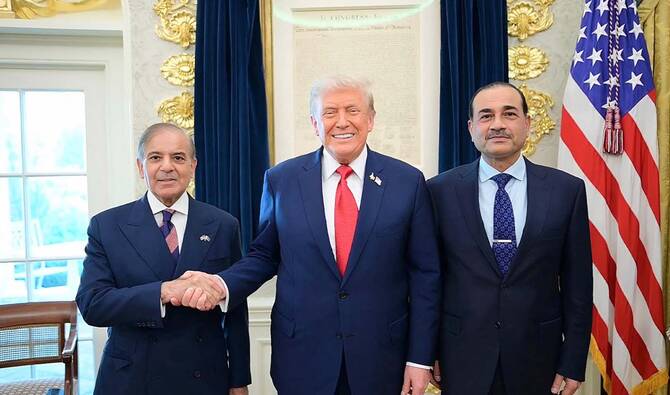

ISLAMABAD: Prime Minister Shehbaz Sharif and Chief of Defense Forces Field Marshal Syed Asim Munir will be part of a high-powered Pakistani delegation that will travel to Switzerland to host the signing ceremony of the US-Iran peace deal, a senior official said on Wednesday.
The US and Iran are set to sign a memorandum of understanding (MoU) in Bürgenstock, Switzerland, on Friday to end their months-long war. Pakistan, which acted as a key mediator between both sides since the war began in February, will host the ceremony, Sharif told lawmakers in Islamabad earlier this week.
A senior government official with direct knowledge of the development told Arab News that a high-powered delegation from Pakistan will travel to Switzerland on Thursday to attend the event. This includes Sharif, Munir, Deputy PM and Foreign Minister Ishaq Dar, and Information Minister Attaullah Tarar.
“Pakistan’s leadership will stand witness to this historic event, which was made possible through Islamabad’s tireless diplomatic efforts,” the official said on condition of anonymity as he was not authorized to speak to the media.
The US-Israel strikes targeting Iran in February prompted Iran to retaliate and virtually close the Strait of Hormuz passageway, a key oil and gas trade maritime route.
The conflict drove energy prices higher, forcing Pakistan to undertake fuel conservation measures and hike prices of petroleum products multiple times.
As the crisis worsened, Sharif and Munir led Pakistan’s diplomatic efforts to de-escalate tensions in the Middle East. Naqvi and Munir traveled to Iran to meet the country’s senior leadership, while Sharif and Dar held conversations with leaders in Iran, the US and Gulf region.
Pakistan hosted direct peace talks between the US and Iran in April that failed to achieve a breakthrough. However, Islamabad relayed peace proposals and exchanged messages between both sides, helping them ultimately reach a final understanding with the help of mediators such as Qatar, Türkiye, Saudi Arabia, Egypt and China.
According to Iran’s Mehr News Agency, the draft agreement gives the two sides 60 days to reach a final settlement on Iran’s nuclear program and decide on what to do with the country’s stockpile of highly enriched uranium.
While the accord is being viewed as a significant breakthrough, the official cautioned that it marks the beginning, rather than the end, of the peace process.
Asked about Pakistan’s role during the upcoming technical negotiations, the official said the next phase would require broad international coordination.
“We are looking at a highly complex, multi-party process over the next two months,” he said.
“Success will depend on close coordination with the institutions responsible for implementing different parts of the agreement.”
He said apart from the US and Iran, the International Atomic Energy Agency will have a role in monitoring Tehran’s nuclear program, while the European Union will be involved in sanctions relief discussions.
“And the United Nations, along with countries holding Iranian assets, will be central to efforts related to asset releases,” the official said.
TRUMP WARNS IRAN TO ‘BEHAVE’
US President Donald Trump warned Iran on Wednesday that he was ready to resume military action if Tehran did not abide by its obligations.
“If I don’t like it, if they don’t behave, we’ll go right back to dropping bombs right smack in the middle of their head, OK?” he said at the G7 summit while sitting alongside Egyptian President Abdel Fattah El-Sisi.
Trump said the Iran MoU did not include immediate sanctions relief for the country.


