

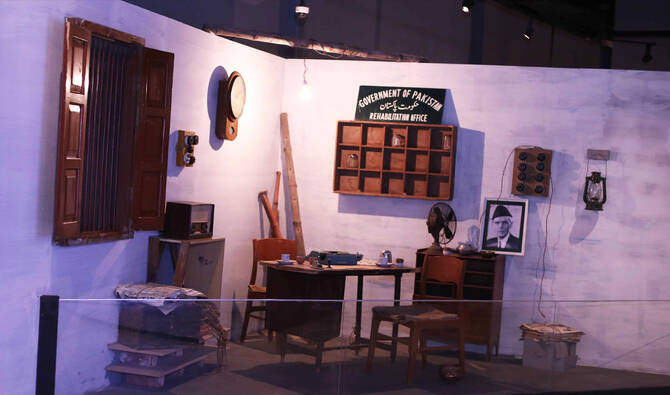

LAHORE: Seated beneath dim gallery lights at Lahore’s National History Museum, writer Adeel Afzal unfolded a stack of yellowing letters and began to read. As his voice echoed through the packed hall, the words of families torn apart by the 1947 Partition came alive again, carrying decades-old accounts of separation, fear, longing and hope that left many in the audience listening in silence.
The dramatic reading, held ahead of Pakistan’s Independence Day, featured original letters exchanged by relatives stranded on opposite sides of the border after the 1947 partition of the Indian subcontinent. At a time when postal mail and telegrams were often the only means of communication, the correspondence offered families their first, and sometimes only, reassurance that loved ones had survived the violence and migration.
Seventy-nine years later, those same letters were given a new voice at the museum, offering an intimate glimpse into one of the defining moments in Pakistan’s history. Read before a captivated audience, these letters chronicled stories of displacement, uncertainty and resilience, and revealed the human cost of a historic event that reshaped the lives of millions across the subcontinent.
“It is very important to understand the circumstances of that era,” Afzal, who considered reading these letters out as a way to remember the suffering behind the birth of the country, told Arab News.
“Whether it is the celebration of independence or its events, they are all in their own place. But I think that on the occasion of that day, all those sacrifices, those sorrows, those griefs, which had passed on to people in that era, it is also important to mention them.”
The 1947 partition resulted in one of the largest migrations in modern history, with millions of Muslims, Hindus and Sikhs crossed the newly established borders amid widespread communal violence, leaving behind homes, possessions and, in many cases, family members.
Organizers said the event sought to preserve personal memories of the partition by sharing the words of people who lived through its upheaval.
“These are very powerful memories that tell us how partition was felt by those early generations,” said Awais Malik, director of the National History Museum, adding that these correspondences contained “confusion and worry” as families sought news about their loved ones while navigating displacement and an uncertain future.
“They paint the picture of what people were feeling at those times because obviously the means of communication were very little. They were only reliant on these letters or the telegrams that would take days to reach their destination.”
All available seats were booked within a day of the event being announced, with people continuing to contact the museum after registrations had closed, according to Malik.
Academic Saadia Ahmed, who moderated an intergenerational discussion accompanying the reading, said she was struck by the number of young people in attendance.
“I wasn’t expecting such a huge audience comprising of Gen Z who were really interested and seemed deeply stimulated by the conversation,” Ahmed told Arab News.
“They also were very eager to be a part of it.”
She said the response challenged assumptions that younger generations were disconnected from the history surrounding the partition.
Ali Rasheed, a 20-year-old student who has spent time listening to oral histories preserved by non-profit Citizens Archive of Pakistan, said such accounts helped him understand what his grandparents and earlier generations had endured.
“Whenever I listen to these partition stories, they create a certain nostalgia and then they also are a source of historical knowledge that helps me connect better to my roots,” he told Arab News.
Salman Tahir, a researcher and archivist at the Citizens Archive of Pakistan, said the dramatic reading and accompanying discussion were intended to encourage Pakistanis to look beyond the celebrations of independence and remember those who had borne its human cost.
“We should revisit our past. We should not forget our history and the people who actually suffered, the people who actually bore the cost of independence and Partition,” Tahir said.
“We should value it ... because it’s our part and we should own it.”
For some members of the audience, the letters were not distant historical documents but echoes of stories preserved within their own families.
Saira Awais, 50, said her grandparents, aunts and uncles had migrated to Pakistan from Delhi, Jalandhar, Uttar Pradesh and other parts of India during the partition.
She grew up hearing their accounts and reading family correspondence from the period.
“I felt as if I used to sit on my aunt’s lap and listen to the stories,” Awais said, describing Afzal’s performance. “I used to listen to the stories of migration from my grandmother, exactly the same way.”
Awais said her family still possessed an ancestral book containing accounts of migration and political events from the period. She attended the event with a particular interest in passing those memories on to younger generations.
“I wanted to tell [these stories] to my son too,” she said. “We would like Generation Z, Alpha and Beta, whichever is coming nowadays, they should know these things.”
Her family’s stories, she said, were not only about what previous generations had lost but about what they expected their descendants to build afterward.
For the museum, it is precisely this transition from personal memory to shared history that gives the decades-old letters their relevance today.
Almost eight decades after they were written, these descriptions of waiting, displacement and hope allowed the audience to briefly encounter the partition not just through dates or statistics, but through the words of ordinary people who lived through it.
“This Pakistan was not achieved just like that,” Awais reminded. “It was achieved through a lot of struggle.”


