


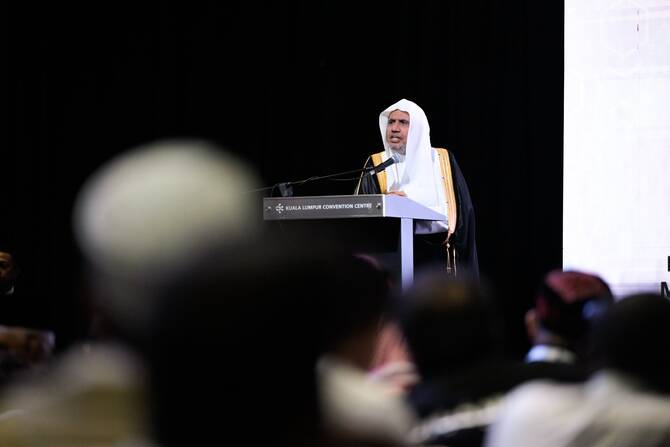


KUALA LUMPUR: The Muslim World League has cautioned that artificial intelligence presents growing ethical challenges, including algorithmic bias, privacy violations and the spread of misinformation, as it seeks to strengthen the capacity of ASEAN youth to address emerging technological risks.
On the sidelines of the Third International Summit of Religious Leaders in Kuala Lumpur, Secretary-General of the Muslim World League Mohammed bin Abdulkarim Al-Issa met youth leaders, university students and researchers from ASEAN countries.
The meeting featured an open dialogue on implementing the summit’s outcomes, with a focus on enhancing youth awareness, strengthening empowerment, and building capabilities to address ethical gaps in information and communication technologies, particularly artificial intelligence.
Al-Issa said AI raises serious ethical concerns, including lack of transparency and accountability in automated decision-making systems, where it can be difficult to understand how outputs are generated, adding that biases embedded in data may lead to unfair outcomes and discrimination against individuals and groups.
He added that the collection and analysis of large datasets raises concerns over privacy violations and the misuse of personal information, while warning that AI can also be exploited to generate fabricated content and spread misinformation that is increasingly difficult to distinguish from authentic material.
The engagement was followed by another event where Al-Issa inaugurated the 4th ASEAN Scholars Council Forum in the presence of Malaysia’s Deputy Prime Minister Ahmad Zahid Hamidi, the Grand Mufti of Malaysia Sheikh Ahmad Fawzi bin Ali Fadzil and the Minister of Religious Affairs Mohd Na’im Mokhtar, alongside senior scholars, and muftis and scholars from across the region.
The forum brought together religious authorities from ASEAN member states to strengthen scholarly coordination and expand cooperation in religious education.
As part of its outcomes, it launched an Arabic Language Program for Qur’an memorizers in the region and recognized a new cohort of certified Qur’an memorizers whose ijazahs were formally endorsed through an unbroken chain of transmission, known as sanad, supported by the MWL’s Global Digital Qur’an Recitation Academy.
The two engagements followed the Third International Summit of Religious Leaders, where participants — including Malaysia’s Sultan of Perak, Sultan Nazrin Shah and Prime Minister Anwar Ibrahim — highlighted the growing intersection between ethical governance, social cohesion and emerging technologies.
The summit, held under the theme “Religious Leaders and Youth Empowerment,” brought together about 2,000 young people from diverse religious and cultural backgrounds. Organizers said the aim was to equip youth to respond to identity challenges, extremist messaging and widening digital influence.


