
ISLAMABAD: Pakistan on Friday unveiled a Rs18.77 trillion ($67.49 billion) federal budget for fiscal year 2026-27, raising defense spending and setting ambitious revenue targets as the government seeks to sustain an International Monetary Fund-backed economic recovery while navigating regional tensions and pressure on public finances.
The budget targets economic growth of 4 percent and inflation of 8.2 percent in the fiscal year beginning in July, as Islamabad attempts to move from economic stabilization toward faster expansion after narrowly avoiding a balance-of-payments crisis in recent years.
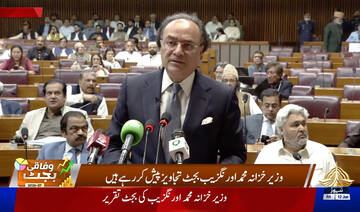
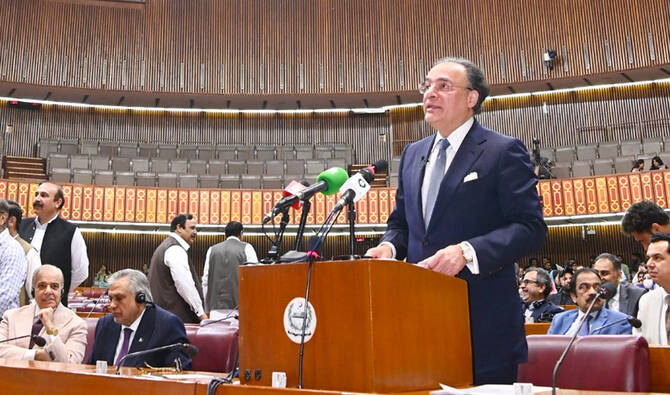
Presenting the budget in parliament, Finance Minister Muhammad Aurangzeb said Pakistan had emerged from a period of severe economic stress and was now positioned to pursue growth while maintaining fiscal discipline.
“Pakistan today stands at a point where, on the one hand, it has achieved economic stability and, on the other, the desire for growth has reawakened,” Aurangzeb said in his budget speech.
The minister said Pakistan’s economy had weathered a series of external shocks over the past year, including global trade uncertainty, devastating floods and the recent Middle East conflict that pushed up oil prices and threatened regional supply chains.
“All of these challenges tested Pakistan’s resilience,” Aurangzeb said. “And as far as I am concerned, we completely and correctly passed that test.”
He said the government had remained on what he described as a “journey from stabilization to growth” despite the setbacks.
The budget comes as Pakistan is under a $7 billion IMF program that has helped the South Asian nation rebuild foreign exchange reserves, reduce inflation and narrow fiscal imbalances through a series of reforms, including higher taxes and cuts in government spending.
The finance minister also proposed a 7 percent increase in public sector salaries and pensions and a 10 percent increase in the minimum wage.
The budget announced lower income tax rates for several salaried-income brackets, reduced taxes on property transfers and cut withholding tax on the international use of bank credit and debit cards as part of broader relief measures.
To meet IMF targets, the government has projected total revenue of Rs20.60 trillion ($74.08 billion) next year, including tax revenue of Rs15.26 trillion ($54.87 billion).
The budget projects a primary surplus, the balance before interest payments on government debt, of 2 percent of gross domestic product, while the overall fiscal deficit is expected at 3.6 percent of GDP.
Defense spending has been set at Rs3 trillion ($10.79 billion), up 18 percent from Rs2.55 trillion ($9.17 billion) in the outgoing fiscal year, following a brief but intense military confrontation with neighboring India last year.
At the same time, the government has kept development spending under pressure as it seeks to contain borrowing and meet fiscal targets agreed with the IMF.
The budget document warned that rising global oil prices could add 0.8 percent of GDP to the fiscal deficit in the coming year, highlighting Pakistan’s vulnerability to external shocks amid continuing instability in the Middle East.
Business groups offered a cautious welcome to the fiscal plan.
The Overseas Investors Chamber of Commerce and Industry (OICCI), which represents multinational firms operating in Pakistan, said the budget showed “restraint, some structural ambition, and meaningful forward movement in select areas.” The Federation of Pakistan
Chambers of Commerce and Industry (FPCCI) described it as a continuation of economic policy but voiced concerns about ambitious revenue and petroleum levy targets.
Pakistan’s economy expanded by an estimated 3.7 percent in the outgoing fiscal year, according to the government’s Economic Survey released a day earlier, while inflation fell sharply from multi-decade highs recorded during the country’s recent economic crisis.