

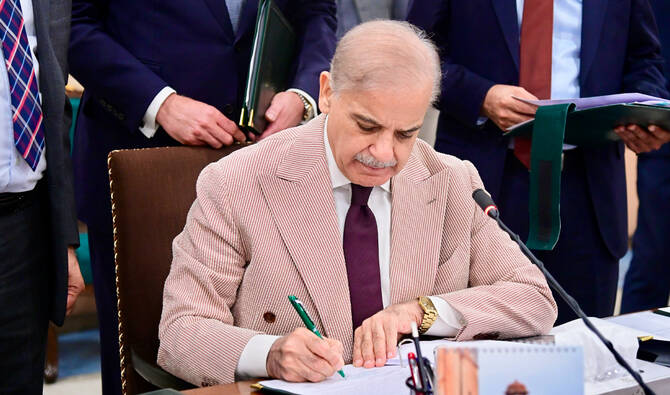

ISLAMABAD: Prime Minister Shehbaz Sharif on Friday said Pakistan had entered a period of “prosperity” after achieving economic stability, describing the newly unveiled federal budget as one that would deliver relief to citizens after years of economic hardship and IMF-backed reforms.
The statement came shortly after Finance Minister Muhammad Aurangzeb presented a Rs18.77 trillion ($67.49 billion) federal budget for fiscal year 2026-27 that targets 4 percent economic growth and seeks to sustain a fragile recovery under a $7 billion International Monetary Fund (IMF) program.
“I had promised the people that once economic stability was achieved, its benefits would be directly passed on to the common man,” Sharif said in a statement issued by his office.
“By the grace of Allah, the time of prosperity has now begun.”
Pakistan narrowly avoided a sovereign default in 2023 and has since implemented a series of IMF-backed reforms that helped reduce inflation, rebuild foreign exchange reserves and stabilize the economy, though at the cost of higher taxes and increased pressure on households and businesses.
Sharif said the government had delivered relief in the budget after achieving economic stability and thanked Pakistanis for showing patience.
“I thank every citizen of Pakistan from the bottom of my heart who demonstrated patience in the most difficult circumstances, endured hardships and played a full role in achieving economic stability for the country,” he said.
The prime minister described the fiscal plan as a “budget of relief” and a “budget of public welfare,” saying it aimed to reduce the burden on salaried workers while promoting exports, industrial growth, agricultural development, investment and broader economic expansion.
“The fundamental objective of this budget is to ensure that the benefits of a stronger economy directly reach the people and that every segment of society shares in this progress,” he added.
Sharif also thanked Deputy Prime Minister Ishaq Dar, Finance Minister Aurangzeb, Chief of Army Staff Field Marshal Asim Munir, the country’s four provincial chief ministers and members of the government’s economic team for helping prepare the budget.
He said the government had taken steps ranging from tax relief and support for businesses to job creation initiatives and housing measures under its Apna Ghar program, and pledged to continue efforts aimed at improving public welfare.


