
BEIRUT: As Israeli warplanes pounded Beirut’s southern suburbs last March and residents fled in panic, one man found his opportunity.
Amid the chaos, he slipped out of his imprisonment in a Hezbollah cell and made his way to the green hills overlooking the Lebanese capital.
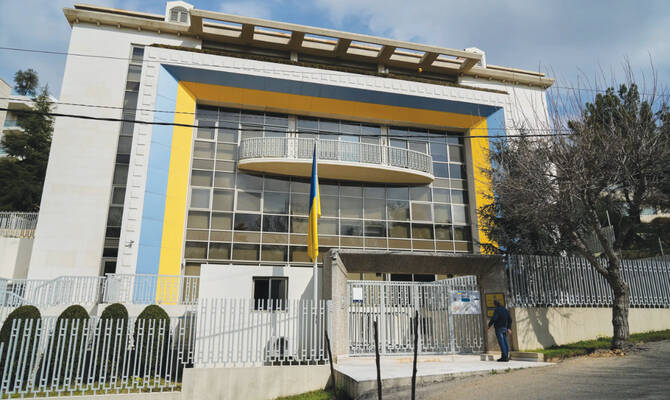
There, in the posh diplomatic quarter of Baabda, he disappeared inside the gates of the Ukrainian Embassy.
Where he is now is a mystery, tangled up in an ongoing spy game as Hezbollah attempts to root out Israeli intelligence operatives that have infiltrated the militant group.
The man identified by Lebanese officials as Khaled Al-Aydi is said to be a Palestinian refugee from Syria who also holds Ukrainian citizenship.
He had been detained by Hezbollah in the Beirut suburbs and accused by Lebanese officials of being part of a thwarted Israeli intelligence plot to carry out bombings and assassinations.
Details of Al-Aydi’s escape and a Lebanese military court’s case against him were provided by three judicial officials and two senior security officials in Lebanon.
A senior political official in Hezbollah also provided details.
Al-Aydi’s disappearance could have political implications for the Lebanese government, which has largely remained silent about the case.
If evidence were to emerge that Al-Aydi escaped Lebanon with help from the government, it could inflame tensions with Hezbollah’s largely Shiite base. The government already faces scrutiny for directly negotiating with Israel, which has been engaged in fierce fighting with Hezbollah since the early days of the Iran war.
The Ukrainian Embassy asked Lebanese authorities in March to facilitate Al-Aydi’s departure from the country after he escaped Hezbollah detention, according to a Lebanese government document. But Lebanon’s General Security agency refused, saying a judicial warrant for his arrest had been issued in September 2025, according to the document.
Israel’s Mossad intelligence agency refused to comment. Ukraine’s Foreign Ministry also declined comment.
A Ukrainian official with knowledge of the case said Al-Aydi is not in the Ukrainian Embassy or its compound in Lebanon.
Since the 2024 Israel-Hezbollah war, Hezbollah and Lebanese authorities have cracked down on alleged spy networks. About 50 people have been convicted and are serving sentences, while others remain under investigation, the judicial officials said.
“We were successful in detecting many spy networks, and the state was also successful in this matter,” Hezbollah political official Wafiq Safa, said. But “the Israelis are always working to recruit young Lebanese people from all communities.”
Many alleged spy networks have involved current or former Hezbollah members or individuals with family ties to the group.
Al-Aydi, in contrast, was an outsider. He had Ukrainian citizenship through his mother, according to the Lebanese government document. It is not known how he was allegedly recruited by Israel.
Hundreds of thousands of Syrians came to Lebanon for refuge during Syria’s 14-year civil war. But Al-Aydi entered the country in August 2025 on a flight from Ethiopia, one of the Lebanese security officials said.
While Hezbollah began in the 1980s as a small guerrilla operation fighting Israel’s occupation of southern Lebanon, it greatly expanded after its 2006 war with Israel, making it “easier for the Israelis to penetrate,” Blanford said. The group’s entry into the Syrian civil war further exposed it, as recruitment standards were lowered, he said.
Lebanon’s economic crisis also aided Israel’s recruitment efforts, Blanford said.
Cases filed in Lebanon’s military court describe operatives being paid between $2,500 and $20,000 to provide intelligence on Hezbollah weapons depots and political offices. Many of the alleged agents were recruited by Israeli handlers through social media, judicial officials said.
One high-profile case was Mohammad Hadi Saleh, a singer and prominent religious performer within circles connected to Hezbollah. He was arrested in May 2025 and charged with providing the Mossad with maps and coordinates of key Hezbollah sites later struck in Israeli operations. He is in jail awaiting trial.
“It’s ironic that they (Hezbollah) were spending a lot of time accusing their opponents of being Israeli spies, and it turns out that the spies were actually from within the organization and its support base,” said Mohanad Hage Ali, a senior fellow at the Malcolm H. Kerr Carnegie Middle East Center in Beirut.
Recruitment efforts continue. During the latest war, Israel has dropped leaflets over Lebanon with QR codes that direct people to an Israeli military unit tasked with recruiting agents.
Lebanon’s General Security said in October it had broken up a network planning bombings and assassinations in Lebanon, including an operation meant to target events for the one-year commemoration of Nasrallah’s death. Authorities discovered a motorcycle rigged with explosives and a car modified to hold explosives, security and judicial officials said.
Al-Aydi and six others, all Lebanese, were charged. One of the six also escaped, and the others are in a Lebanese jail awaiting trial, the judicial officials said. Only Al-Aydi was being held by Hezbollah, likely because he was seen as a high-value catch.
The military court alleges the operation was orchestrated by a Mossad handler living in Germany who communicated with others through encrypted applications. The court sent a summons to the Ukrainian Embassy that went unanswered.
Safa said there was an unsuccessful attempt to smuggle Al-Aydi out of Lebanon to Syria. He did not elaborate.
The two senior Lebanese security officials said Al-Aydi is believed to have left the country. It was not clear whether he crossed into Syria, where officials said they had no information about him.
If Lebanese authorities refused to let Al-Aydi leave the country, the US and Ukraine were “well-positioned to exert significant pressure” to secure his release, Hage Ali said. On the other hand, if the state is seen to have let Al-Aydi escape, it would face “public anger, predominantly among Lebanese Shia” sympathetic to Hezbollah, which could use that emotion to inflame internal tensions, he said.