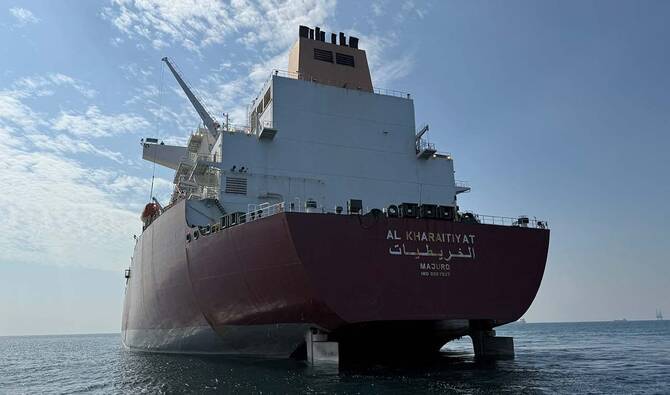

ISLAMABAD: Pakistan received its second spot Liquefied Natural Gas (LNG) cargo since April after a vessel from Oman arrived at Port Qasim on Sunday, an official said as Islamabad seeks to bolster its energy reserves amid oil supply disruptions triggered by the Iran war.
The vessel named “BW Helios” arrived at Port Qasim on Sunday and berthed at the PGPCL terminal at 12:24 p.m., the port’s Public Relations Officer Aktaf Hussain Warsi said in a statement. He said the Singapore-flagged vessel was carrying 167,070 cubic meters of LNG.
“The vessel has been positioned at berth for commencement of operational activities as per schedule,” Warsi said. “Further updates regarding loading operations and departure timelines will be communicated as they become available.”
Pakistan received its first LNG spot cargo since the Iran war began on Apr. 30, when the carrier Seapeak Magellan delivered 140,000 cubic meters of LNG from TotalEnergies.
Pakistan invited bids from international suppliers for two spot LNG cargoes last month to meet its energy requirements as contracted supplies from Qatar remained uncertain amid continued disruptions to shipping through the Strait of Hormuz.
Iran has effectively closed the strait, through which nearly 20 percent of the world’s oil and gas products are transported, since the US and Israel launched joint airstrikes against it.
In March, as the Iran conflict disrupted regional energy trade, Pakistan could only import $70.2 million worth of LNG, 69 percent down from $226 million last year, according to the Pakistan Bureau of Statistics.
Pakistan, which depends mostly on fuel supplies from the Middle East for its energy needs, has cautiously sought to maintain adequate levels of energy products since then.