

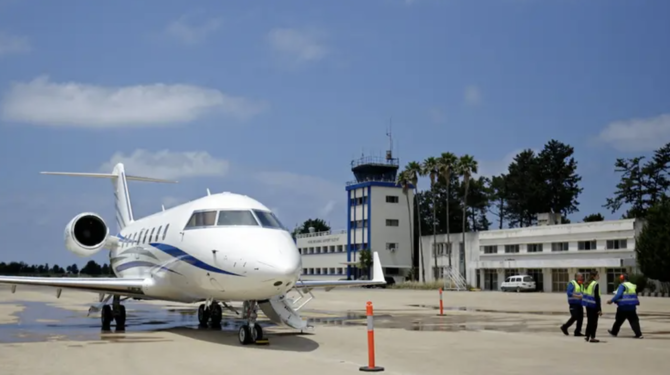

BEIRUT: Qlayaat Airport was officially reopened on Saturday as a civilian airport, becoming the country’s second airport for civil use after Beirut Rafic Hariri International.
Prime Minister Nawaf Salam, who attended the inauguration ceremony, described the occasion as “a political, developmental and national decision of the highest significance; The Akkar region (in northern Lebanon) will no longer be absent from the state’s development priorities.”
The reopening of Qlayaat Airport — named after former President Rene Moawad — to civilian air traffic comes after decades of calls from residents of northern Lebanon. A plane carrying Salam landed at the airport amid a gathering of invited guests, including ambassadors, representatives of economic bodies, international organizations and entities from the transport and aviation sectors.
The event was held under tight logistical and security arrangements, with the Lebanese military deployed at the airport’s entrances and along access roads, while army helicopters conducted aerial patrols over the area.
Salam said that the state “will not abandon its duty to safeguard Lebanon’s right to its land, sovereignty and the security of its people, as it does not neglect its responsibility to advance development, economic growth and social justice.” He added that “just as there can be no stability in Lebanon while the South remains under threat, the country cannot recover if Akkar remains neglected and the Bekaa deprived.”
Salam highlighted the importance of Akkar, which has endured decades of deprivation, noting that “thousands of its residents are serving in the army and security forces, and many have been martyred for their country.”
According to official statistics, Akkar Governorate recorded the highest poverty rate in Lebanon, reaching 62 percent compared to 33 percent nationally. It also recorded the lowest economic activity labor force participation rate, at no more than 35 percent compared to 43 percent nationwide, while indicators also show that nearly a quarter of its population is unemployed.
Salam described the “launch of rehabilitation and operation of the Rene Mouawad Airport in Qlayaat as not merely an investment project, but a step at the heart of balanced development, at the heart of regional justice and at the heart of the state’s responsibility toward its citizens.”
He stressed that Qlayaat Airport is not intended to replace Rafik Hariri International Airport.
"Lebanon needs a modern, integrated aviation network,” he said. “It also needs infrastructure that links all regions of the country to the national economy.”
He added that reviving President Rene Moawad Airport goes beyond reopening a public facility. “It is about strengthening state institutions and advancing the implementation of the Taif Agreement,” he confirmed, describing the inauguration as part of a broader effort to promote reform, balanced development, and a sovereign state that serves all Lebanese citizens.
Lebanese Minister of Public Works and Transport Fayez Rassamni said the airport would be fully operational within weeks, marking a new chapter for air transport in Lebanon.
Initial services will connect Qlayaat with Mersin, Istanbul and Dubai, with additional flights to Medina, Cairo and Athens planned for a later stage.
Airport officials are also seeking to attract low-cost carriers, including AJet, Pegasus and Air Arabia, as part of efforts to expand the network and improve links with destinations across the region and beyond.
Rassamni said the ministry is discussing partnerships with European airlines, including Ryanair through Paphos in Cyprus and Aegean through Athens. The arrangements would give Lebanese travelers access to dozens of European destinations at lower fares.
Rassamni said the ministry is working to connect Qlayaat Airport to Lebanon’s public transport network through bus services linking the airport with Beirut at affordable fares.
The government plans to upgrade the 4 km road connecting the Abdeh-Arida international highway to the airport entrance, according to the minister.
Rene Mouawad Airport covers more than 5 million square meters on the outskirts of Qlayaat. It lies a few hundred meters from the Mediterranean coast and about six kilometers from the Arida border crossing with Syria.
In 1941, the Allies established Qlayaat military airport on the northern coast of Lebanon. In 1960, it became affiliated with the IPC oil company, which used it for civilian purposes, transporting engineers, employees, and workers between Lebanon and Arab countries.
Six years later, the airport came under the control of the Lebanese Army, which expanded the facility and upgraded its infrastructure, making it one of the most advanced air bases in the region at the time.
According to an agreement between Lebanon and France, the Lebanese Air Force was supplied with a number of Mirage aircraft.
During the Lebanese Civil War, operations at the airport were suspended, and the aircraft were placed in storage.
However, in 1989, it played a significant role in the presidential election, as members of parliament convened at Qlayaat Airport and elected Rene Moawad as President of Lebanon. Following his assassination, the airport was renamed in his honor.


