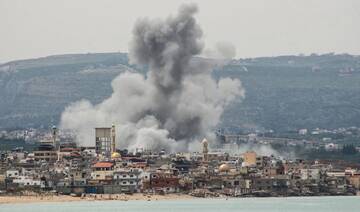
BEIRUT: While Washington and Tehran argue over a deal to end the attacks on shipping that are shaking the world economy, Iran’s most powerful ally Hezbollah and Israel are stepping up a drone war in Lebanon — on camera — that is complicating the path to peace.
In recent weeks, Hezbollah has used cheap, easy-to-assemble First Person View kamikaze drones to transform the war it has been fighting since it began firing on Israel on March 2, days after the US-Israeli forces began their attacks on Iran.
Controlled with fiber-optic cables, the FPV drones can evade Israel’s high-tech jamming technologies to target its troops occupying southern Lebanon during a shaky ceasefire announced on April 16, a week after the truce in the wider Iran war began. The Iran-backed group has published videos of more than 45 FPV attacks, 28 of them in the nearly four weeks since the ceasefire, which had halted Israeli attacks on the Lebanese capital before Israel said it targeted a Hezbollah commander there on Wednesday.
The truce has also left Israeli ground forces occupying a so-called buffer zone up to 10 km in from the border, in confined territory, which Hezbollah knows well, and vulnerable to such attacks.
All of the videos before the ceasefire was announced showed UAVs flying at static positions or vehicles including tanks and excavators, with no fatalities reported by Israel. But since the ceasefire was announced, Hezbollah began targeting groups of soldiers, reporting five attacks. Three Israeli soldiers and one contractor were reported by Israel to have been killed.
Israel is firing back, with at least two deadly FPV drone attacks against Hezbollah in April complete with published drone images purporting to show Hezbollah fighters up close. The widespread use of FPV attack drones began several years ago and thousands of kilometers away in Ukraine, where front lines are covered with netting to defend against Russia’s drones, and where some drone operators are watching Hezbollah.
“They are amateurs, but they are learning,” said Dmytro Putiata, a drone warfare expert serving in Ukraine’s Unmanned Systems Brigades.
Iran and mediator Pakistan say any US-Iranian peace agreement must include a halt to Israeli strikes in Lebanon to prevent an escalation there restarting the wider Iran war. US-mediated direct talks between the Lebanese government and Israel are due to resume on Thursday and Friday, but progress has been slow; Israel insists that Lebanon disarm Hezbollah, which risks reigniting conflict in a country that suffered a 1975-1990 civil war.
Hezbollah’s head of media relations, Youssef El-Zein, said the group assessed that continued Israeli troop casualties from FPV drones could force an Israeli withdrawal more effectively than the negotiations with Israel, which Hezbollah opposes.
Israeli troops who have invaded southern Lebanon in the current conflict presented “an opportunity, and not a threat,” as they could be more easily targeted, he said.
“We know the enemy’s supremacy, but we also know their points of weakness. We are taking advantage of the points of weakness to create that balance,” Zein told reporters.