


RIYADH: Saudi Aramco posted first-quarter adjusted net income of $33.6 billion, up 26 percent year on year, as resilient operations helped offset regional geopolitical disruptions.
The state oil giant reported net income of $32.5 billion in the three months ended March 31, compared with $26 billion a year earlier.
Cash flow from operating activities slipped to $30.7 billion from $31.7 billion a year earlier, while free cash flow declined to $18.6 billion from $19.2 billion, partly due to a $15.8 billion working capital build.
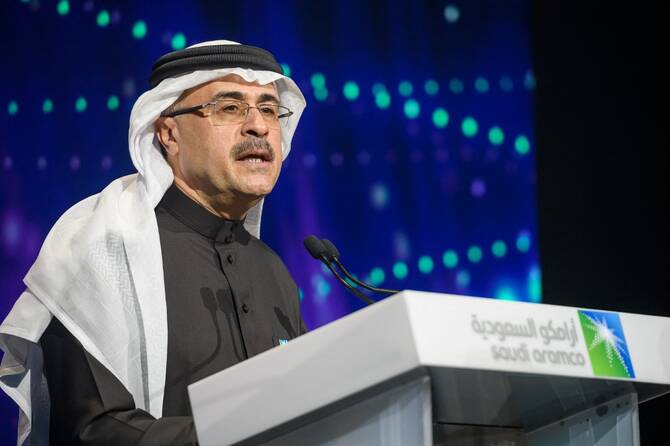
Aramco President & CEO Amin H. Nasser said: “Aramco’s first-quarter performance reflects strong resilience and operational flexibility in a complex geopolitical environment.”
He added: “Our East-West Pipeline, which reached its maximum capacity of 7 million barrels of oil per day, has proven itself to be a critical supply artery, helping to mitigate the impact of a global energy shock and providing relief to customers affected by shipping constraints in the Strait of Hormuz.”
Nasser said recent events had demonstrated “the vital contribution of oil and gas to energy security and the global economy” and underscored the importance of reliable energy supplies.
“Despite these headwinds, Aramco remains focused on its strategic priorities and is leveraging both its domestic infrastructure and its global network to navigate disruption,” he added.
Aramco said its gearing ratio rose to 4.8 percent at the end of March from 3.8 percent at the end of 2025, while capital expenditures stood at $12.1 billion in the quarter as the company continued to invest in growth projects.
The company’s board declared a first-quarter base dividend of SR82.08 billion ($21.89 billion), equivalent to SR0.3393 per share, up 3.5 percent year on year. Shareholders registered by June 1 will be eligible for the payout, which is scheduled for distribution on June 9.
Aramco said its average realized crude oil price rose to $76.90 a barrel in the first quarter from $76.30 a year earlier and $64.10 in the previous quarter.
Ahmed Azzam, head of market research at Equiti Group, told Arab News that Aramco’s first-quarter results “deserve to be read with more care than the headline suggests,” arguing that the company’s 25.5 percent rise in adjusted net income reflected more than just oil price movements.
He noted that Aramco’s average realized crude price stood at $76.9 per barrel in the first quarter, only slightly higher than $76.3 a year earlier, while adjusted net income climbed sharply to $33.6 billion from $26.6 billion.
Azzam said the stronger earnings were driven by several factors beyond crude prices, including higher crude sales volumes, improved prices and volumes for refined and chemical products, and increased income linked to sales. “Aramco did not just ride a slightly firmer oil market; it captured value from more parts of the energy chain around the barrel,” he said, highlighting the company’s ability to benefit across multiple segments of the energy value chain.
He also pointed to growing geopolitical tensions and shipping risks around the Strait of Hormuz as a key backdrop for the results, saying energy security has become “a live market issue again, not a theoretical one.” Azzam noted that Aramco’s East-West Pipeline reaching its full capacity of 7 million barrels per day represents “a strategic advantage,” allowing the company to move crude to the Red Sea when Gulf shipping routes face disruption. “The company is not only producing oil; it is controlling more of the route between the field and the customer,” he added.
Azzam said the quarter underscored a broader shift in the oil market, where investors are increasingly valuing reliability, logistics, and supply assurance alongside production volumes and costs. While he noted that free cash flow slipped to $18.6 billion and gearing rose to 4.8 percent, he said the company’s dividend of SR82.08 billion reinforced its position as “one of the most important cash-return stories in global energy.”
He added: “In normal times, the market rewards barrels. In moments like this, it rewards barrels that can actually reach customers.”
Ahmad Chreim, economist at MT Trading, told Arab News that Aramco has demonstrated strong resilience and operational strength during the current regional crisis, particularly through its ability to mitigate risks linked to the Strait of Hormuz.
He pointed to the Kingdom’s East-West Pipeline, developed more than a decade ago, as a key strategic asset connecting eastern production hubs with western export terminals.
Chreim noted that analysts had previously questioned Saudi Arabia’s ability to maximize throughput through the pipeline, but said Aramco had shown “immense operational flexibility” by rapidly scaling capacity. He added that the company reported a sharp rise in profits at a time when some regional producers were facing export-related challenges.
He also said Aramco’s strategic positioning had helped stabilize global oil markets during the crisis. While many economists initially expected crude prices to surge to between $150 and $200 per barrel, “the market has remained remarkably stable thanks to these proactive measures,” he said.


