

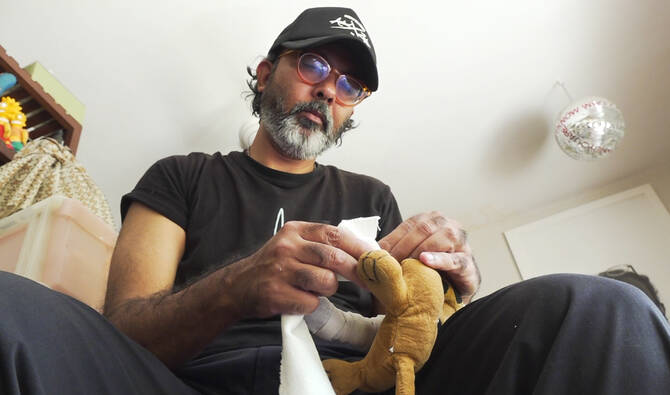

KARACHI: Pakistani artist Adeel Uz Zafar hopes his recent collaboration with local streetwear brand Movement will help take his work beyond galleries and into everyday life, as artists around the world increasingly turn to fashion to reach wider audiences.
Collaborations between artists and fashion brands have become a defining feature of global streetwear, with companies like Uniqlo and Nike turning artwork into mass-market apparel. From Japanese artist Takashi Murakami’s partnership with Louis Vuitton to contemporary artist KAWS’ long-running collaboration with Uniqlo, where he was recently named the brand’s first artist-in-residence, such projects have helped bring gallery-style art into everyday clothing and expand artists’ reach beyond traditional audiences.
Zafar, a Karachi-based artist and illustrator who also teaches at the Indus Valley School of Art and Architecture, is known for his signature work: children’s plush toys wrapped in gauze bandages, set against pitch-black backdrops to create a stark, unsettling visual contrast.
Movement, a Pakistani streetwear brand founded by Abdullah Seja in 2023, collaborated with Zafar to place images of his artwork, including drawings of teddy bears and rabbits wrapped in bandages, on t-shirts, polo shirts, pouches, hoodies and caps.
The collection, titled “Movement X Adeel Uz Zafar,” launched on April 3 in collaboration with Sanat Initiative at the Sanat Art Gallery in Karachi. Sanat Initiative is a contemporary art space run by curator Abid Aziz Merchant, whose gallery represents Zafar.
“Someone roaming around wearing my art is definitely different from something hung on your wall,” Zafar told Arab News.
“I am very confident that my artwork will reach a wider audience through this [collaboration].”
The limited collection features fewer than 10 items and is not expected to be restocked for now.
Prices range from Rs8,000 ($28.65) for a linen shirt to Rs14,000 ($50.05) for a hoodie, with accessories such as caps and pouches also carrying Zafar’s designs.
Zafar said he was surprised by the response.
“A while back when I went to my barber, he told me he saw about my work and my collaboration [on social media] two days back,” he said.
Seja said demand had been strong.
“It is mostly sold out,” he said.
‘CHANGING THE NARRATIVE’
Zafar graduated from the National College of Arts in 1998 and has worked across illustration and fine art. He previously collaborated with the British Council on projects involving culturally rooted characters for educational material.
Over time, he developed his distinctive visual language, drawing on plush toys he began collecting from Karachi’s flea markets more than a decade ago.
Zafar says when he read about the toys, “their fictional stories were more like our reality.”
His work reflects broader themes of conflict, inequality and instability, with the bandaged figures symbolizing vulnerability and trauma in an increasingly complex world.
But why the signature bandages?
“I felt if I put them or conceal them in a bandage, it will change the narrative,” he said.
Zafar creates highly detailed observational drawings that give the illusion of three-dimensional objects on a flat surface.
His bunny, teddy bear and Mickey Mouse-inspired figures caught Seja’s attention for the Movement collaboration.
This is not Zafar’s first foray into fashion. Around eight years ago, he worked with Korean designer Juun.J, who incorporated his artwork into a runway collection.
“I found that process very interesting and I felt that there is an expansion of my own work into other categories,” said Zafar.
“We [usually] create an artwork and exhibit it at a gallery. Brand collaboration [on the other hand] is not a norm in our part of the world but many people internationally have had such collaborations.”
‘ENJOY THE ART’
Zafar said financial gain was not the primary motivation behind the latest collaboration, given that Movement is still a young brand.
However, he expects stronger commercial prospects as the brand grows and expands its product range.
Cultural commentator Atiya Khan said such collaborations help democratize art.
“Not everybody can afford a painting from a very prominent artist but everyone can afford a T-shirt or a mug,” she said.
“So, merchandising art or prints makes it much more accessible. It allows ordinary people to enjoy the art as well.”


