
LONDON: When more than 200,000 people fled from Lebanon into neighboring Syria to escape the latest escalation between Israel and Hezbollah, many were unaware of the silent danger lurking underfoot, scattered across farmland and border areas.
Syria ranks among the world’s most heavily mine-contaminated countries. The main crossing point at Jdeidet Yabous feeds directly into rural Damascus governorate, one of the worst affected regions in the country.
The 2025 Landmine Monitor places Syria second globally in unexploded ordnance casualties.
Since December 2024, when many displaced families began returning to their towns and villages following the fall of Bashar Assad’s regime, the HALO Trust has recorded more than 700 deaths resulting from UXO, more than 200 of them children, and 1,900 injuries.
Within a year of Assad’s downfall, more than 1.8 million internally displaced Syrians and 780,000 refugees had returned home, according to UN figures. Now the country is absorbing yet another wave.
On March 2, Hezbollah launched rockets and drones into northern Israel in retaliation for the US-Israeli killing of Iran’s supreme leader, Ayatollah Ali Khamenei, on Feb. 28. Israel responded with a renewed air and ground offensive against Lebanon.

Mech task in Saraqeb, northern Syria. Image taken in October 2025. (HALO Trust/Bethany Langham)
Peace prospects remain uncertain after Israel said on April 11 it would not discuss a ceasefire with Hezbollah during next week’s talks with Lebanese officials in Washington, according to media reports.
Israeli attacks and evacuation orders have displaced more than a million people across Lebanon, including more than 200,000 who have fled across the border into Syria between March 2 and 27, according to the UN refugee agency, UNHCR.
“The vast majority, nearly 180,000, are Syrians, including Syrian refugees who had fled Syria seeking safety in the past in Lebanon and now forced to flee again,” Aseer Al-Madaien, UNHCR’s representative in Syria, said in a statement on March 31.
More than 28,000 Lebanese also have crossed into Syria. “Most are people fleeing the intense Israeli bombardments,” Al-Madaien said. “They arrive exhausted, traumatized and with very, very few belongings.”
UNHCR is preparing for as many as 350,000 to make the crossing.
Those who have entered Syria have not stayed in one place. The International Organization for Migration said on March 23 that more than 82,000 individuals are sheltering at hundreds of locations. The dispersal underscores the breadth of the movement and, with it, the geographic reach of the contamination risk.

Amer Al-da'eef and his wife Mariam, a Bedouin family from Al-Kafr in Sweida countryside, sit with their children in a school that is used as a shelter center, in Dael, Deraa governorate, Syria July 24, 2025. (Reuters)
“Most people are moving towards the Syrian governorates that border Lebanon, predominantly the southern part of rural Damascus and the southwestern part of Homs, and also into Tartus,” Simon Jackson, Syria program manager for the UK-based HALO Trust, told Arab News.
“This reflects that the displacement is largely coming from southern Lebanon.”
The risk is compounded in southern Syria by a separate crisis. Daraa, Jackson noted, is seeing “a lot of returnees as well as internal displacement from the conflict in Sweida about nine months ago.”
UN human rights investigators said on March 27 that more than 1,700 people were killed and nearly 200,000 displaced in the July 2025 violence in Sweida.
The UN Commission of Inquiry on Syria documented widespread violations against Druze and Bedouin communities by multiple actors in what it said “may amount to war crimes or even crimes against humanity.”

A drone view shows refugees' tents in the countryside of Idlib near the Turkish border, in Syria, January 3, 2026. (Reuters)
That layered displacement from the civil war, from sectarian violence, and now from Lebanon, means more people are being pushed into territory they do not know.
“As people move into unfamiliar areas, they don’t understand the threat,” Jackson said.
“The same applies to those who have been living in Lebanon for the last 10 to 15 years and are now being displaced back into Syria. They may lack awareness of the different kinds of risks they face.”
HALO and other organizations are racing to close that gap. “We are developing and continually adapting our risk education materials to address the most urgent needs,” Jackson said.
But reaching people and clearing UXO requires resources that the sector currently lacks.

Syrians living in Lebanon wait outside the Ministry of Interior Immigration and Passports Department, at the Syrian-Lebanese border, as they return to Syria due to ongoing hostilities between Hezbollah and Israeli forces, amid the US-Israeli conflict with Iran, in Jdaydet Yabous, Syria, March 3, 2026. (Reuters)
“The biggest challenge for us right now is funding,” Jackson said. “There isn’t a lack of need for this work — but this time last year, there was a lot of optimism that with access opening across Syria, funding would flow in and we’d be able to scale up.
“That really hasn’t materialized, which makes it very difficult to respond rapidly to situations like the current influx.”
HALO has operated primarily in the northwestern governorates of Idlib and Aleppo since before Assad’s removal, with mine action programs centered in Daraa and extending into rural Damascus.
The organization also maintains a small operation in Deir Ezzor in the east and is slowly expanding from there.
“I would love for us to be doing more and to be more responsive to this latest displacement, but funding constraints mean we have very limited capacity despite the huge need,” Jackson said.
INNUMBERS:
• 200,000 People crossed from Lebanon into Syria between March 2-27.
• 700 Explosive ordnance deaths recorded since December 2024.
(Sources: UNHCR, HALO)
The contamination problem, accumulated over roughly 14 years of civil war, is now being compounded by further violence.
Fighting around Sweida, in the northeast, in the southwest, and along the Lebanese border, together with the Iran war, has introduced new hazards.
“There’s an additional dimension to the conflict — new explosive remnants are arriving in Syria, whether through cross-border engagements with mortars and artillery across the Lebanese border, or from drones and missiles being shot down over Syrian territory,” Jackson said.
“That only increases the risk of people encountering something, out of curiosity investigating it, and then suffering a serious injury or death.”
The Iran conflict has since spread to multiple fronts across the Middle East. Iran has retaliated with missile and drone strikes on Israel and Arab states hosting US bases, while Iran-backed militias in Iraq, Syria, Lebanon and Yemen have intensified cross-border operations.
In Syria, Jackson noted, “the impact of the ongoing regional conflict has predominantly been felt in the southern portion of Deir Ezzor, where there have been some reported attacks by Iranian-backed groups on bases previously held by American forces and now taken over by the transitional government.”

A child stands next to a missile after it fell near Qamishli International Airport, amid the US-Israeli conflict with Iran, in Qamishli, Syria, March 4, 2026. (Reuters)
“In the areas where HALO is operating, we have yet to see much direct impact,” he said, adding that “occasionally, there are drones and missiles shot down over the southern portion of Syria as they fly towards Israel and Palestine.”
“We are aware of activity to our west and into southern Lebanon, across the border in the contested area around the Golan Heights and the southern Lebanese border,” he said, “but we don’t currently have any operational teams in close proximity to those border areas.”
The situation in Syria’s southwest has been further complicated by Israeli military activity.
Since Assad’s downfall, Israel has seized control of a demilitarized buffer zone in the Golan Heights and carried out multiple incursions into the southwestern Quneitra province. The Israeli military has also occupied Mount Hermon, the highest peak in Syria.
On March 29, the Israeli army said it carried out a cross-border operation from the Syrian side of Mount Hermon toward the Jabal Al-Rous area in Lebanon’s occupied Shebaa Farms.
Since late February, debris from Iranian missiles intercepted by Israeli air defenses has been falling on Syria, causing civilian casualties.

United Nations peacekeepers and civilians stand near the wreckage of an Iranian rocket that was reportedly intercepted by Israeli forces in the southern Syrian countryside of Quneitra, near the Golan Heights, close to the town of Ghadir Al-Bustan. (AFP)
On the first day of the US-Israeli strikes on Iran, several Iranian missiles bound for Israel fell in southern Syria, killing and wounding civilians.
In one incident, four people, including children, were injured after missile debris struck the Southern Ring Road near Ain Tarma and Jaramana in rural Damascus, the news website Enab Baladi reported.
On March 4, an Iranian ballistic missile landed in a field outside Qamishli in Hasakah province near the Turkish border, Reuters reported.
Children account for 40 percent of UXO injuries and more than 30 percent of fatalities, according to a March 23 HALO report.
“About one third of casualties are children,” Jackson said. “Quite often as families return home, kids go out exploring and encounter explosive ordnance. There’s a natural curiosity about something new they don’t recognize as dangerous.
“The sad reality is that people will handle explosive items, move them around, and nothing appears to happen — but you can never tell whether something is safe to move just by looking at it. That’s why we have specially trained teams to identify hazards and dispose of them safely.”

Mech task in Khan Sheikhoun where clearance of a school was taking place. The school was able to reopen within weeks of clearance being complete. Image taken in October 2025. (HALO Trust/Bethany Langham)
More than 60 percent of UXO accidents occur on agricultural or pastoral land. Farmers returning to restart cultivation face acute risk.
“People are returning desperately wanting to rebuild their lives, grow food and look after their livestock,” Jackson said. “That sector is particularly badly affected by explosive remnants of war.”
The pattern, he said, is consistent across Daraa, Idlib and Aleppo — and likely wherever farming exists across the country.
HALO’s recent assessment of Daraa governorate found that the vast majority of communities there are affected by some form of explosive remnants.
The organization is now extending that work into rural Damascus, which has some of the most contaminated areas. Jobar, a district on the northern edge of the capital, was the site of some of the fiercest fighting in Syria’s civil war from 2013 to 2018.
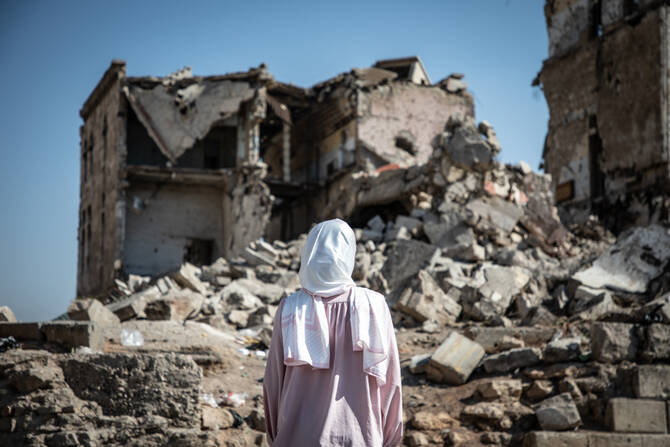
Once home to some 300,000 people, it was besieged by government forces in 2018 before remaining residents and fighters were evacuated under a deal and transferred to opposition-held northwest Syria. Today, Jobar lies in ruins.

Mech task in Saraqeb, northern Syria. Image taken in October 2025. (HALO Trust/Bethany Langham)
“We’ve been clearing rubble from streets so the transitional government can implement a housing, land, and property rights investigation that will allow people to understand who owns which parts of what was once a densely built-up residential area and is now a sea of rubble mixed with explosive ordnance,” Jackson said.
“That area has been largely untouched for nine years.”
Unless conditions change, Jackson expects the toll to rise.
“We saw a real spike in the first three months of 2025 as large numbers of people returned home and accessed previously unreachable areas, encountering contaminated land,” he said.
“That trend holds true everywhere HALO works. When access suddenly opens up, but land remains contaminated, people want to come home and rebuild their lives without knowing the risks.”

Syrians living in Lebanon wait at the Ministry of Interior Immigration and Passports Department, at the Syrian-Lebanese border, as they return to Syria due to ongoing hostilities between Hezbollah and Israeli forces, amid the US-Israeli conflict with Iran, in Jdaydet Yabous, Syria, March 3, 2026. (Reuters)
Economic desperation adds another layer of danger. “We regularly see accidents involving people trying to harvest scrap metal from explosive remnants, attempting to dismantle devices to sell the metal,” Jackson said.
“It’s not carelessness — it’s desperation to find the means to feed their families.”
The convergence of mass displacement, contaminated land, inadequate risk education and a widening funding gap has set the stage for a worsening casualty curve.
“Without the funding to deploy our teams to safely dispose of these items and educate communities about the risks, what you have is more people encountering more devices, not understanding the danger, and taking risks with their own lives and their families,” Jackson said.
“I would expect the trend of accidents, sadly, to continue rising should this displacement go on.”