

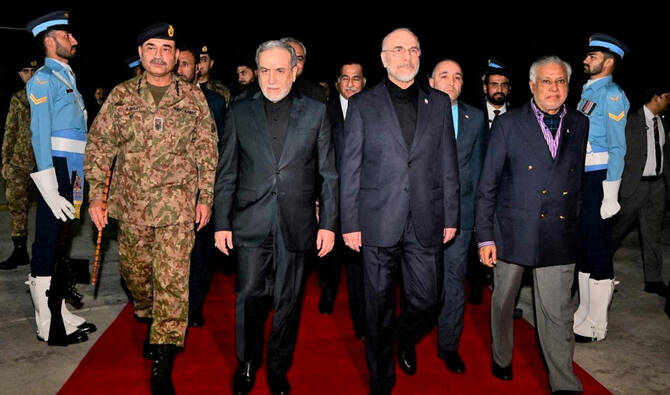
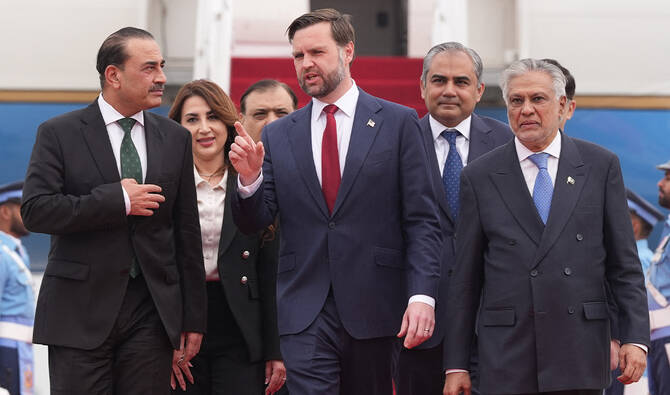

ISLAMABAD: High-level delegations from Iran and the United States arrived in Islamabad on Saturday for “make-or-break” negotiations, as Pakistan hosts talks aimed at turning a fragile ceasefire into a broader settlement to the Middle East conflict.
An Iranian delegation, led by Parliament Speaker Mohammad Baqer Ghalibaf and Foreign Minister Abbas Araghchi, arrived early in the day for the first round of negotiations following a two-week truce agreed earlier this week.
A US delegation headed by Vice President JD Vance also arrived later on Saturday, accompanied by Special Envoy Steve Witkoff and Jared Kushner, the son in law of US President Donald Trump, according to Pakistan’s foreign office.
“DPM/FM expressed the hope that parties would engage constructively, and reiterated Pakistan’s desire to continue facilitating the parties toward reaching lasting and durable solution to the conflict,” the foreign office said in a statement, quoting Deputy Prime Minister and Foreign Minister Ishaq Dar who received the US delegation with Chief of Army Staff Field Marshal Asim Munir and Interior Minister Mohsin Naqvi.
Pakistan is hosting the talks after weeks of diplomatic outreach led by Prime Minister Shehbaz Sharif, Dar and Munir, positioning Islamabad as a key intermediary in a conflict that began with US-Israeli strikes on Iran on Feb. 28.
The Iran war has caused the biggest oil supply shock on record, damaging Gulf energy production and raising fears of inflation, food insecurity and a potential global economic slowdown.
Trump, ahead of midterm elections later this year, faces pressure to find an off-ramp from the conflict. He announced the ceasefire on Tuesday, just hours before a deadline after which he had threatened to destroy Iran’s “civilization.”
Ahead of the talks, White House officials said they were skeptical that the discussions could immediately reopen the Strait of Hormuz, while Iran’s lead negotiators warned talks could not begin without commitments on Lebanon and sanctions.
Ghalibaf and Araghchi have said the ceasefire must include Israel’s assault on Hezbollah in Lebanon and that Iranian assets blocked by sanctions must be released.
It remains unclear whether those demands could derail the talks, which mark the highest-level engagement between the US and Iran since the 1979 Islamic Revolution.
In televised remarks on Friday, Sharif described the negotiations as a “make-or-break” moment as mediators seek to convert the temporary ceasefire into lasting peace.
Meanwhile, Vance said Trump had given him “some pretty clear guidelines” for the talks.
“We’re going to try to have a positive negotiation,” Vance told reporters before boarding his flight for Islamabad, adding that Washington remained open to diplomacy but would take a firm stance if talks faltered.
“If the Iranians are willing to negotiate in good faith, we’re certainly willing to extend the open hand,” he said. “If they’re going to try to play us, then they’re going to find that the negotiating team is not that receptive.”
Iran has put forward a 10-point proposal that includes maintaining control of the Strait of Hormuz, recognition of its right to nuclear enrichment, lifting of sanctions and an end to hostilities, including in Lebanon.
However, key differences remain over the scope of the ceasefire. The United States and Israel say the truce does not extend to Lebanon, while Iran and Pakistan maintain it was part of the understanding, highlighting the challenges facing the talks.
Authorities in Islamabad have tightened security ahead of the high-profile meeting, with hundreds of military, paramilitary and police personnel deployed across the capital.
With additional input from Reuters


